‘Dismissing global warming? That was a joke’: Jeremy Clarkson on fury, farming and why he’s a changed man
“Are you happy?” I ask Jeremy Clarkson. A few times on Clarkson’s Farm, you said were happy. His thick eyebrows seem low, like storm clouds gathering. “I said that in season one, episode one,” he replies. “And I meant it then. Lockdown was a blessed relief. You thought: no one’s inviting me out, I don’t have to go anywhere. Lisa would say, ‘Let’s go on holiday again next weekend.’ And I could say, ‘No! We can’t!’ It was brilliant. We were stuck here. So I was very happy at work then.” Didn’t he say he was happy at another point, while building his pigpen or sowing on his tractor? He looks at me, eyebrows locking, lips pursed in thought. He has perfect recall of the entire Clarkson’s Farm archive. He was pleased when he did those things, but it wasn’t a blanket expression of happiness. Pleased? “Well, what did I do for 25 years? I drove around corners shouting and achieved nothing. Nothing! And then you plant a field of mustard, which I did last year, and some of it grew. Not as much as I’d been hoping, but some. So you have a sense of achievement.”
Could we allow for the possibility that he might be contented, then? Clarkson concedes that springtime is nice. “This is going to sound awfully pretentious, but I’ve never noticed the buds coming on the trees before. I spent a good 20 minutes yesterday staring at buds, going, is that too early? Or is that later than normal?”
Reasons Jeremy Clarkson might have to be happy: his Amazon Prime show Clarkson’s Farm is the most watched on the streamer in the UK and series four has already been commissioned. He hosts Who Wants to Be a Millionaire and writes two newspaper columns, has his own brewery and is looking to buy a pub. He has a beautiful Georgian-style Palladian house, built in honey-coloured stone atop a gently sloping hill. His bedroom has a balcony with stone balustrades and miles of galloping rural views. He has a beautiful not-wife, but wife-adjacent partner in the form of towering Irish blond Lisa Hogan, Aunt Sally to his Worzel Gummidge. He has two fox-red Labrador bitches, Arya and Sansa, whom he is not supposed to feed crisps from the table, but does. He has pigs of all shapes and sizes including new little piglets. “I love my pigs, truly love my pigs.”
So he can sit at his kitchen island, laptop on the polished stone, surrounded by 10-foot windows, and think of ideas for shows, columns, what to have for supper. He can walk over to the fridge and eat the mustard he grew, feeling that sense of achievement you get when you plant something with a tractor, “which is quite complicated”, as opposed to in a vegetable garden. He can have Sunday lunch with beef or lamb from the farm, gravy made with flour from the farm, vegetables from the farm, potatoes and even beer from the farm. This is all, in his words, “properly satisfying”.
It’s a very different Clarkson to the one I interviewed eight years ago. Back then, on a spring morning like this one, he’d been sitting at the bottom of a swimming pool in Barbados with a head-crushing hangover and an oxygen tank, wondering what to do with his life. “My luck stopped suddenly,” he said then. He was grieving his mother, angry at the explosive end to his career at the BBC (he was sacked for punching a producer in 2015), defensive that he’d been forced to go “somewhere like prison” (a clinic) for “stress” (treatment) and had given up drinking for four months. Over two days, I watched him move seamlessly from beer at 11am to wine to banana daiquiris to wine again, while making his way through 60 cigarettes, boxes stacked beside him.
But when I suggest the Clarkson before me today is a changed man, happier, maybe one age has mellowed – he’s 64 – or maybe one who has less to be angry about, now that every TV concept he’s had since has been not just gold, but pure 24-carat liquid gold on tap, he bridles. “No, no, no. I’ve got slightly more air in my lungs. But changed, no. People’s perception of me may have changed, but I haven’t.” The Clarkson I met before, the one everyone watched on Top Gear, followed by The Grand Tour, the one who wrote outrageous things (which we will get to), that Clarkson was a caricature, “a comic creation”, he insists. “Everyone assumes the character they see on motoring shows is me, but it’s exaggerated. To think that I was like I was on Top Gear is the same as thinking that Anthony Hopkins is a cannibal.”
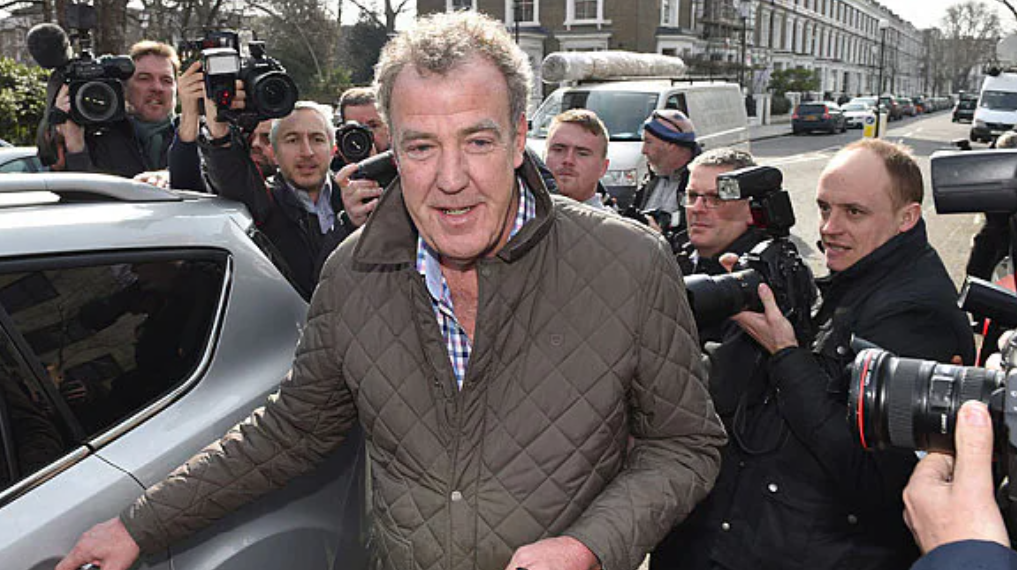
He feels no pressure to be controversial any more. He can say a line like, “I noticed the buds today” and it can mean that and not have a perverse double meaning. “That’s just me being me, for once. I don’t have to think, ‘Right, I’m going to say something stupidly provocative now.’ That’s relaxing.” Pause. “Also, you,” he means him, “don’t wake up every morning to find you’re in the middle of a tabloid maelstrom for something you’ve said or done.” I study his face for a flicker. It remains impassive, a bear emerged from a 500-year hibernation.
Can we talk about what he wrote in the Sun in December 2022 about the Duchess of Sussex? “You can try. You won’t get anywhere.” Clarkson said his hatred of Meghan operated on a “cellular level”, that he disliked her more than the serial killer Rose West and fantasised of a day “when she is made to parade naked through the streets of every town in Britain while the crowds chant ‘Shame!’ and throw lumps of excrement at her”. It was written in the controversial era, he says, the era he has just told me is firmly behind him, “So, actually, I’ve already addressed that.” Right, it wasn’t the real you.

Is it true the Sun’s editor tried to stop him, but he went over her head? “I won’t say anything. Put me in a half-nelson and I won’t say anything.” Is it right he emailed Harry to apologise, and Harry didn’t email back? “Honestly, I’m not talking about that. There’s enough to be talking about with farming. You can say you tried.”
Later, I see a wicked twitch in the mouth of nouveau era Clarkson, when the idea of baiting me becomes irresistible. “I don’t have to be contrary, but I might say something Guardian readers might say, ‘That’s contrary.’ Badgers are a case in point. Badgers are much loved in certain circles. Not here.” Wildlife group activists – “hunt saboteurs” – report him for illegally filling in badger setts which means there’s a policeman in a stab vest in his kitchen on a near weekly basis. “But we haven’t filled in a badger’s sett. There’s no point, because we’ve shot them. So is it contrary to say we’ve shot our badgers? It’s a true fact. So, yeah, it’s difficult to know where contrary starts and ends, really.”
When I arrive from London, Clarkson is waiting for me, arm resting on the open window, in the car park of the local train station. It’s a glorious spring morning, sky wide open across the vast Cotswolds landscape. We speed past hedgerows of hawthorn blossom in his old Land Rover, moss-green and muddy in the footwell. He’s smoked so much in this car over the years that even the steering wheel has emphysema. He slows so that I can hear a noise like an expiratory wheeze when he turns it. Does he miss smoking? “No.” He chews nicotine gum constantly. About him are balls of it, carefully removed from his mouth and placed on the closest convenient surface once the active ingredient has been thoroughly drained into his bloodstream, before he pops another from the blister pack.
On the gravel outside his house there is topiary of a dog cocking his leg, a white Aston Martin (“a bargain”) and a brand new Land Rover (“Lisa’s”). There’s also a red vintage Massey Ferguson, waxed to a sheen. “Vintage tractors: mark of a hobby farmer,” he says when I stop to admire it (later he’ll say the same of chickens; “hobby farmers” are evidently low in farming hierarchy). The Massey had to have a new engine after his neighbour David Cameron, the David Cameron, Lord, and current foreign secretary, blew it up. “He’s got his own tractor now,” Clarkson says.
The Camerons live on the left side of the valley. Across there is Rebekah Brooks, CEO of News UK, queen of the “country supper”. He dots the landscape with his finger naming people. Film people, business people, aristos. Not far are Lord and Lady Bamford, the Conservative party donors who lent Boris Johnson a house when he was ejected. No wonder Chipping Norton has a reputation for being an incestuous nest of media and politics. As I’m saying this, Clarkson spies a lorry coming up the road to his house. “Not another fucking delivery,” he mutters, darkly. “Lisa’s.”
In the kitchen he insists I try their water because it tastes delicious. He recently had a glass of tap water in London and mouth-sprayed it across the room in disgust; London is a place he rarely visits. Now, his life has contracted to this small corner of the Cotswolds. He’s been here on and off nearly 30 years (previously with his second wife, Frances Cain, mother of his three grown-up children). Judging by the bored “Mornings” from locals, they’ve just about come to terms with him. Diddly Squat is the 1,000 acre working farm he bought in 2008. It comprises a farm shop run by Lisa, a burger van, 29 goats, 60-70 pigs, seven cows (soon to be 30-40), 40 chickens, 100 sheep and a cat. “Lisa’s cat, not my cat.” He had a restaurant in the lamb barn but the council closed it.

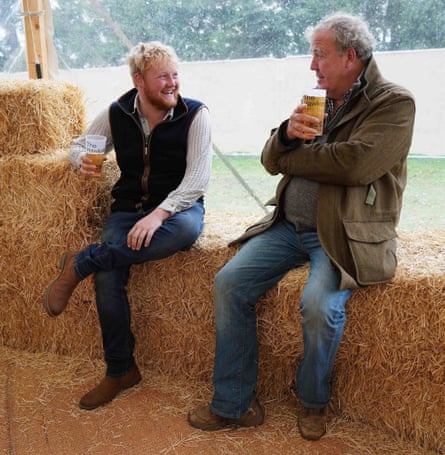
Clarkson’s Farm is gentler than The Grand Tour. There’s hugging and crying – I can’t say why because I’ve signed an NDA. There’s a lovers’ tiff between Clarkson and Kaleb Cooper, his young blond-mopped farmer foil. A concession to car fans was buying an enormous Lamborghini R8 270 DCR tractor in series one. Don’t worry, lads, he hasn’t forgotten you in the new series! When the vet asks if they have lube to help the pigs give birth, Clarkson suggests Lisa does. Teehee. There are further run-ins with the council over planning permissions for the shop and van. I fear this storyline may set off frothing over red tape.
Clarkson has filed 11 applications since he bought the farm (the latest at Christmas for a large grain store) which lies in an area of outstanding natural beauty – “Because farmers have made it outstanding,” he points out. “Nothing natural out there.” He says the government tells farmers to diversify, to use buildings and broaden businesses. “But if you try, your local authority will say, no, you can’t. We put in for planning permission to turn the lambing barn into a restaurant and all hell broke loose.” In this series, the future of the burger van hangs in the balance. The council have denied a “vendetta” against Clarkson, driven by a few newcomers, but the highs and lows are woven through the show.
At one point in 2022, “when it was getting really sticky”, Clarkson remembered he knew Michael Gove – who is in charge of planning – and rang him up. “Put it this way, he was the person in government who I actually had a phone number for. I thought, ‘Who do I know? Boris has gone. Cameron’s gone. Gove!’” Clarkson says it was “flattering” that Gove agreed to a meeting and he was expecting a quick coffee in Whitehall, but, “bugger me, he’d got half the government in there. Kemi Badenoch and countless others. It seems to have done the trick, though. Exactly what I said to him now seems to be becoming reality. In the papers this morning, a Defra minister said, ‘I’ve just had enough of these local councils’ and he’s going to make it easier for farmers to convert buildings into gyms and things, so that’s good.”
In the first series, the farm turned a profit of £144. He blames uncontrollable outside forces, such as extreme weather: “Somebody’s going to say, ‘You drive cars!’ but you know what I mean.” This year earnings were better, but still not a living wage. Yes, he knows he is not going to starve, but most farmers don’t have TV shows and they are “fucked. And it’s terrifying because they’re going to have to sell. The farms are going to be snapped up by hedge funders or farming conglomerates, who will see hedgerows and woods as annoyances and will bulldoze and turn England into Canada. We will lose the countryside unless we protect farmers.”