Chris Doumit shared the real reason he left Parker Schnabel’s team, and it’s a sad story!

The world of gold mining television has seen its fair share of tension, but Season 15 of Gold Rush revealed a behind-the-scenes story that few viewers could anticipate. Parker Schnabel, the Klondike prodigy who has consistently pushed the limits of mining operations, set a staggering 10,000-ounce goal for the season, aiming to break records and elevate his status as one of Alaska’s most successful miners. Behind the scenes, however, this ambitious target placed unprecedented pressure on the team, culminating in the departure of longtime foreman Chris Dumit. While the on-camera narrative attributed Dumit’s exit to exhaustion, insiders reveal a far more complex picture involving operational strain, financial disputes, and the human cost of relentless ambition .
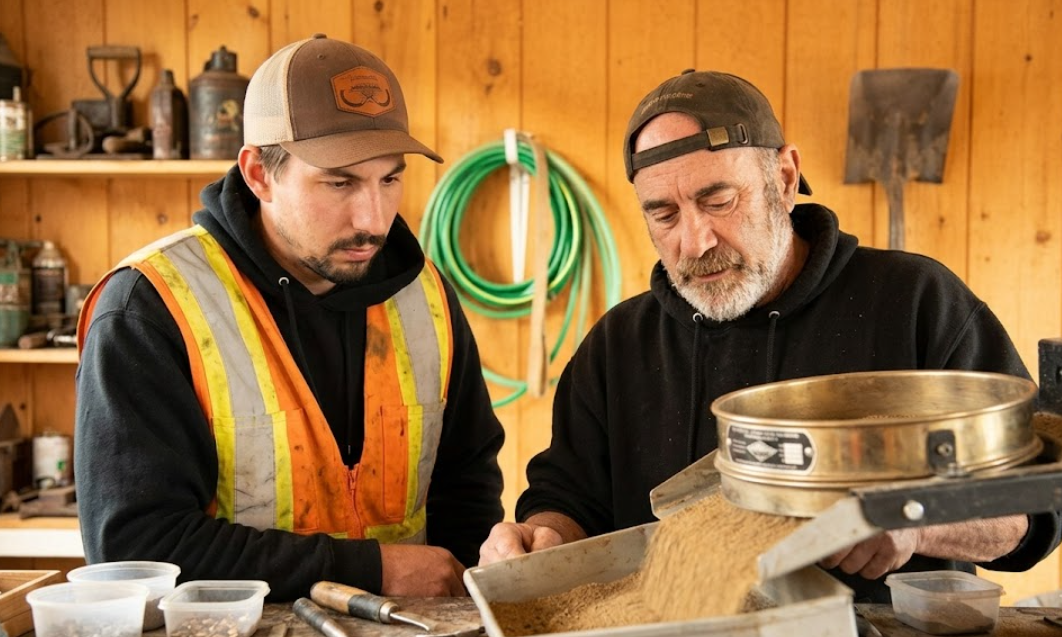
Chris Dumit’s journey on Gold Rush is a testament to skill, adaptability, and quiet reliability. Initially a carpenter for Todd Hoffman’s crew, Dumit found himself immersed in mining operations almost by accident. Over the years, he became an essential part of Parker Schnabel’s team, eventually overseeing the “gold room,” where the final extraction and cleanup of concentrates occur. This role is crucial: errors at this stage can cost thousands, even hundreds of thousands of dollars in lost gold. Dumit’s meticulous work ensured that Parker’s ambitious operations translated into tangible ounces, maximizing profits while keeping the massive machinery-driven operations functioning smoothly .
Season 15 elevated the operational complexity to unprecedented levels. Parker ran three wash plants simultaneously—Big Red, Rock Monster, and Slooifer—tasking Dumit with the careful management of all three. The workload was immense: finishing a 12-hour shift cleaning and processing gold from multiple streams of concentrate left Dumit physically drained. The addition of a third plant required constant attention to avoid losing even a single flake of gold, stretching both human resources and operational capacity to their limits. For a man whose role had previously been manageable, this was an entirely new level of intensity .
Financially, the pressure was compounded by disagreements over operational priorities and resource allocation. The transcript suggests that Dumit’s departure involved a fundamental clash over values and responsibilities. Parker’s relentless focus on the 10,000-ounce goal placed him at odds with his foreman, whose commitment to precision and sustainable operations required maintaining standards that sometimes slowed immediate output. The resulting friction became unsustainable, ultimately forcing Dumit to step away rather than compromise his professional principles and health .
Dumit’s decision to leave underscores a broader truth about extreme operations in gold mining: even the most reliable and skilled individuals can reach a breaking point when the combination of physical labor, mental stress, and uncompromising targets becomes too great. Analysts note that the gold room is often the unseen backbone of any mining operation. While Parker’s ambition drives machinery, manpower, and strategy, it is the meticulous work of individuals like Dumit that converts risk and raw material into actual revenue. Without his oversight, the integrity of the operation—and the efficiency of gold recovery—was at potential risk .
From an operational perspective, the departure highlights a key challenge in scaling resource-intensive enterprises. Running multiple wash plants simultaneously can theoretically maximize output, but it requires a perfectly coordinated team, clear communication, and trust in every individual’s ability to perform under pressure. When one critical link becomes overwhelmed, the chain is vulnerable, regardless of how well-funded or technologically advanced the operation may be. Parker’s strategy illustrates both the potential and the peril of pushing production limits in high-volume gold mining.
Looking ahead, several predictions emerge for Parker Schnabel’s operations. First, the team will need to adjust workflows to accommodate Dumit’s absence, either by redistributing responsibilities among existing crew members or by training new personnel for the gold room. This may introduce short-term inefficiencies, but with careful management, the long-term output could remain strong. Analysts suggest that the lesson here is clear: operational capacity is only as strong as its most skilled members, and high ambition requires commensurate support for key personnel .

Second, Parker’s relentless pursuit of record-breaking totals is likely to continue, but future strategies may integrate more redundancy and support systems to prevent burnout and attrition. The departure of a central figure like Dumit may prompt adjustments in machinery scheduling, crew rotations, and workload distribution, ensuring that human limits are respected while pursuing large-scale extraction goals. In this sense, the episode serves as both a cautionary tale and a roadmap for sustainable expansion in gold mining operations.
Finally, Dumit’s exit offers a human narrative that complements the technical spectacle of mining. Viewers are reminded that behind every massive machine and multi-ton haul of pay dirt lies a network of skilled individuals whose decisions, judgment, and endurance shape the outcome. Dumit’s departure is not simply a staffing change—it is a reflection of the tension between ambition and sustainability, highlighting the importance of balancing personal well-being with operational objectives .
In conclusion, Season 15 of Gold Rush reveals that even the most ambitious operations are built on human expertise. Chris Dumit’s departure, precipitated by the combination of Parker Schnabel’s record-setting goals and the enormous workload, underscores the delicate balance between output and human capacity. Analysts suggest that while Parker’s gold totals may continue to impress, the story behind the scenes reminds audiences that the people behind the machines are just as critical as the machinery itself. As future seasons unfold, viewers will likely see a recalibration of strategy, emphasizing both ambition and the sustainable management of the skilled crew that makes it possible.