Jeremy Clarkson donated a pub to Charlie Ireland to celebrate his return after the unfortunate accident at the farm.
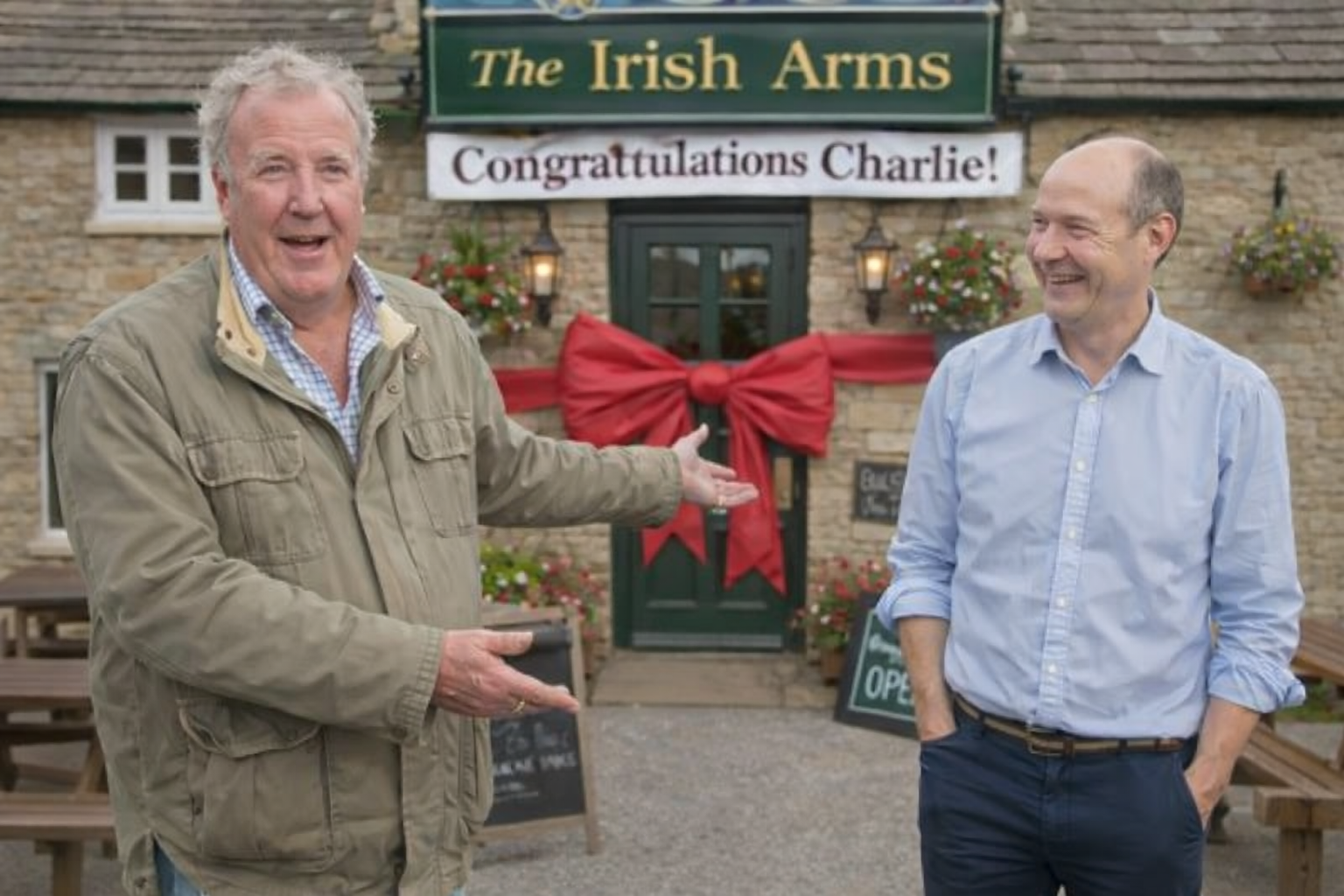
The world of Clarkson’s Farm has once again shifted into unfamiliar territory following reports that Jeremy Clarkson has symbolically “donated” a pub to land agent Charlie Ireland in recognition of his return to duties after a recent on-farm accident. While the gesture has not been officially framed as a legal transfer of ownership, industry observers say the move represents one of the most significant symbolic acknowledgements of Ireland’s role in the entire farm ecosystem to date.
At the center of this development is Diddly Squat Farm, where production is continuing under heightened scrutiny following Clarkson’s health recovery and ongoing expansion of the farm’s commercial operations. The reported gesture toward Ireland is now being interpreted as more than gratitude—it is being viewed as a structural redefinition of responsibility inside the Clarkson farming empire.
A GESTURE THAT REVEALS A DEEPER POWER STRUCTURE
On the surface, the idea of Clarkson “donating a pub” reads like one of his characteristic acts of eccentric generosity. However, television production analysts argue that the timing of the gesture—following both Clarkson’s health scare and an on-farm accident involving key personnel—suggests a deeper recalibration of roles within the operation.
Charlie Ireland, long positioned as the pragmatic land agent balancing regulatory constraints and agricultural feasibility, has increasingly become the stabilizing force behind the farm’s rapid expansion. His expertise in land management, planning compliance, and agricultural optimization has quietly evolved into something closer to operational governance.
The pub gesture, whether literal or symbolic, signals recognition that Ireland’s responsibilities now extend beyond advisory input. He is no longer simply interpreting the rules of rural land use—he is effectively shaping how the entire enterprise adapts to them.
THE FARM ACCIDENT AND ITS AFTERMATH
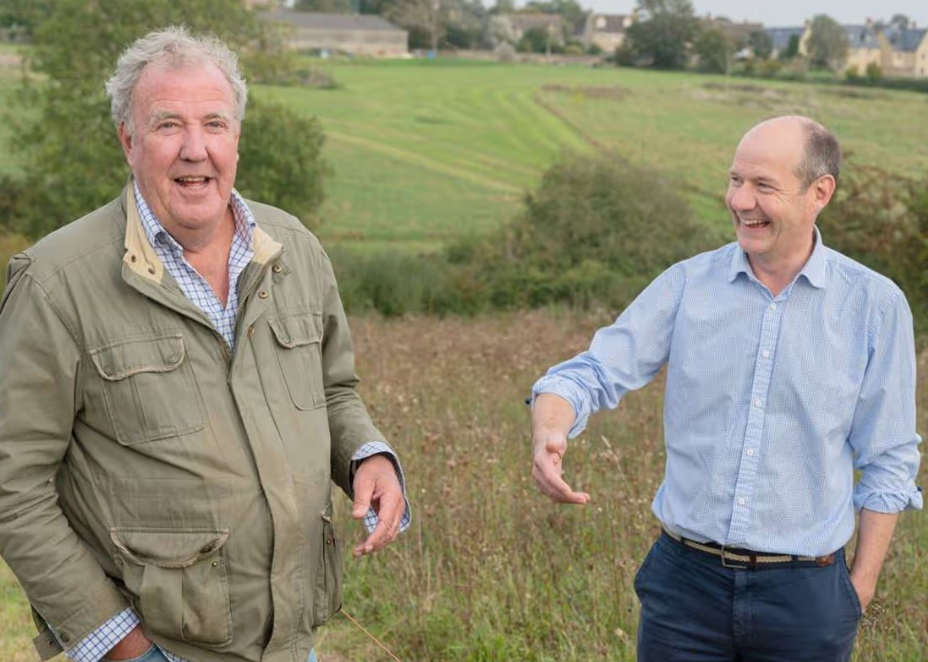
While official production details remain limited, the referenced “accident at the farm” has been described by insiders as a disruption that temporarily halted certain operations at Diddly Squat Farm. Though not life-threatening, the incident reportedly exposed vulnerabilities in the farm’s increasingly complex infrastructure, where agriculture, tourism, and hospitality now intersect.
This disruption has accelerated internal reassessment of leadership distribution. Clarkson, while still the public face of the operation, is now managing a business environment that requires more structured delegation than in earlier seasons.
Within that context, Ireland’s role becomes even more critical. His return following the incident is being framed not just as a recovery milestone, but as a restoration of operational balance.
THE FARM PUB AS A STRATEGIC NODE
The inclusion of a pub—widely understood to be tied to Clarkson’s broader hospitality ambitions—adds another layer to the analysis. The hospitality arm of the farm has increasingly become a parallel enterprise, sitting alongside traditional farming operations.
If the pub is viewed as a symbolic “donation” to Ireland, analysts suggest it may indicate a strategic repositioning: assigning Ireland greater oversight over commercial interfaces that require strict regulatory navigation and logistical precision.
In practical terms, this would place him at the intersection of three key systems:
- Agricultural production cycles
- Planning and regulatory compliance
- Hospitality and visitor economy management
This tri-layer structure mirrors the broader evolution of Clarkson’s Farm from a rural documentary into a multi-sector rural enterprise narrative.
CLARKSON’S POST-HEALTH ERA MANAGEMENT STYLE
Clarkson’s recent health experience has become an unavoidable contextual factor in interpreting all production developments. While he remains actively involved in filming and decision-making, observers note a subtle shift toward delegation and trust-based management.
In this recalibrated environment, Ireland’s analytical approach provides a counterweight to Clarkson’s instinct-driven decision style. Where Clarkson prioritizes narrative and immediacy, Ireland prioritizes sustainability, legality, and long-term feasibility.
This contrast is increasingly central to the show’s internal dynamics.
PREDICTED SEASON 6 DEVELOPMENTS
Based on current trajectory, Season 6 of Clarkson’s Farm is likely to amplify the structural importance of Charlie Ireland in three key ways:
1. Formalized Responsibility Expansion
Ireland may be shown taking on broader oversight of infrastructure planning, particularly in relation to hospitality expansion and land use optimization.
2. Conflict Between Vision and Regulation
As Clarkson pushes for rapid development of new ventures, Ireland is expected to serve as the primary checkpoint preventing overextension or regulatory breach.
3. Post-Incident Operational Reform
The farm accident is likely to trigger visible changes in workflow safety, project planning, and delegation—areas where Ireland’s influence will be most apparent.
THE EMERGENCE OF THE “SYSTEM MANAGER”
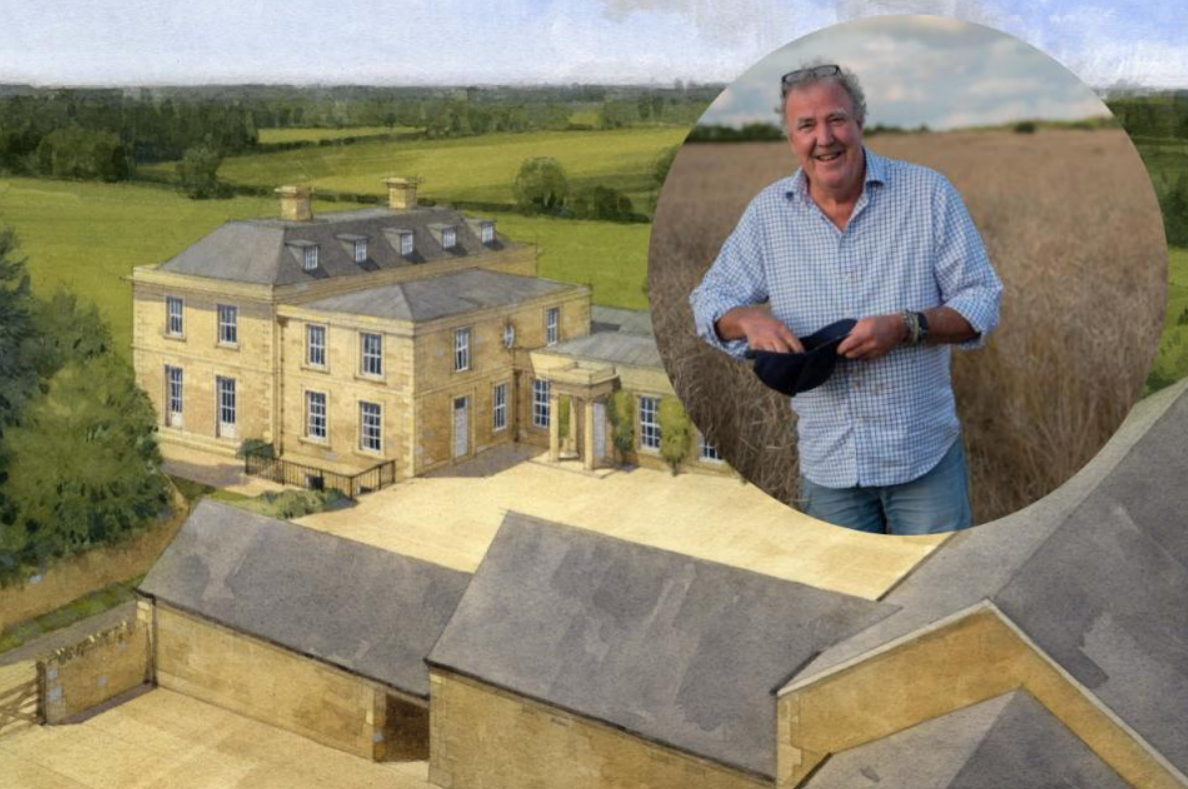
Television analysts have begun describing Ireland not as a supporting character, but as the farm’s “system manager”—the individual ensuring that ambition does not outpace infrastructure.
In this interpretation, Clarkson provides vision, Kaleb Cooper delivers execution on the ground, and Ireland maintains structural integrity across an increasingly complex rural enterprise.
CONCLUSION: A QUIET SHIFT WITH MAJOR CONSEQUENCES
What appears at first glance to be a symbolic gesture—a pub “donation” following a recovery period—may in fact represent a deeper transformation in the operational hierarchy of Clarkson’s Farm.
At Diddly Squat Farm, the story is no longer just about farming experiments or rural entertainment. It is about the management of a growing enterprise under real-world constraints, where resilience depends not only on charisma and labor, but on structured expertise.
And in that evolving system, Charlie Ireland’s role is no longer peripheral.
It is foundational.