EXCLUSIVE REVEAL: PARKER SCHNABEL’S NEXT GOLD MINING SITE CONFIRMED—ANALYSTS PREDICT A MAJOR TURNING POINT FOR THE NEXT SEASON
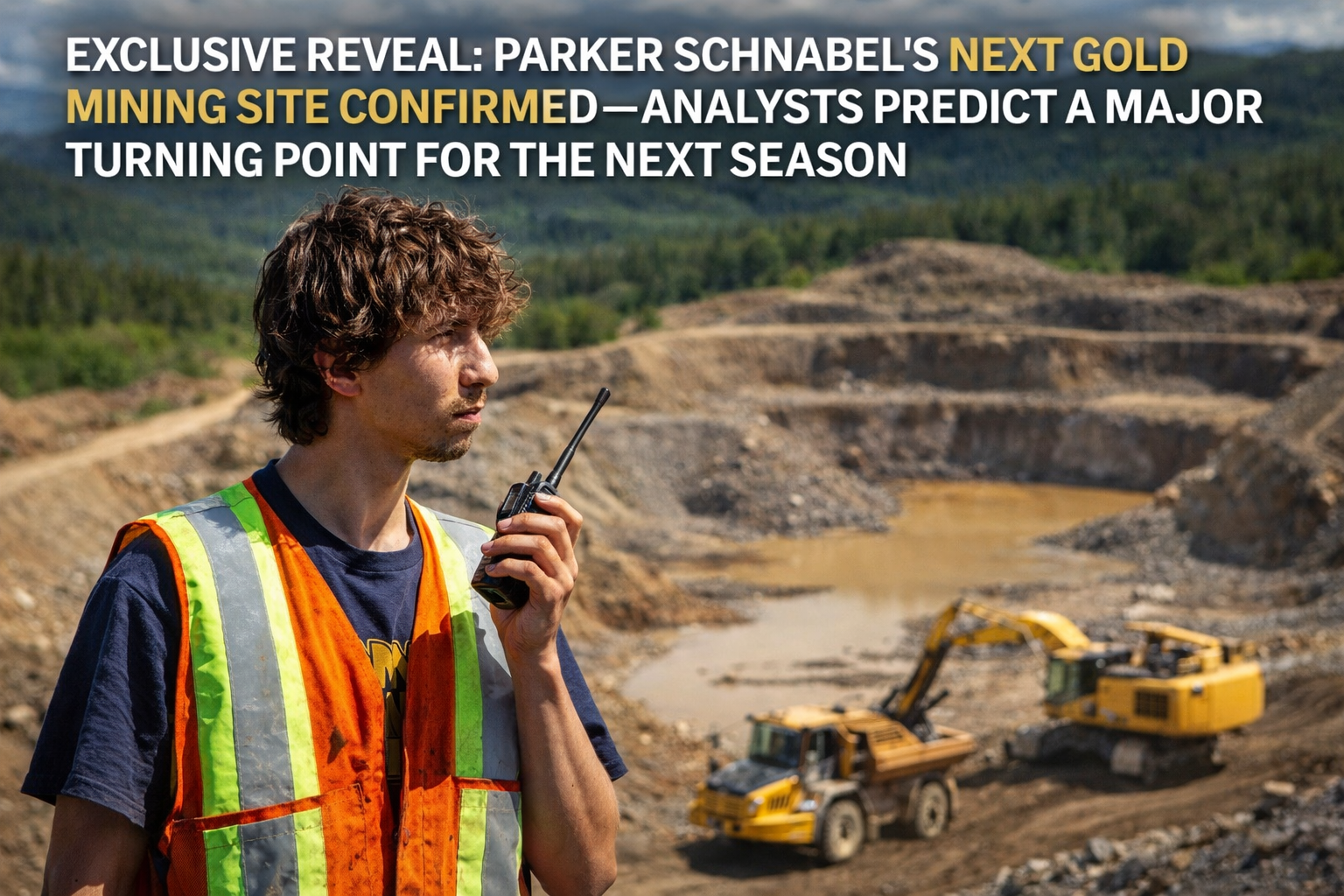
In the ever-evolving landscape of Gold Rush, few announcements generate as much anticipation as the confirmation of a new mining location for Parker Schnabel’s crew. This time, industry chatter surrounding the next excavation site has intensified after confirmation emerged regarding where Parker’s operation will deploy next—setting the stage for what analysts believe could be one of the most strategically important moves of the season.
The decision comes at a crucial moment for Schnabel’s expanding mining empire, as production pressure, ground depletion cycles, and logistical scaling challenges converge across multiple active claims. The newly confirmed site is now expected to define the trajectory of the entire season.
A STRATEGIC RELOCATION, NOT JUST A NEW HOLE IN THE GROUND
Unlike early-career moves where Parker Schnabel would aggressively test new ground on instinct and geological mapping, this latest shift reflects a more calculated phase of his operation within Gold Rush.
Analysts describe the decision as a “strategic relocation of production capacity,” rather than a simple expansion. That distinction matters. It suggests that the current ground—while still productive—is no longer sufficient to sustain the high-output expectations established earlier in the season.


Instead, the crew is being repositioned toward a site believed to offer:
- Higher continuity of pay streaks
- Reduced overburden removal ratios
- More stable water management conditions
- Faster access to wash plant throughput zones
In mining terms, this is not exploration—it is optimization under pressure.
WHY THIS NEW SITE MATTERS MORE THAN USUAL
What elevates this development beyond routine operational movement is timing.
Parker Schnabel’s current season has already shown strong early yields, particularly from high-performing cuts such as Sulphur Creek. However, sustaining momentum in placer mining is notoriously difficult. Even the most productive ground can become inconsistent once shallow, high-grade material is exhausted.
The newly confirmed location is therefore being viewed as a “stabilizer site”—a strategic buffer designed to maintain output consistency while other areas mature or are repositioned.
In the world of Gold Rush, this type of move often determines whether a season peaks early or builds toward a record-breaking finish.

THE LOGISTICS BEHIND THE MOVE
Relocating a large-scale Yukon mining operation is not a simple task. It involves the coordinated movement of excavators, haul trucks, wash plants, fuel infrastructure, and an experienced crew accustomed to working under extreme time constraints.
Industry observers note that Parker Schnabel’s advantage lies not only in ground selection but in his ability to transition operations quickly without significant downtime.
Key logistical considerations for the new site reportedly include:
- Establishing access roads capable of supporting heavy equipment
- Installing or repositioning wash plant feed systems
- Managing water flow and tailings disposal
- Recalibrating stripping sequences for optimal gold recovery
Each of these steps carries risk. Any delay in setup can translate directly into lost ounces during a limited mining window.
CREW IMPACT AND OPERATIONAL PRESSURE
Within the broader framework of Gold Rush, Parker Schnabel’s crew plays a critical role in executing such transitions.
Long-time operators and field specialists are now expected to handle dual challenges: maintaining current production while simultaneously building infrastructure at the new site. This dual-pressure model is where many mining operations fail to maintain consistency.
Analysts highlight three key human factors:
1. Fatigue Management
Extended shifts during relocation periods increase mechanical error risk and reduce operational precision.
2. Equipment Familiarity Under Change
Operators must adapt quickly to new terrain, soil composition, and load distribution patterns.
3. Coordination Under Time Compression
With limited seasonal windows, every day lost in setup reduces total seasonal yield potential.
Despite these pressures, Parker’s leadership structure has historically excelled in maintaining discipline during transitions.
GEOLOGICAL EXPECTATIONS: WHY THE SITE WAS CHOSEN
While full geological data remains undisclosed, early indicators suggest the new location shares characteristics with previously successful cuts:
- Evidence of historic water channel deposition
- Stratified gravel layers conducive to gold trapping
- Moderate overburden depth allowing faster access to pay zones
In placer mining, these conditions are critical. They increase the probability that gold has been naturally concentrated over time rather than dispersed.
However, analysts caution that even promising geology does not guarantee consistency. Yukon ground is notoriously variable, with gold distribution often changing dramatically within short distances.
RISKS THAT COULD DEFINE THE SEASON
Despite optimism surrounding the move, several risks remain firmly in play:
Weather Volatility
Sudden rainfall or early freeze conditions could severely disrupt stripping and washing operations.
Equipment Stress Points
Relocation increases mechanical strain, particularly on excavators and conveyors.
Unknown Pay Variability
Early sampling may not reflect deeper ground conditions, leading to possible overestimation of yield potential.
In Gold Rush history, similar transitions have produced both record-breaking results and unexpected mid-season slowdowns.

ANALYST FORECAST: THREE POSSIBLE OUTCOMES
Based on current operational patterns, analysts outline three probable scenarios:
1. High-Yield Acceleration Scenario
The new site performs above expectations, extending Parker’s strong season into a record-level finish.
2. Stabilized Output Scenario
The site delivers consistent but moderate yields, maintaining overall season strength without dramatic expansion.
3. Adjustment Scenario
Geological variability forces partial relocation or hybrid operation across multiple cuts.
At present, sentiment leans toward the second and third scenarios, with early indicators still incomplete.
CONCLUSION: A SEASON DEFINED BY MOVEMENT, NOT JUST MINING
The confirmation of Parker Schnabel’s next mining site marks more than just a change in location—it signals a strategic phase shift in how his operation approaches the season.
Within Gold Rush, success is rarely defined by a single discovery. It is defined by the ability to adapt, relocate, and sustain production under relentless environmental and operational pressure.
As the crew prepares to mobilize, one question now dominates the narrative:
Will this new ground extend an already strong season—or become the turning point that determines its final outcome?
For Parker Schnabel, the answer will be written not in announcements, but in ounces poured.