Emma Culligan: The Scientist Who May Finally Change the Fate of Oak Island — And What Her Discoveries Could Mean Next
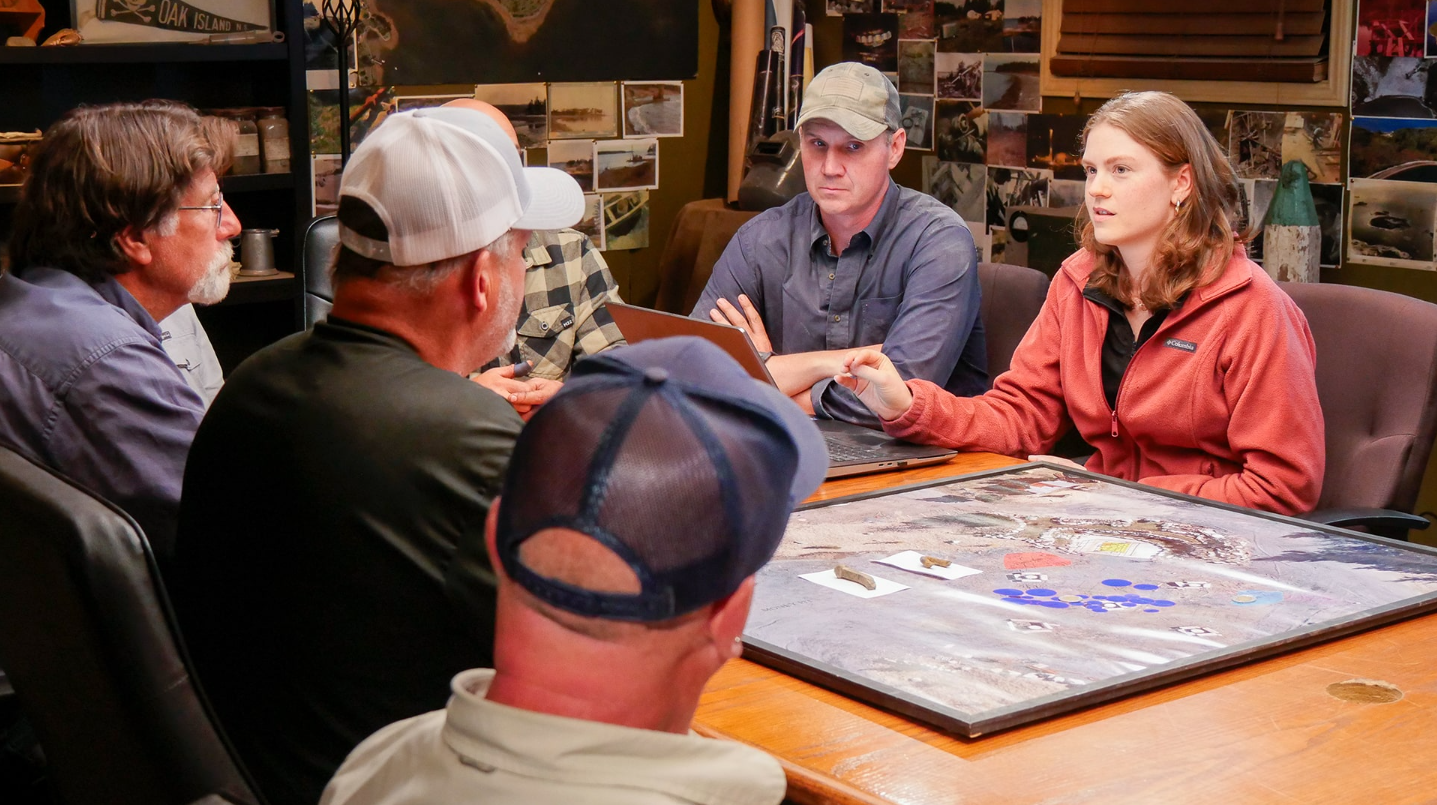
For more than a decade, The Curse of Oak Island has attracted millions of devoted viewers with its blend of archaeological mystery, scientific investigation, and historical speculation. Rick and Marty Lagina have spent years chasing clues through tunnels, anomalies, shafts, and seawater-filled chambers, all while critics insisted the series would ultimately end without a defining breakthrough.
That narrative began to shift the moment Emma Culligan arrived.
In Season 12, the young archaeometallurgist emerged not just as another expert consultant, but as a catalytic force — providing scientific clarity, delivering surprising results, and reshaping how the Oak Island team interprets nearly every artifact they uncover. And her impact suggests that the show may soon enter its most revealing phase yet.
A New Kind of Expert for a New Kind of Oak Island
Unlike many earlier specialists, Culligan brings an unusually broad skill set to the island: CT scanning, metallurgical testing, elemental analysis, and experience in handling artifacts from multiple cultures and eras. Her background — growing up in Japan, learning English as a teenager, and later training in Newfoundland — gives her a global mindset and a level of analytical caution that stands out.
It also gives her a willingness to question everything.
When she first joined the show, Culligan admitted she assumed it would be little more than a dramatized treasure hunt. But it quickly became clear that the team needed hard data, not theatrics — and Culligan arrived ready to provide it.
From the moment she stepped into the lab, the tone changed. For the first time in years, Oak Island’s discoveries began transforming from intriguing “possibilities” into testable scientific evidence.

The Roman Coin That Changed the Conversation
Season 12’s defining moment came when a weathered coin from Lot 5 landed in Culligan’s hands.
At first, it seemed unremarkable — just another out-of-place artifact on an island known for them. But metallurgical testing told a different story. With a composition of 70% copper and 16% lead, the coin did not resemble anything from colonial North America.
Instead, Culligan proposed that it most closely matched Roman coinage from the 3rd century AD.
If her assessment is correct, this discovery would rewrite not merely Oak Island history, but Atlantic history. No confirmed record exists of Roman contact with North America. Even speculative theories place Roman explorers no farther than the coast of West Africa.
Yet here, in Nova Scotia, lay a coin that defied explanation.
The Oak Island team reacted accordingly. Geologist Jack Begley called it “a paradigm shift.” Gary Drayton labeled it “a mind-blower.” Rick Lagina, always measured, simply called it “historic.”
And for viewers, the implications were electrifying.
Gold in the Wood: A Discovery That Changes Everything
Then came the discovery that shook the team even more. While analyzing wood fibers from a deep core sample, Culligan detected actual gold residue embedded within the grain.
Not flakes carried in by groundwater. Not dust introduced by modern contamination. But gold that appeared to be ancient and associated with the wood itself — suggesting that the material had once been part of a container or structure holding gold objects.
Researcher Larivan said that her immediate reaction in the lab was an unfiltered “holy ****.”
This revelation changes how the team interprets previous anomalies:
-
trace gold in Smith’s Cove
-
gold-bearing water samples
-
unusual sediment signatures
-
voids detected in deep drilling
Together, these findings suggest that gold — real, physical gold — once sat inside a confined structure somewhere below the Money Pit or its adjacent tunnels.
And if gold was there… someone put it there.

What Comes Next: Predictions Based on Culligan’s Work
As an analyst, several likely developments emerge from the direction of her discoveries:
1. The Lab Will Become the Center of the Show
Expect more testing, more elemental analysis, and more CT scans. Now that Culligan has provided hard scientific leads, producers will push to validate more artifacts quickly.
2. The Team Will Expand the Search on Lot 5
The Roman coin did not appear by accident. Lot 5 may contain evidence of older settlements, ancient visitors, or cross-cultural trade far beyond what anyone imagined.
3. More Large-Scale Excavation Near Gold-Bearing Woods
Where gold residue exists, the team will drill deeper. Culligan’s findings make the “gold zone” one of the most promising targets in modern Oak Island history.
4. Expect a Renewed Search for Maritime Connections
Roman, Phoenician, Templar, and medieval theories will gain new life. Culligan’s data will push the research team to evaluate oceanic cross-currents, shipwreck probabilities, and ancient metallurgy at a level not previously possible.
5. The Narrative Will Shift From “Treasure Hunt” to “Scientific Breakthrough”
For the first time, Oak Island is not relying solely on legend, folklore, or circumstantial artifacts. It has data — traceable, testable, peer-reviewable data.
And that changes everything.
The Turning Point Fans Have Waited For
Emma Culligan represents more than just another expert. She is the bridge between Oak Island mythology and scientific reality. The Roman coin, the gold residue, the elemental anomalies — all combine to form the most compelling evidence yet that the island holds secrets older and more extraordinary than previously believed.
Skeptics once claimed Oak Island would end with nothing.
But if the trajectory continues, they may soon be proven wrong.
Because with the right scientist, at the right moment, even a 230-year-old mystery can begin to speak.
And on Oak Island, it finally is.