Parker Schnabel made a surprising decision when considering acquiring the giant gold refining plant.
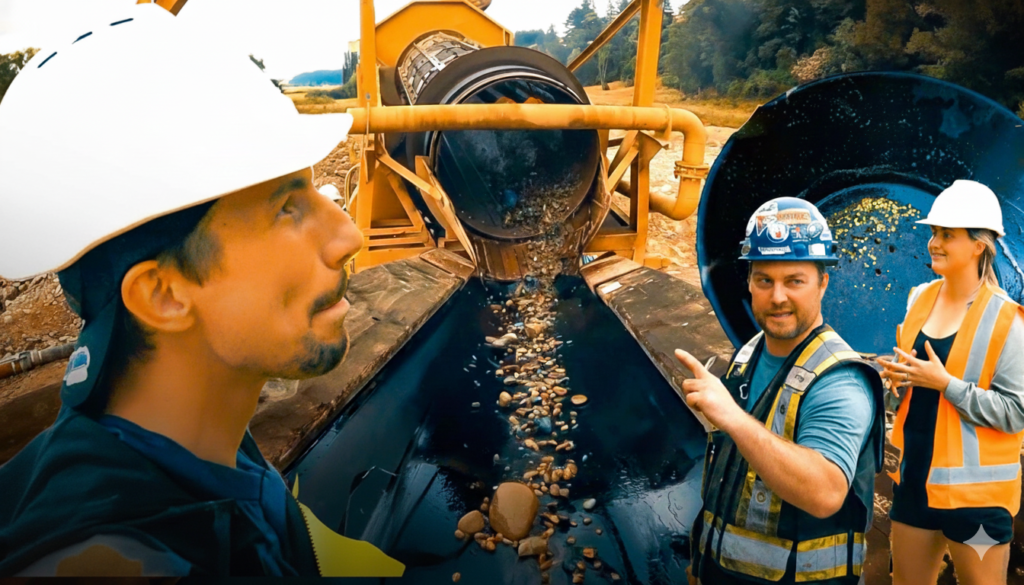
As gold prices remain strong and operating costs continue to climb, Parker Schnabel is once again rethinking how his mining operation should evolve. During a recent visit to inspect a compact, highly portable wash plant, the Gold Rush star took time to study an alternative approach that challenges many of the assumptions behind large-scale Yukon mining.
The visit was not about making a quick purchase. Instead, it was an exercise in learning—examining how smaller, more agile wash plants perform, and whether their design principles could be adapted to meet the demands of Parker’s much larger operation.
From the moment the plant fired up, the conversation focused on efficiency rather than raw power. The wash plant in question, a compact trommel-style unit, was designed to be moved and set up in half a day. In regions such as Fairbanks and parts of Alaska, where frequent relocations are unavoidable, portability can significantly reduce downtime and labour costs.
For Parker, that immediately stood out. In the Yukon, moving a traditional wash plant can take days, involving multiple machines and a sizeable crew. Any delay translates directly into lost production. A plant that can be relocated quickly, with just a few people, represents a very different operating philosophy.
Running at around 40 cubic yards per hour, the plant was deliberately tuned low. That output is modest by Parker’s standards—his own plants often target four times that volume—but there was a reason for the conservative pace. The goal was to keep material distribution controlled, ensuring that gold recovery remained consistent, particularly for fine gold.
As the plant ran, Parker and his team examined the sluice setup closely. Unlike most Klondike systems, which use external sluice runs, this unit featured an underhung sluice integrated beneath the trommel. The design kept everything compact and reduced the overall footprint, a key advantage when road legality and transport restrictions come into play.
Initial results were encouraging. After several hours of operation, the cleanup revealed a healthy amount of fine gold. The purity, measured at over 96 per cent, impressed Parker. High purity directly affects returns, and even small improvements can make a noticeable difference over a full season.
Still, Parker remained cautious. While the plant performed well at its intended capacity, scaling it up presented challenges. The limiting factor was sluice width. At roughly three feet per run, the system simply could not process the 160 to 180 cubic yards per hour Parker typically aims for without risking gold loss.
Jeff, one of the engineers present, outlined what it would take to adapt the concept. Increasing yardage would require a redesigned distribution system and much wider sluice runs. That, however, would compromise the very features that made the plant appealing: its compact size, low fuel consumption, and ease of transport.
Fuel efficiency was another point of contrast. The compact plant reportedly cost around twenty dollars a day to operate—an amount Parker noted his larger plants could burn through in minutes. In an era of rising fuel costs, that difference is impossible to ignore.
Yet Parker was clear-eyed about the trade-offs. His operation relies on volume. Processing fewer yards, even at high recovery rates, may not be enough to meet seasonal targets. The question, then, was not whether this particular plant was suitable, but whether its underlying ideas could inform the next generation of Parker’s equipment.
Throughout the visit, Parker compared notes with his foreman, weighing maneuverability against throughput. The underhung sluice design appealed to him, as did the hydraulically controlled conveyor that allowed discharge piles to be adjusted without repositioning the entire plant. These were practical features that could reduce downtime and simplify daily operations.
In the end, Parker reached a familiar conclusion. The plant was well built, thoughtfully designed, and effective within its niche—but it was not the right fit for his current needs. That decision, however, did not make the visit a dead end.
For Parker, seeing alternative systems in action is part of a broader strategy. Mining technology continues to evolve, and the most successful operators are those willing to borrow ideas from different regions and adapt them to their own conditions. What works in New Zealand or Alaska may not translate directly to the Klondike, but elements of those designs can still influence future builds.
As the group wrapped up, the emphasis shifted from buying to networking. Maintaining relationships with plant builders and fellow miners keeps options open, especially as Parker plans for future seasons. New technology, after all, often arrives through conversations rather than catalogues.
The takeaway from the visit was not a new machine, but clarity. Parker reaffirmed what his operation requires—high yardage, wide sluice capacity, and reliability—while also identifying features he would like to incorporate going forward. Compactness, efficient hydraulics, and fine-gold recovery all moved higher on the priority list.
For viewers, the moment offered insight into a side of gold mining rarely highlighted on screen. Success is not just about digging deeper or running bigger machines. It is about constant evaluation, learning from others, and knowing when an option is interesting but not quite right.
As Parker and his team prepared to move on to the next stop, the search continued—not for gold this time, but for ideas. Somewhere, he believes, is a wash plant design that will make him stop, think, and say: this could be the one.