An island believed to hide 900kg of gold has led many to risk their lives searching for it.

From the perspective of a long-time analyst of The Curse of Oak Island, the legend of a Canadian island hiding 900 kilograms of gold is not simply a treasure story. It is a case study in how myth, early documentation, engineering anomalies, and human persistence have fused into one of the longest-running historical investigations in North America.
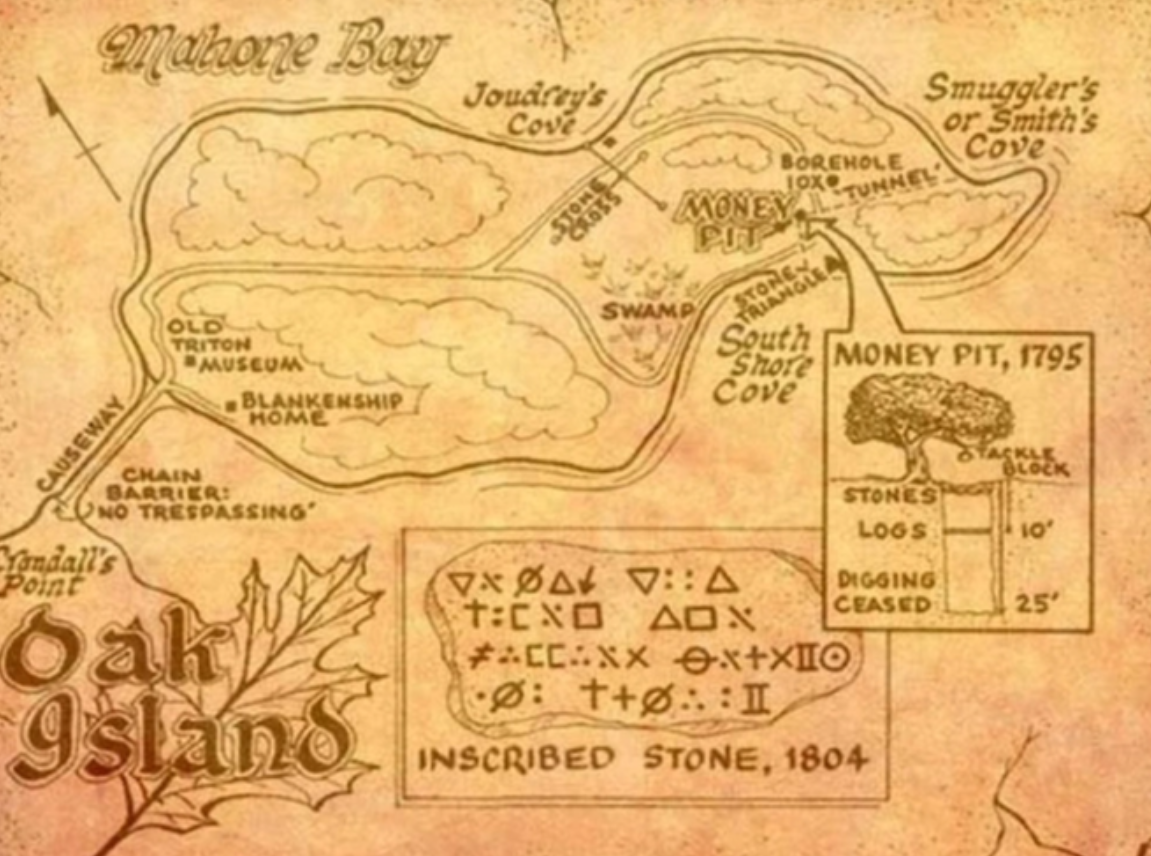
Oak Island, lying just off the southern coast of Nova Scotia, entered legend in 1795, when a young man named Daniel McGinnis noticed something that did not belong in a quiet woodland clearing: scars on an old oak tree, a depression in the ground beneath it, and signs that the soil had been deliberately disturbed. Even by late-18th-century standards, this looked intentional. McGinnis’s instinct—that something valuable had been hidden there—would echo across centuries.
Early digging efforts revealed a detail that still matters today: structure. Layers of clay, stone, and timber appeared at regular intervals, suggesting deliberate engineering rather than a random pit. This detail is often overlooked in simplified retellings, yet it is central to why Oak Island refuses to fade into folklore. From the very beginning, the island hinted at planning, not panic.
Nine years later, the story took on its most enduring artifact: the so-called inscribed stone. Removed from the site and later lost to history, the stone allegedly bore coded symbols that, decades later, were interpreted to suggest a precise depth, a warning, and a staggering quantity of gold. While modern scholars debate the accuracy of that translation, the idea that a deposit of roughly 900 kilograms of gold lay hidden beneath the island became embedded in public consciousness.
As an analyst watching The Curse of Oak Island, what stands out is not whether that exact quantity exists, but why the island keeps producing evidence of intent without delivering a final answer. Over more than two centuries, searchers have encountered flood tunnels, water management systems, and voids that behave unlike natural formations. These features suggest that Oak Island may represent one of the most complex underground constructions attempted in the pre-industrial era in North America.
This is where modern analysis diverges sharply from early treasure hunting. Today’s investigations increasingly treat Oak Island less as a single pit and more as a system. The show’s recent seasons reflect this shift. Attention has moved toward solution channels, geometric alignments, and the relationship between surface markers and subsurface anomalies. Rather than asking “Where is the gold?”, the better question has become “What was this island designed to do?”
The long list of failed searches, mechanical disasters, and tragic outcomes has given rise to talk of a curse. From an analytical standpoint, this narrative persists because Oak Island combines three volatile elements: waterlogged geology, early industrial machinery, and escalating ambition. Accidents occurred not because the island demanded sacrifice, but because human technology repeatedly underestimated the engineering beneath their feet.
What the modern series has done well is replace superstition with data. Advanced drilling, metal analysis, and geophysical scanning have revealed something previous generations could not see clearly: Oak Island appears to have been engineered to resist intrusion. Flooding is not incidental; it is reactive. Voids collapse or refill. Tunnels interconnect in ways that frustrate linear digging. These are hallmarks of defensive design.
So what can be predicted from the data now on the table?
First, it is increasingly unlikely that Oak Island holds a single, intact hoard waiting at the bottom of one shaft. If gold exists—and the metal traces suggest that valuable materials were present—it was likely distributed, relocated, or sealed within multiple compartments. This aligns with practices seen in other historical contexts where assets, documents, or sacred items were protected rather than buried hastily.
Second, future breakthroughs are more likely to come from structural understanding than from deeper drilling. Identifying access points, construction phases, and the logic of water control may matter more than chasing depth records. The show’s emphasis on mapping and alignment suggests the team is already moving in this direction.
Third, the significance of Oak Island may ultimately shift from monetary value to historical impact. Even if 900 kilograms of gold never materialize, proving the existence of a sophisticated, pre-modern engineering project would redefine accepted timelines of capability in the region. That alone would justify decades of effort.

Finally, Oak Island’s greatest “treasure” may be explanatory rather than material. Why was so much effort invested in this small island? Who had the resources, knowledge, and motivation to build such complexity? And what were they trying to protect long enough that discovery would be delayed for centuries?
More than 230 years after Daniel McGinnis first noticed disturbed earth beneath an oak tree, Oak Island still resists a simple ending. As a television analyst, the pattern is clear: the closer investigators come to understanding the island as a system, the further the story moves beyond gold alone. Whether or not 900 kilograms of treasure exists, Oak Island has already delivered something rarer—an unresolved puzzle that continues to challenge modern assumptions about history, engineering, and human ambition.