THE MIDNIGHT REVELATION: RICK LAGINA UNCOVERS TEMPLAR “SECRET SHAFT” VALUED AT $210 MILLION

In a move that has sent shockwaves through the archaeological community, Rick Lagina has broken his long-standing silence to reveal the discovery of a sealed, medieval-standard shaft hidden in a remote sector of Oak Island. The find, which Lagina describes as an “engineered vault entrance,” is estimated to house a multinational hoard of gold and silver with a modern valuation exceeding $210 million.
A Midnight Breakthrough
The discovery reportedly occurred during a solo midnight survey of the island. Lagina, acting on a “splinter in the mind” regarding a terrain anomaly, detected a sharp metallic resonance beneath his boots. When metal detection expert Gary Drayton arrived with a CTX 3030, the equipment reportedly “whited out” from the intensity of the readings—a phenomenon usually reserved for massive concentrations of non-ferrous metal.
Manual excavation revealed a soil-reinforced timber panel which, when pried away, exposed a vertical cavity extending into total darkness. Unlike previous searcher shafts, this structure features interlocking, non-decayed timbers treated with an unknown ancient preservative.
The Templar Signature
The shaft’s walls are reportedly engraved with unmistakable medieval Templar symbols, including crosses and celestial coordinates that form a navigational star map. Experts suggest these carvings are a “Templar cipher” dating back to 1347, a year synonymous with the order’s flight from European persecution.

Lagina noted that the construction relies on ancient European mining standards that vanished by the 1500s. “This was never a dig site,” Lagina whispered during the initial descent. “It was never meant for retrieval. This space had a single purpose: it was meant to hide.”
A Lethal Defense System
Perhaps most startling is the revelation that the shaft is a “living” defense system. As Lagina descended to a depth of roughly 100 feet, he encountered a massive stone plug fitted with spiral grooves designed for a pressure-lock mechanism. Beneath this plug, investigators found:
-
Silver-Infused Clay: A medieval decoy material designed to distort primitive probing tools.
-
Gold Leaf and Dust: Microscopic fragments of hammered gold embedded in the seals, suggesting that raw gold bars or ingots were moved through the chamber before it was closed.
-
Iberian Hardware: Rusted hinges from reinforced crates, confirming a multinational origin for the hoard, likely involving both Templar and Spanish royal reserves.
The chamber is reportedly rigged with “delayed structural traps.” Lagina described a rhythmic vibration and a faint hissing sound—the activation of ancient flood tunnels—triggered by a pressure plate in the floor. These hydraulic traps, relying on gravity and carefully sealed clay barriers, are designed to collapse the exit rather than the entry, effectively burying any intruder alive.
The $210 Million Vault
Within a concealed crawlspace beyond the main shaft, the team discovered a mural-lined “Underground Gallery.” The carvings depict armored knights transporting cylindrical scroll tubes and ornate gold chests. The presence of genuine gold leaf pressed into these murals indicates that the site is a “Sanctuary Vault,” designed to protect religious relics and gold reserves of a magnitude never before seen in North America.
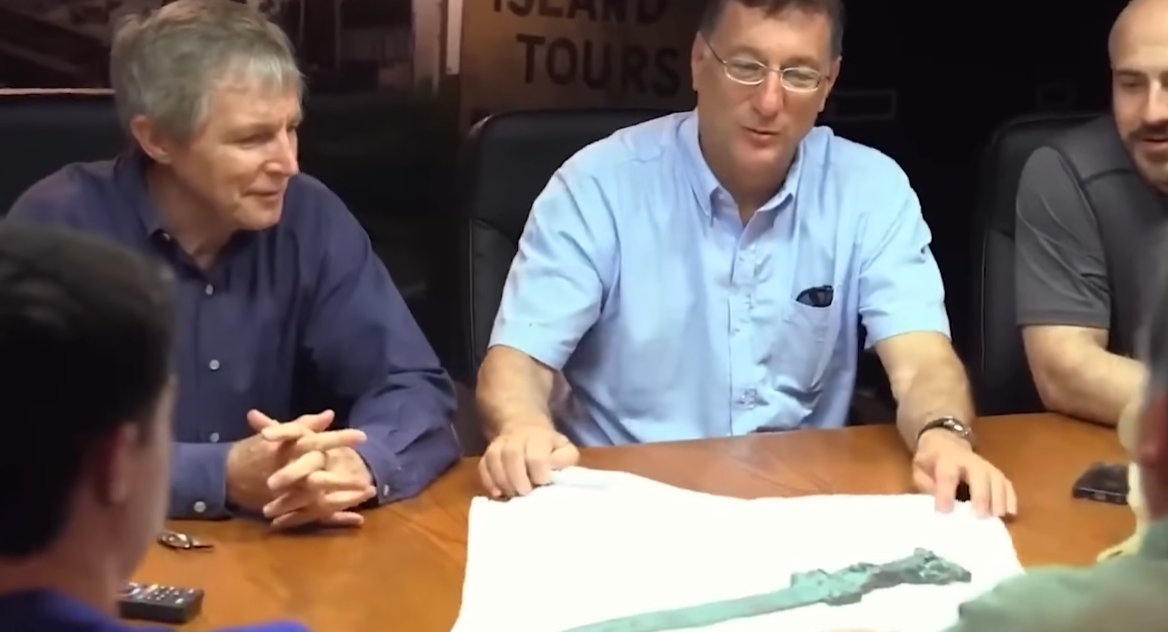
While the Lagina brothers have faced decades of skepticism, this documented historical site—engineered with a level of precision that rivals modern hydrology—suggests that the Oak Island mystery is no longer a legend of “maybe,” but a reality of “when.” As winter approaches, the fellowship faces its ultimate test: outsmarting a 700-year-old defense system that has outlasted every monarch and explorer to date.