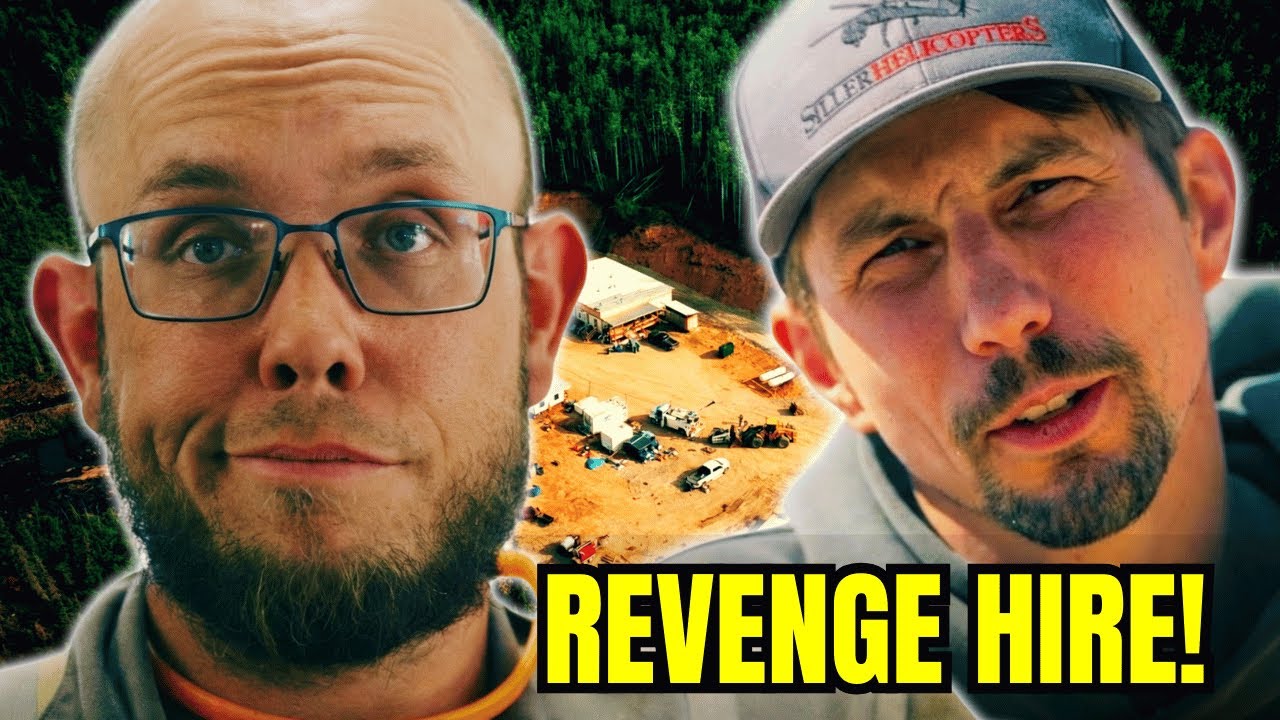
Kevin Beets’ “revenge” attack has left Parker Schnabel terrified!

Season 16 of Gold Rush has unfolded less like a straightforward race for ounces and more like a study in modern mine leadership under pressure. At the centre of it stands Parker Schnabel, long regarded as the benchmark for scale, efficiency, and results. Yet this season, a subtle but meaningful shift has emerged—one driven not by ground quality or machinery, but by people.
From the opening weeks, Parker made it clear he was expanding aggressively. Bigger targets required deeper benches, longer runs, and more manpower. As his operation absorbed talent from neighbouring crews, the ripple effects were immediate. One of the miners most affected was Kevin Beets, who began the season already stretched thin, trying to prove himself as a mine boss independent of his father’s towering legacy.
Losing experienced hands early forced Kevin into survival mode. Roles blurred, shifts lengthened, and production became a daily balancing act. Yet as the season progressed, the flow of personnel unexpectedly reversed—and that reversal would reshape Kevin’s year.
At Dominion Creek, Parker’s own camp encountered internal friction. Tavan Peterson, a second-year loader and excavator operator, returned with the intention of securing a long-term future in one of the Yukon’s strongest crews. Mining was not a temporary stop for him; it was a deliberate career choice. But despite his experience and commitment, tensions surfaced.
When operations manager Nona Loveless confronted Tavan, the feedback focused less on output and more on perception. He was told he struggled with teamwork and came across as overly confident. To Tavan, the assessment felt abrupt and confusing. Within moments, his season was over.
For a young miner, the decision carried real consequences. Leaving the Yukon mid-season is not merely a professional setback—it can be financially devastating. More than that, it can signal an end to hard-earned momentum. Instead of walking away, Tavan chose to keep searching.

One hundred miles west, Kevin Beets was facing his own reckoning. Mechanical setbacks, uneven gold totals, and constant comparisons to Tony Beets had turned every weigh-in into a referendum on his leadership. Skilled labour was scarce, especially mid-season, and the margin for error was narrow.
When Tavan arrived at Kevin’s claim and asked if there was work, the conversation was brief but decisive. His experience with wash plants, loaders, and night shifts addressed Kevin’s most urgent needs. The job offer came immediately.
The symbolism was impossible to ignore. After losing crew members to Parker earlier in the year, Kevin had now brought in someone released from Parker’s own operation. There were no raised voices or pointed remarks, but the move marked a clear shift. Kevin was no longer reacting—he was building.
Tavan’s initiation was uncompromising. Assigned to night shift at the demanding Sphinx cut, he was tasked with keeping the wash plant fed continuously through the Yukon’s endless daylight. Alongside veteran Rick Johnson, the workload was relentless. Any delay meant lost production; any error risked shutting the plant down.
Ten hours into that first shift, the test arrived. A massive boulder slipped through the grizzlies and jammed the hopper, halting operations entirely. For a new hire, the moment could have defined his future either way. Instead of hesitating, Tavan worked with Chelsea and Tyler to engineer a solution—digging beneath the obstruction, securing it with chains, and applying controlled hydraulic force until the rock finally gave way.
Production resumed. More importantly, confidence followed.
Kevin’s response the next morning was telling. There was no lecture, no second-guessing. Instead, Tavan received recognition for staying composed and restoring the run under pressure. In a season where stability had been elusive, Kevin had found a worker who thrived when the margin for error disappeared.
Over the following weeks, the impact became measurable. With the plant running consistently and the crew settling into a rhythm, gold totals climbed. Kevin’s operation pushed past 500 ounces, delivering more than $2 million in gold and restoring belief that a 2,000-ounce season was still achievable.
For Tavan, the move became a professional reset. In a smaller crew, effort was visible and valued. Expectations were clear, communication direct. The same qualities once questioned now translated into reliability.
For Kevin Beets, the implications ran deeper. This was no longer a season defined solely by comparison. By identifying and backing the right people, he had shifted momentum on his own terms.
The broader lesson extends beyond one crew change. In an industry where skilled operators are increasingly hard to find, leadership decisions resonate far beyond a single season. Evaluating talent fairly, understanding context, and recognising when environment—not ability—is the issue can determine whether an operation advances or stalls.
Parker Schnabel remains the standard-setter in scale and output. But Season 16 suggests that adaptability and people management are becoming just as decisive as ounces per hour. Kevin Beets’ quiet recalibration is evidence that competition in the Yukon is evolving—and that success does not always announce itself loudly.