Parker failed – even £769,000 in gold wasn’t enough to save his season.

A routine haul turned into a costly setback this week at Duncan Creek, as a major mechanical failure brought one of Parker Schnabel’s primary haul trucks to a halt — and exposed just how narrow the margins are in a season chasing 8,000 ounces of gold.
The incident began when 22-year-old rookie operator James Curtis, running one of the mine’s Volvo A60 articulated trucks for the first time, heard a noise he instantly knew was wrong.
“It’s beeping at me,” Curtis radioed. “I’ve got like four error codes flashing.”
Moments later, the truck — loaded with 60 tons of pay dirt — went down.
A Catastrophic Snap
Inspection revealed that the companion flange connecting the drive shaft to the rear axle had snapped. As the wheels continued to turn, the broken shaft effectively “blenderized” surrounding components, tearing through brake lines and hydraulic hoses that power the dump box.
“It’s probably the worst one I’ve seen,” said mechanic Taylor, assessing the damage.
With 60 tons sitting in the bed and the dump hydraulics disabled, the crew faced a complex problem: they could not unload the truck, and they could not move it safely in full drive mode.
The immediate plan was triage. Replace the destroyed brake lines and electrical harnesses, restore minimal hydraulic function to dump the load, then limp the machine back to the yard using only the front two-wheel drive.
It was a high-pressure repair in the middle of active production.
Six Hours Against the Clock
In gold mining, idle equipment equals lost revenue. The A60 trucks are the arteries feeding wash plants, and without them, sluicing slows dramatically.
“They are screaming to have this truck back in the cut,” Taylor said, as the crew worked against time.
The team installed a new wiring harness, replaced hydraulic lines, and craned in a fresh drive shaft. Precision mattered. The shaft grooves had to align perfectly with the flange to prevent vibration or further damage.
With the transmission in neutral and components under tension, the final alignment required careful coordination. Once bolted into place, the machine roared back to life.
After just six hours, the A60 was back hauling pay.
“Taylor is a wizard,” one crew member said. “He got it back up in only a couple of hours.”
But the damage had already cost them something more than parts and labour.
Production Under Pressure
While the truck was down, wash plant throughput dropped. And in a season where Parker Schnabel is targeting 8,000 ounces, every interruption carries weight.
To stay on pace, the operation needs to average roughly 600 ounces per week.
This week’s weigh-in told a sobering story.
Big Red, processing red gravel from the Bridge Cut, delivered 100.8 ounces — down significantly from prior weeks. Roxanne, running material from the Long Cut, produced 206.8 ounces.
Combined total: 307.6 ounces.
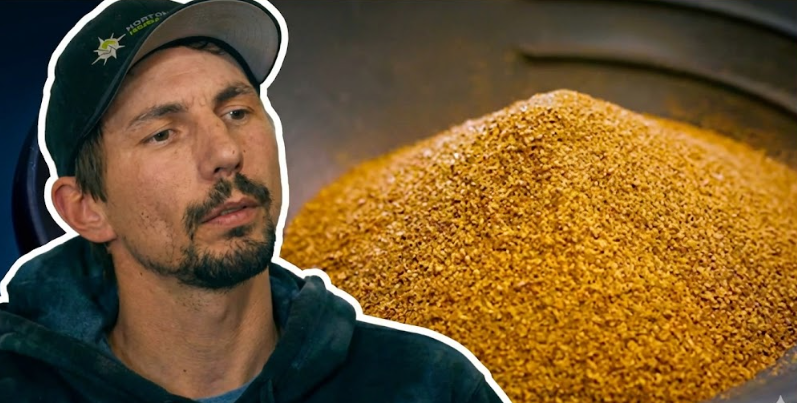
At current gold prices, the haul was worth approximately $769,000. But compared to recent results, it was Parker’s weakest weigh-in in seven weeks — nearly 100 ounces below the previous week’s output.
For an operation built around scaling and efficiency, the dip raised concern.
Midseason Reality Check
At the season midpoint, the cumulative gold total stands at 4,175.4 ounces — just over halfway to the 8,000-ounce goal.
On paper, that is solid progress.
But momentum matters in mining. Production typically peaks in mid-season when ground conditions are optimal and equipment is running at full capacity. Two consecutive weeks of declining totals suggest that mechanical reliability and cut efficiency must tighten if Parker is to maintain his target trajectory.
“You guys have to pump those numbers up,” Parker said during the weigh-in, half joking but fully aware of the stakes.
The slump comes at a time when production should be accelerating, not tapering.
The Human Factor
For rookie James Curtis, the breakdown was an abrupt introduction to the realities of heavy mining equipment.
“Definitely a good learning lesson,” he said. “It’s my first time ever working at a mine.”
Running a 60-ton truck on steep Yukon ramps demands precision and awareness. While the flange failure may have stemmed from a pre-existing crack rather than operator error, the moment underscores the pressure placed on newer crew members.
In operations of this scale, one mechanical weakness can cascade into lost production hours, strained crew morale and budget adjustments.
Margin for Error
Parker’s operation is known for redundancy — backup parts, spare pumps and rapid-response repair protocols. That philosophy paid off this week.
But the broader lesson remains: large-scale output depends not only on rich ground and strong leadership, but on uninterrupted mechanical flow.
With wash plants capable of processing thousands of cubic yards per day, hauling capacity must keep pace. A disabled truck narrows the pipeline instantly.
If breakdowns become frequent, weekly gold totals will reflect it.
Looking Ahead
The crew is now back to hauling at full speed. Both Big Red and Roxanne are operational, and the repaired A60 has returned to the cut.
The next weigh-in will reveal whether this week’s slump was a temporary dip or the beginning of a plateau.
At 4,175 ounces halfway through the season, Parker Schnabel remains on track. But 8,000 ounces leaves little room for sustained setbacks.
In the Klondike, success often hinges on resilience — mechanical, financial and psychological.
This week proved that when equipment fails, the real test begins not underground, but above it — in how quickly a team can adapt, repair and recover.
For Parker and his crew, the message is clear: keep the trucks moving, keep the plants running, and keep the gold flowing.
Because in modern mining, consistency is everything.