Exceeding All Expectations: Archaeological Team Touches ‘The Light’ Worth $250 Million in the Templar Labyrinth
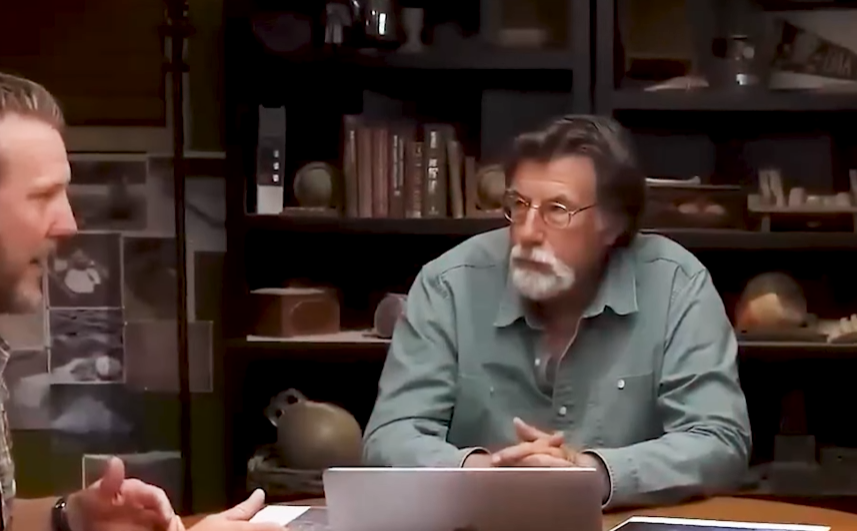
After 228 years of industrial-scale failure, the mystery of Oak Island has transitioned from folklore to fact. In a stunning breakthrough during the latest excavation of Shaft 9, Rick and Marty Lagina have breached a sealed subterranean chamber containing a treasure cache valued at an estimated $250 million. More significantly, the find includes 14th-century documents that threaten to rewrite the history of North American exploration.
The “Triangular” Breakthrough
The discovery was precipitated by seismic scans that identified a perfect geometric anomaly deep beneath the Money Pit zone. While drilling near the T1 corridor, the ground gave way, revealing a passage lined with mineral deposits and hand-carved limestone.
The team, led by Rick Lagina, bypassed a massive stone slab reinforced with iron clamps—an engineering feat intended to be permanent. Upon breaching the barrier, the fellowship discovered a spiraling stone staircase leading to a fortified oak and iron door.
[Image: A cross-section of the newly discovered “Labyrinth” showing the spiral staircase and the vaulted chamber at 150 feet]
The 1347 Inscription
The threshold of the vault bore a chilling Latin inscription: “Noli aperire. Custos aeternis.” (Do not open. The eternal guardian.) Beneath the warning was the date 1347—the height of the Black Death in Europe.

“This isn’t a pirate’s hole,” Marty Lagina noted as the team entered a high-arched, symmetrical sanctum. “This is a cathedral built for a secret.” Inside, the team found rows of stacked stone chests and lead-sealed reliquaries.
$250 Million in Physical Gold
Upon forcing the rusted clasps of the primary chests, the team revealed hundreds of solid gold bars, each roughly the size of a man’s forearm. Initial metallurgical assessments indicate the gold is stamped with Templar crosses and unfamiliar seals, suggesting an organized, state-level treasury rather than disorganized loot.
The Oak Island “Sanctum” Inventory:
| Item | Quantity/Type | Estimated Value |
| :— | :— | :— |
| Gold Bullion | Stamped bars, 22.5k purity | $250,000,000 |
| Parchment Scrolls | Wax-sealed Latin manuscripts | Invaluable |
| Lead Seals | Knights Templar Crests | Historical Breakthrough |
| Reliquaries | Iron-bound wooden containers | Pending Analysis |
History in the Scrolls
While the gold provides the “wow factor,” the linen-wrapped scrolls may be the find’s true legacy. Written in a meticulous medieval hand, the documents describe transatlantic voyages occurring nearly 150 years before Christopher Columbus. Maps found within the vault trace a global network connecting Jerusalem, Scotland, and Portugal, with Oak Island marked not as a destination, but as a “waypoint” in a larger repository system.

A New Curse: Possession
The discovery has brought immediate geopolitical and security challenges. Strange vessels have been spotted anchoring off the coast of Smith’s Cove, and the island is currently under 24-hour armed patrol. Multiple international organizations and governments have already begun filing claims of “cultural patrimony” over the vault’s contents.
For Rick Lagina, the realization is bittersweet. “We’ve uncovered the secret,” he said, holding a 14th-century gold bar. “But the weight of this history is heavier than the metal.”
The team is currently working with federal authorities to stabilize the chamber, as the scrolls suggest this vault is merely one of several “repositories” hidden along the Atlantic coast.