THE KING OF THE KLONDIKE STRIKES IVORY: Tony Beets Unearths Rare Mammoth Find
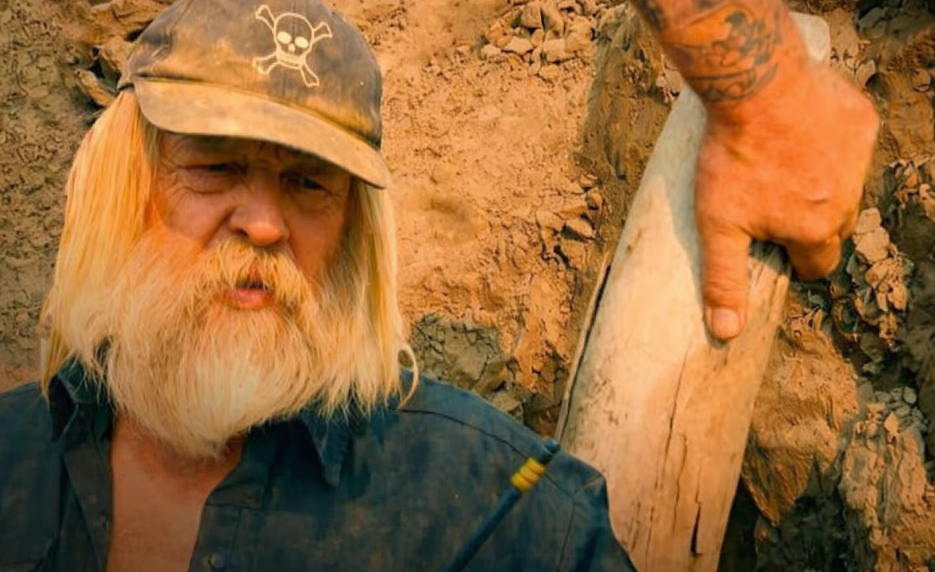
In the relentless pursuit of gold, the legendary “King of the Klondike” Tony Beets is used to moving mountains of dirt. But this week, the earth gave up something far older than the gold-bearing gravel Beets is known for mining. During a routine excavation of a frozen permafrost bank, the veteran miner unearthed a massive, prehistoric mammoth tusk, signaling a discovery that could be far more significant than a mere fragment of ivory.
A Giant in the Bank
The discovery occurred as the Beets crew was stripping away layers of “muck”—the frozen prehistoric mud that covers the pay dirt. As the bucket of the massive excavator pulled back, it revealed the unmistakable curve of a woolly mammoth tusk, still anchored firmly in the frozen wall.
“I believe I found a tusk,” Beets remarked with his characteristic bluntness, though even the seasoned miner seemed struck by the find. “Whoa. That certainly is. Look at that.”
While finding isolated pieces of “black ivory” is a semi-regular occurrence in the Yukon, finding a tusk of this scale still embedded in its original geological context—in situ—is a rarity that changes the stakes for the operation.
More Than Just Ivory
For Beets, the intrigue lies not in the value of the ivory, but in the potential for what remains hidden behind the frost. In the mining world, an isolated tusk is often a “washout”—a piece of bone moved by ancient rivers. However, a tusk still held by the bank suggests the animal may have died exactly where it currently rests.
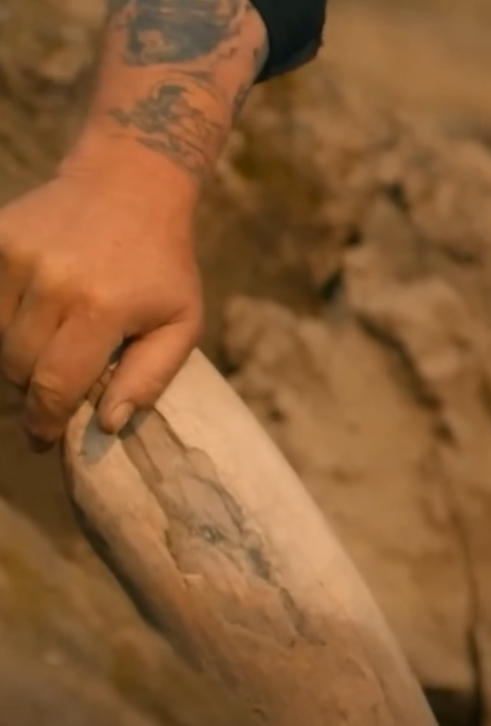
“Tusks is not that big of a discovery,” Beets explained to his crew. “But if there’s something attached to it, that’s a whole different story. It’s very rare that I find a tusk like this still [in the bank].”
The presence of an attached skull or a complete articulated skeleton would represent a major scientific breakthrough. It would suggest that the animal was flash-frozen or buried rapidly during the Pleistocene epoch, preserving a snapshot of life in the Yukon from over 30,000 years ago.
The Race Against the Thaw
The discovery presents a unique challenge for the Beets operation. Once permafrost is exposed to the air, the “frost-lock” that has preserved the ivory for millennia begins to fail. If not handled with extreme care, the tusk can dry out and shatter within hours of being removed from the cold, moist earth.
“Taken out of the bank, this could be, who knows?” Beets mused, eyeing the dark wall of mud. For now, the heavy machinery has been silenced in the immediate area as the team decides whether to proceed with the gold hunt or pivot to a paleontological rescue.
In the Yukon, the gold belongs to the miner, but the bones belong to history. As Beets continues to dig, the world waits to see if the “King” has found a treasure that cannot be melted down into bars.