“Prehistoric people once lived here”: Fossilized footprints discovered inside Oak Island.
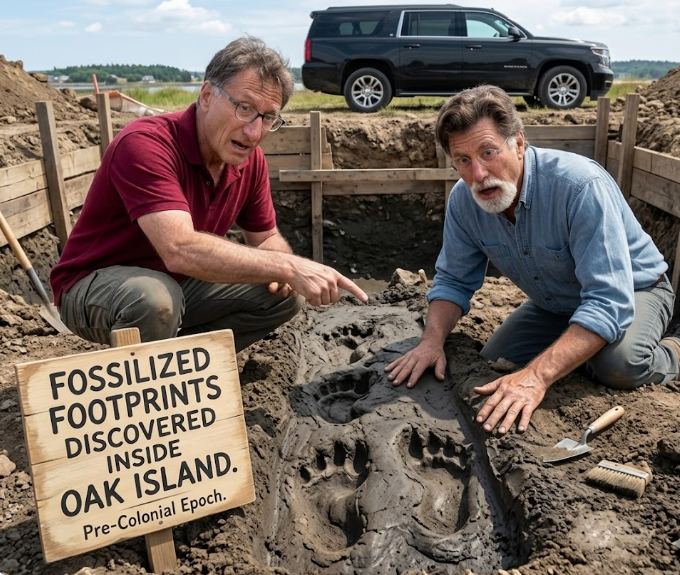
For over two centuries, The Curse of Oak Island has built its identity around one central question: who came to Oak Island, and what did they leave behind? Now, a new and unexpected development is beginning to reshape that narrative. Reports of fossilised footprints discovered beneath the island’s surface suggest that human activity on Oak Island may stretch back far earlier than any of the prevailing theories have proposed.
From a programme analysis perspective, this is not just another intriguing find. It represents a potential shift in the chronological framework that has guided the Lagina team’s investigation for years.
The current working theories on Oak Island typically revolve around activity from the medieval to early modern period. Connections to the Knights Templar, early European explorers, and even colonial-era engineering have dominated both the show’s direction and its interpretive lens. Figures such as Rick Lagina and Marty Lagina have consistently followed evidence that points to deliberate, engineered efforts occurring within the last 500 to 800 years.
However, the discovery of what are being described as fossilised human footprints—potentially embedded within ancient sediment layers—introduces a far older timeline. If verified, this would suggest that Oak Island was not merely a site of historical intrigue, but a location of prehistoric human presence.
That distinction matters.
In geological terms, fossilised footprints are not casual surface impressions. They form under very specific conditions, often requiring rapid burial by sediment and long-term mineralisation. If such prints are indeed found below layers associated with later constructions, it would indicate that human or human-like activity predated any known engineering works on the island.
For the show’s narrative, this opens two competing interpretive paths.
The first is separation. The footprints may represent an entirely unrelated chapter of Oak Island’s past—a natural, prehistoric occurrence with no direct connection to the treasure mystery. From a scientific standpoint, this is the most conservative interpretation. Many regions across North America have yielded ancient traces of early human movement, particularly in areas shaped by glacial retreat. Oak Island, located along a historically dynamic coastline, would not be exempt from such processes.
But the second path is far more compelling from a storytelling and investigative standpoint.
If the footprints are found in proximity to features already considered anomalous—such as stone alignments, subsurface voids, or areas like the Money Pit—then the question becomes harder to dismiss. Could earlier inhabitants have recognised something about this land? Was Oak Island already a place of significance long before the arrival of European actors?
This is where the programme’s analytical tension lies.
Historically, the show has leaned into layered occupation theories—suggesting that different groups may have used the island across different time periods. A prehistoric presence, if confirmed, would extend that layering dramatically. It would transform Oak Island from a site of singular mystery into a continuum of human interaction, stretching across thousands of years.
From a production standpoint, this also introduces new investigative tools and disciplines. The involvement of paleoanthropologists, sediment specialists, and advanced dating techniques would likely follow. Viewers could expect a shift away from purely treasure-focused excavation toward a more interdisciplinary approach, blending archaeology with geological science.
There is also a strategic implication for where the team chooses to dig next.
If the footprints are located within a specific stratigraphic layer, the team may begin to reassess how different layers across the island relate to one another. Areas previously dismissed as natural could be re-evaluated. Conversely, zones thought to be heavily modified might require closer scrutiny to determine whether they overlay something much older.
For Rick and Marty Lagina, the challenge will be maintaining focus.
The strength of their operation has always been its ability to pursue multiple lines of evidence while still working toward a central objective. Introducing a prehistoric dimension risks expanding the scope beyond manageable limits. Yet ignoring it entirely could mean overlooking a critical piece of the island’s history.
From a programme analyst’s viewpoint, the most likely outcome is a hybrid approach.
The team will continue its core efforts around established targets such as the Money Pit and nearby shafts, while allocating limited but strategic resources to investigate the footprint discovery. This allows them to acknowledge the significance of the find without diverting the entire operation.
Looking ahead, several developments seem plausible.
First, confirmation. The prints will undergo rigorous testing to determine their age and origin. This will be the decisive factor in how seriously the discovery is integrated into the broader narrative.
Second, contextual expansion. If the prints are validated as prehistoric, the show will likely introduce new historical frameworks, potentially linking Oak Island to early migration routes or coastal habitation patterns.
Third, narrative recalibration. Even if the footprints are ultimately deemed unrelated to the treasure, their presence will still influence how the island is understood—less as a singular mystery, and more as a layered historical site.
In the end, this discovery does not provide answers. Instead, it complicates the question in a way that is entirely consistent with the identity of The Curse of Oak Island.
Because on this island, every new find—no matter how unexpected—does not close the story.
It expands it.