Clarkson’s Farm season 5 sets premiere date for first episode: A brand new season with many surprises awaits.
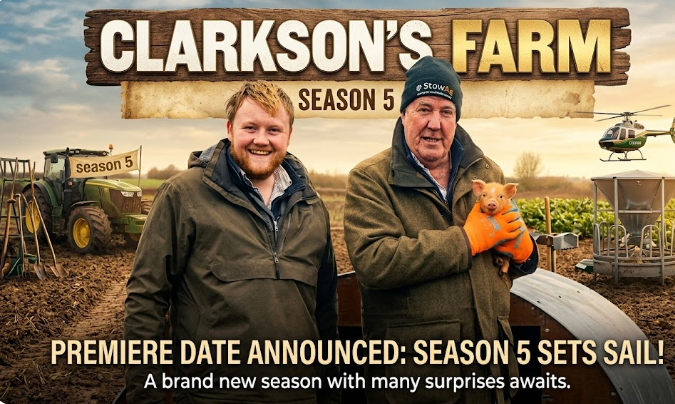
The confirmation of a premiere date for Season 5 of Clarkson’s Farm is more than just a scheduling update—it signals the next phase in the evolution of one of Britain’s most influential factual entertainment formats. Since its debut, the series has moved beyond a simple fish-out-of-water narrative featuring Jeremy Clarkson, transforming into a layered exploration of modern farming, rural economics, and regulatory tension. Season 5 now arrives with heightened expectations, both narratively and commercially.
From a programme analysis perspective, the timing of this premiere is critical. The production cycle—reportedly wrapping months earlier—suggests that Season 5 will reflect a more stabilized operational phase at Diddly Squat Farm. This matters because earlier seasons thrived on chaos: failed crops, livestock crises, and Clarkson’s steep learning curve. Now, the narrative tension must evolve. Viewers are no longer watching a novice—they are watching a farmer-businessman navigating scale, reputation, and expansion.
One of the most significant shifts expected in Season 5 is the increasing centrality of commercial strategy. Clarkson’s ventures—ranging from the farm shop to branded products—have already blurred the line between television narrative and real-world enterprise. Analysts should anticipate deeper coverage of vertical integration: production, branding, and distribution. This is no longer just a farm; it is a rural brand ecosystem. The storytelling challenge will be to maintain authenticity while documenting a business that is becoming increasingly sophisticated.
A key storyline likely to dominate early episodes is the continued development of The Farmer’s Dog, Clarkson’s high-profile pub venture. Previous planning disputes and infrastructure challenges created a natural narrative arc, positioning Clarkson in direct conflict with local authorities and community expectations. With new approvals now in place, Season 5 may pivot from conflict to execution. The question is no longer whether the pub can operate—it is whether it can succeed sustainably. Expect detailed exploration of staffing pressures, supply chain logistics, and the delicate balance between tourism and local integration.
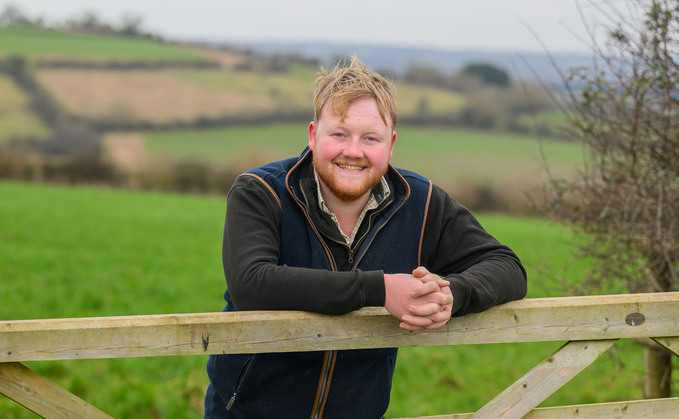
Another crucial analytical angle lies in character dynamics. Kaleb Cooper has evolved from a supporting figure into a central pillar of the show’s credibility. His growing public profile introduces an interesting tension: as he becomes a brand in his own right, the power balance within the narrative subtly shifts. Season 5 may explore this dynamic more explicitly, particularly if decision-making authority on the farm becomes more distributed. This could introduce a quasi-dual-lead structure, moving the show away from its original Clarkson-centric format.
Equally important is how the series continues to frame the realities of British agriculture. Clarkson’s public interventions—questioning policy decisions and highlighting financial pressures—have increasingly overlapped with real-world discourse. Season 5 is likely to lean further into this territory, especially given ongoing debates around subsidies, environmental regulations, and post-Brexit agricultural frameworks. The programme has, in effect, become a soft power tool for communicating rural issues to a mainstream audience. Expect more direct engagement with policymakers, whether through on-screen commentary or embedded narrative threads.
From a structural standpoint, the new season will also need to innovate in pacing. Earlier episodes relied heavily on episodic setbacks and recoveries. However, as operations become more complex, the show may adopt longer narrative arcs—tracking projects across multiple episodes rather than resolving them within a single installment. This would align Clarkson’s Farm more closely with serialized documentary formats, enhancing audience retention but requiring tighter editorial discipline.
There is also the question of scale. With rumours of further expansion—both in terms of land use and commercial output—Season 5 may introduce new locations, partnerships, or even international elements. While the core identity of the show is rooted in the Cotswolds, diversification could provide fresh visual and narrative textures. The risk, however, is dilution. The strength of the series has always been its specificity: one farm, one community, one set of constraints. Expanding too far could weaken that focus.
Finally, the premiere itself will be closely watched as a performance indicator. Audience engagement metrics—viewership, social media traction, and international reach—will offer early signals about the longevity of the format. With reports suggesting that further seasons are already under consideration, Season 5 effectively functions as a bridge between the show’s established success and its long-term sustainability.
In conclusion, the arrival of Season 5 is not just another chapter—it is a recalibration. Clarkson’s Farm must now transition from a story of adaptation to one of consolidation and growth. The elements are all in place: a recognizable brand, a loyal audience, and a real-world operation that continues to evolve. The challenge will be maintaining narrative tension in a world that is becoming more controlled, more strategic, and arguably less chaotic. Whether the series can retain its raw appeal while embracing this maturity will define not only Season 5, but the future trajectory of the programme itself.