Ancient walls, mysterious clays, and the connection to the Templars: What truly lies within Oak Island?
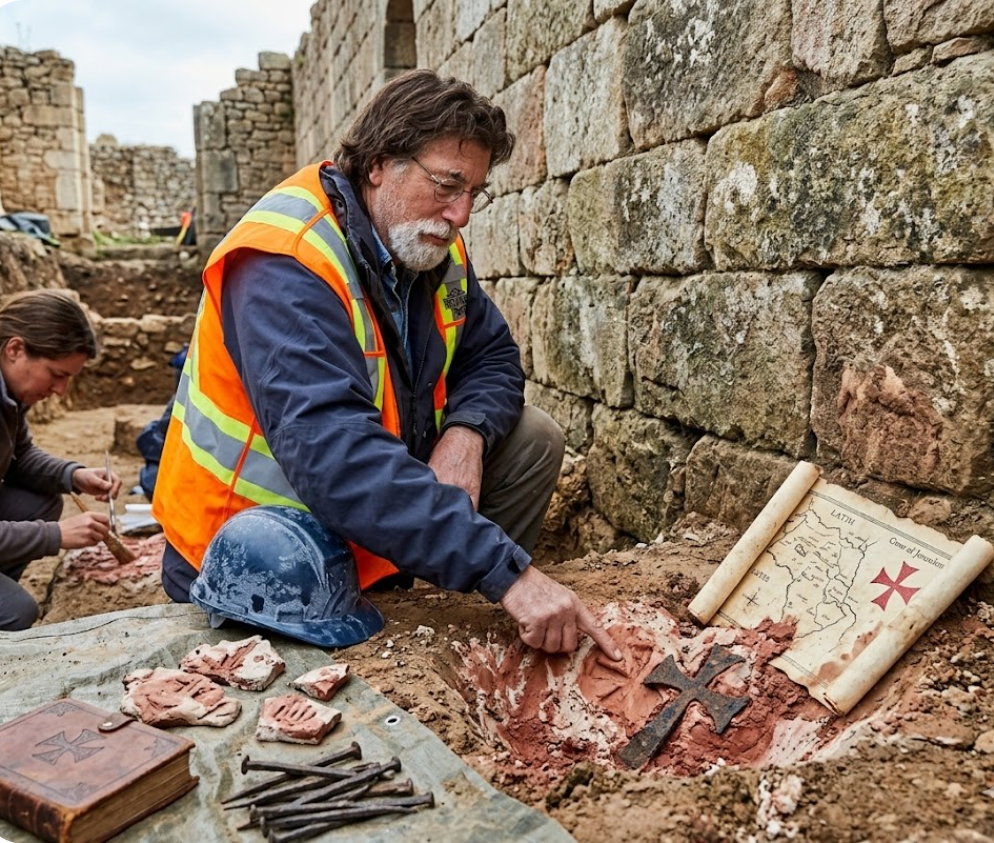
As Oak Island’s treasure hunt continues, the team of researchers and excavators has uncovered some of the most intriguing evidence to date, further suggesting that the island’s history could be deeply intertwined with the legendary Knights Templar. Recent discoveries made on Lot 8, combined with a new archaeoastronomical analysis of church alignments in France, have added new layers of mystery to what has long been a subject of speculation and fascination. The team, led by Rick and Marty Lagina, is now working to determine whether this evidence could finally reveal the long-hidden secrets of Oak Island and its mysterious treasure.
The Cradle-Shaped Feature: New Clues and Discoveries on Lot 8
The investigation on Lot 8 has taken an unexpected turn as members of the Oak Island team, including Rick, Craig, and Fiona, have been meticulously studying a cradle-shaped formation of stones beneath a massive 40,000-pound boulder. The team’s exploration of this formation has led to the discovery of several unusual materials, including handworked blue clay and a mortar-like substance that had been carefully applied to seal the stones together.
Fiona revealed that the mortar-like material was particularly intriguing, with three distinct types discovered. One was a fine powder, another was a blue-gray clay that matched the puddling clay found at the Money Pit, and the third was a more cement-like substance. These findings prompted speculation that whoever had constructed this stone formation had a deliberate and skilled approach, unlike the chaotic mining operations that would have followed the gold rush. Could this be evidence of a hidden tunnel shaft or a structure built with precision and purpose?
Fiona and her team collected samples of the clay and mortar materials for further analysis, hoping to confirm whether these substances were sourced from elsewhere—potentially providing crucial evidence that the original builders were from outside the region. If the materials prove to be non-local, it would strongly suggest a deliberate construction effort by a group with advanced knowledge of engineering. The team’s next step is to conduct a bisection on the left side of the structure to understand how it was built and possibly uncover further details that could explain the purpose of this remarkable feature.
A Historic Connection: The Templar Churches and Oak Island
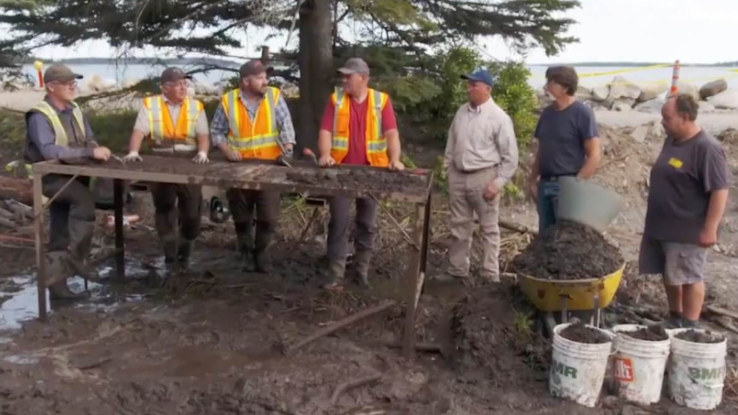
Meanwhile, another team, led by archaeologist Laird Niven, has been continuing their investigation of the rounded stone foundation on Lot 5. This site has yielded numerous artifacts, including a button made of recycled arsenical bronze, potentially dating back to the medieval period. As the team continues to search for more clues, the recent scientific report on a mysterious lead artifact has raised new questions about the origins of these items and their potential connections to the island’s past.
Adding to the intrigue, the Oak Island team has recently engaged with archaeoastronomy expert Professor Adriano Gaspani to analyze the alignment of churches in France with features on Oak Island. A breakthrough came when researcher Charlotte Wheatley revealed that three medieval churches near Talmont-sur-Gironde, located on the west coast of France, are aligned with Oak Island. According to Wheatley’s research, these churches, all dating back to the 12th and 13th centuries, point directly towards the island, forming an east-to-west line.
Professor Gaspani’s analysis confirmed that these churches were indeed aligned with specific features on Oak Island, suggesting that there could be a connection between the island and the Knights Templar, a group known for its secretive nature and historical ties to treasures and ancient knowledge. The alignment with the rising star Sirius and other celestial markers further supports the theory that the Templars used these churches as part of a wider system of navigation and possibly as a code for locating treasures hidden on the island.
Zena Halpern’s Map: Is There a Templar Connection?
This new discovery has added weight to the belief that Oak Island may have been used by the Templars, who are thought to have hidden valuable relics and treasures during their time. Zena Halpern’s controversial map, which she believed was created by the Templars in the 14th century, has always been a point of contention among researchers. The map mentions Talmont-sur-Gironde, and the alignment of these churches now appears to corroborate Halpern’s theory.
According to Doug and Steve, the recent evidence connecting the churches in France with Oak Island suggests that the Templars may have been involved in a multigenerational effort to conceal something of great value on the island. This aligns with Halpern’s idea that the Templars made repeated journeys to Oak Island, beginning in the 1200s, and that their treasure might still be hidden somewhere on the island. The fact that the map’s points of reference are now being proven significant raises the question: Could the Templars have left behind a treasure, hidden in plain sight?
The research on Oak Island is now taking a new direction, with the alignment of the churches and the confirmation of historical connections suggesting that the island’s story may not just be about colonial settlers, but about a much deeper, older European legacy. The team is now working to examine whether the features on Oak Island, including the stone structures and the mysterious blue clay, were intentionally placed by a group of advanced builders with knowledge of engineering, astronomy, and treasure hunting.

A Turning Point in the Search for Oak Island’s Treasure
As the team continues to dig deeper into these new discoveries, the possibility of a Templar connection grows stronger. The evidence points to a long and deliberate effort to hide something on Oak Island, and the recent findings suggest that the treasure could be more valuable—and older—than anyone imagined. The presence of skilled construction techniques, the alignment with historical churches, and the discovery of ancient materials all suggest that this might be the breakthrough the team has been waiting for.
But with each new discovery comes more questions. If the Templars were involved, what exactly were they hiding? Was it religious relics, treasure, or something even more mysterious? And if the Templars did indeed leave clues behind, how far are the team members from uncovering the final secret?
As Rick, Marty, and the team push forward in their quest, the stakes have never been higher. The clues are pointing in an exciting new direction, and with each discovery, the mystery of Oak Island gets closer to being solved. The road ahead is filled with challenges, but with the new evidence, the team is more determined than ever to uncover the island’s secrets. The next chapter of the Oak Island story is unfolding, and it promises to be one for the history books.