UNTOUCHED FOR CENTURIES: Massive 40,000lb Capstone on Lot 8 Conceals “Megalithic” Structure and Silver Traces
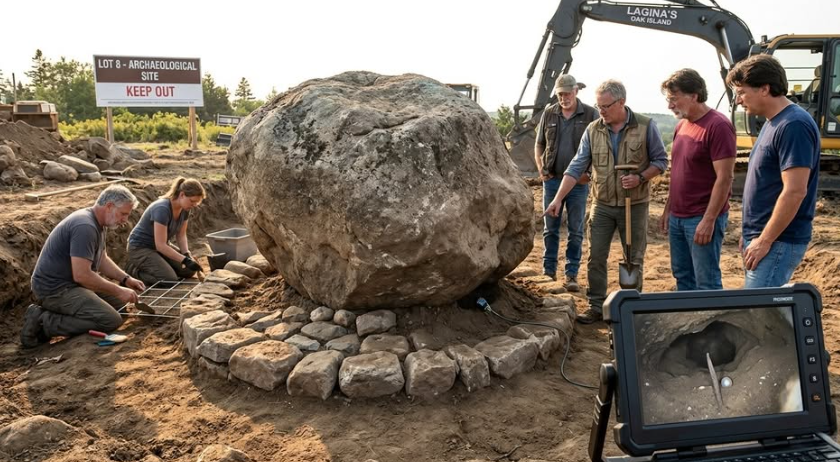
In what is being hailed as perhaps the most significant breakthrough in the 231-year history of the Oak Island mystery, a joint team of archaeologists and researchers has uncovered a massive, purposefully engineered stone structure hidden beneath a 40,000-pound boulder on Lot 8. Unlike the heavily disturbed Money Pit area, this site appears to have remained entirely untouched by searchers since its original construction—possibly dating back to the 14th century.
The discovery began when the team moved a massive granite boulder that had been omitted from all historical maps and survey records. Beneath it, they found a carefully arranged circular ring of stones surrounding a tightly packed depression, a feature that geoscientist Dr. Ian Spooner confirms is “absolutely not natural.”
The “Smoking Gun” of Metallurgy: Lead and Silver
The physical evidence is bolstered by startling scientific data. Using an XRF (X-ray fluorescence) scanner, Dr. Spooner analyzed soil samples sealed beneath the boulder. The scans initially revealed unusually high levels of lead combined with charcoal—a signature of “fire setting,” an ancient mining technique used to break bedrock before the invention of explosives.
However, the discovery took a dramatic turn when a second, deeper scan detected the presence of silver in the undisturbed earth. “Silver doesn’t just exist in untouched soil without a reason,” Spooner noted. The presence of precious metals in a sealed environment suggests that whatever lies beneath the stone structure is of immense value or historical importance.
European Engineering in the “Middle of Nowhere”
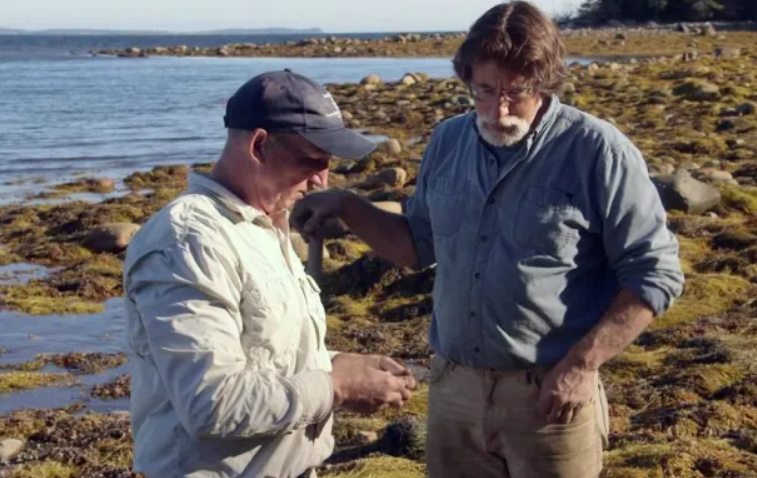
Archaeologist Fiona Steele and European masonry expert Peter have identified the construction as a “load-bearing” formation, utilizing a European style of megalithic engineering. The structure consists of a circular “cradle” of rocks designed to protect a central shaft or chamber from the crushing weight of the 20-ton capstone above.
“This level of design suggests a deep understanding of geometry and physics,” Peter explained. “It aligns with European building traditions, requiring specialized tools and significant manpower—neither of which match local indigenous construction methods for this specific context.”
The location of the find has left the team baffled. Lot 8 is an open field with no obvious landmarks, described by researchers as “the middle of nowhere.” This has led to the theory that the 40,000-pound boulder was used as a “stealth” capstone—meant to look like a natural feature of the landscape while permanently sealing a subterranean vault.
Pre-dating the Legend?
Perhaps the most striking aspect of the Lot 8 site is the total absence of “searcher debris.” On an island littered with 19th-century tools, broken pottery, and modern trash, this site is surgically clean. Rick Lagina noted that the absence of artifacts suggests the builders were either meticulously careful or that the site is so old that any surface traces have long since vanished.
“This could pre-date the 1700s, before the first recorded treasure hunts, and even before the legends of the Money Pit began,” Steele suggested. The team is now drawing parallels to the 14th-century Portuguese silver coin found on the island in 1849 and the engineered stone roadway in the swamp, which is estimated to be at least 500 years old.
The Next Phase: Lifting the Seal
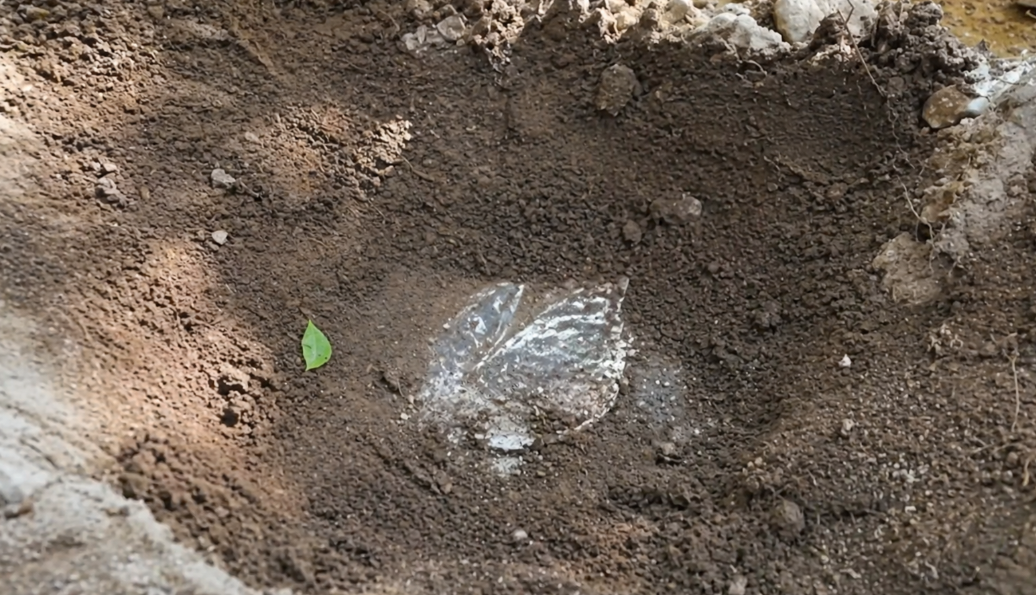
The discovery has sent shockwaves through the Fellowship. Marty Lagina, following the developments remotely, emphasized that because there is no record of previous searchers ever touching the Lot 8 boulder, the team may be the first people to see this structure since it was sealed hundreds of years ago.
The excavation is now proceeding with extreme caution. The team intends to lift the inner layers of flat stones to reveal what the “cradle” has been protecting for centuries. “We can’t rush this,” Rick Lagina said, staring into the pit. “If something is down there, it was important enough to move 40,000 pounds of stone to hide it. We owe it to history to find out why.”