Leaked Oak Island Claims Suggest Hidden Chamber Could Redefine the Money Pit Mystery

For more than two centuries, Oak Island has been defined by one central question: what lies beneath the Money Pit? Generations of searchers have spent fortunes, lost equipment, and risked everything trying to reach what many believe is a hidden vault. But new claims surrounding The Curse of Oak Island Season 13 suggest the island’s greatest secret may not be directly beneath the famous pit at all.
According to alleged production leaks, the team may have detected a deep underground chamber buried more than 130 feet below the surface. The structure is described as rectangular, measuring roughly 10 feet wide and 15 feet long, with a shape too precise to be dismissed as a natural void. If accurate, the find could force the Lagina brothers and their team to reconsider the entire layout of Oak Island’s underground system.
The most important detail is not simply the chamber’s existence, but its reported condition. At that depth, pressure, water, and shifting ground should have damaged or destroyed most man-made structures long ago. Yet the chamber is said to appear unusually well-preserved. That has led some researchers to suggest it may have been deliberately protected, possibly by advanced construction techniques or a lining designed to resist corrosion and collapse.
The reported scans allegedly revealed three large rectangular objects resting on the chamber floor. Their density readings were said to be unusually high, leading to speculation that they could be metal-filled containers, sealed chests, or protective cases. While treasure hunters naturally imagine gold and silver, the more compelling possibility is that these objects may contain records, relics, or artifacts connected to the people who built the chamber.

That possibility would shift Oak Island away from a simple treasure story. If the objects contain documents, ceremonial pieces, or historical materials, their value may be far greater than money. They could explain who came to Oak Island, why they chose the site, and what they were trying to hide or preserve.
The alleged metallic lining inside the chamber has become the centre of the latest speculation. Reports claim that traces of a lead-silver alloy may have been found in nearby samples, raising comparisons to materials associated with ancient engineering. Some researchers have linked this to Roman-style preservation methods, though such a claim would require independent verification before being accepted as evidence.
Still, the idea has reopened debate over earlier Oak Island finds that have long puzzled viewers. Artifacts sometimes connected to Roman, medieval, or pre-Columbian theories were once treated by sceptics as isolated oddities. But if a metallic-lined chamber exists beneath the island, those scattered clues may start to look less random. They could point toward a larger historical pattern.
This is where the Knights Templar theory inevitably returns. Oak Island has often been linked to legends involving the Templars, the Knights of Malta, sacred relics, hidden records, and transatlantic routes before the official age of European exploration. None of those theories has been proven. Yet the reported chamber would give theorists a new structure around which to build their arguments.
One of the most interesting claims is that the chamber is not located directly beneath the Money Pit. Instead, it is allegedly positioned along a hidden geometric point connected to Nolan’s Cross, the large stone formation that has fascinated researchers for decades. If true, this would support the idea that Oak Island was designed as a larger puzzle, with the Money Pit acting as one part of a wider underground system.
That interpretation would change the meaning of the entire search. For generations, explorers assumed the Money Pit was the final destination. But what if it was a decoy? What if its flood tunnels, collapses, and confusing searcher history were meant to draw attention away from a more important chamber nearby? Such a theory would explain why the island has resisted clear answers for so long.
From an analyst’s perspective, this is exactly the kind of storyline that gives The Curse of Oak Island its lasting power. The show rarely offers complete answers. Instead, it builds through layers: one artifact connects to one theory, one scan connects to one structure, and one mystery leads to another. A hidden chamber would not end the story. It would expand it.
The next likely phase would involve confirmation. The team would need more scans, careful drilling, soil analysis, metal testing, and expert review before any major excavation. If the chamber is real, accessing it would be extremely difficult. Any careless move could damage the structure, contaminate the evidence, or destabilise the surrounding ground.
The role of online researchers also cannot be ignored. Oak Island is no longer investigated only by the people on screen. Fans around the world examine maps, symbols, satellite images, historical records, and every frame of each episode. Some theories that begin in online communities eventually become part of the wider conversation. The search has become a global collaboration, with professional investigators and independent researchers feeding into the same mystery.
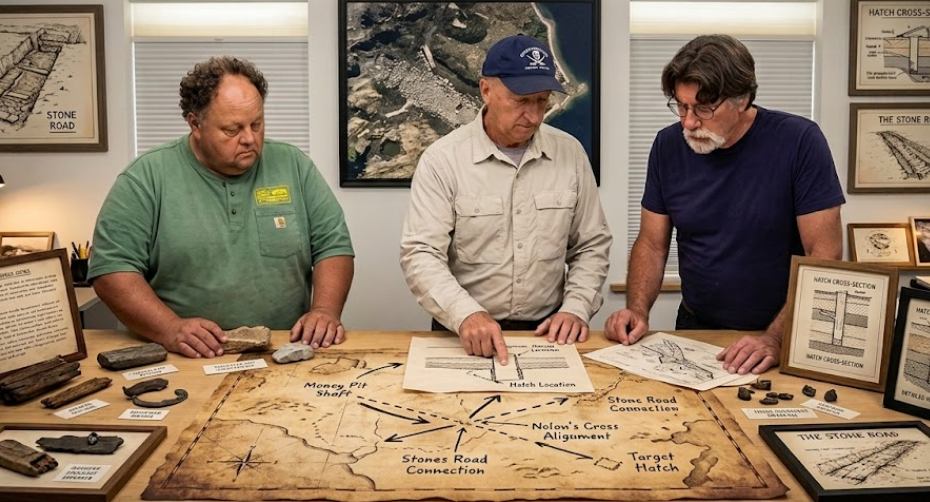
That may be one of the most important modern developments in the Oak Island story. The Fellowship of the Dig may operate the machinery, but thousands of viewers are building theories from afar. If a hidden chamber is eventually confirmed, many will see it as the result not only of excavation, but of years of collective analysis.
For Rick and Marty Lagina, the alleged discovery would represent a turning point. Rick has always been drawn to the story behind the treasure, while Marty has demanded evidence strong enough to justify the next major investment. A preserved underground chamber could satisfy both instincts: it offers mystery, but also a physical target.
Whether the chamber contains treasure, documents, relics, or nothing at all, its existence would matter. It would suggest that Oak Island’s underground world is more complex than previously understood. It could point to a hidden construction project, a protected repository, or a carefully planned system designed to confuse anyone who came later.
For now, the claims remain unconfirmed. But if the leaks prove accurate, Oak Island may be approaching one of the most important moments in its long history. The real secret may not be a chest of coins. It may be the story of the people who built beneath the island — and the reason they wanted their work to stay hidden for centuries.