An ancient statue beneath Oak Island: Rick Lagiana’s latest discovery helps shed light on Oak Island’s past.
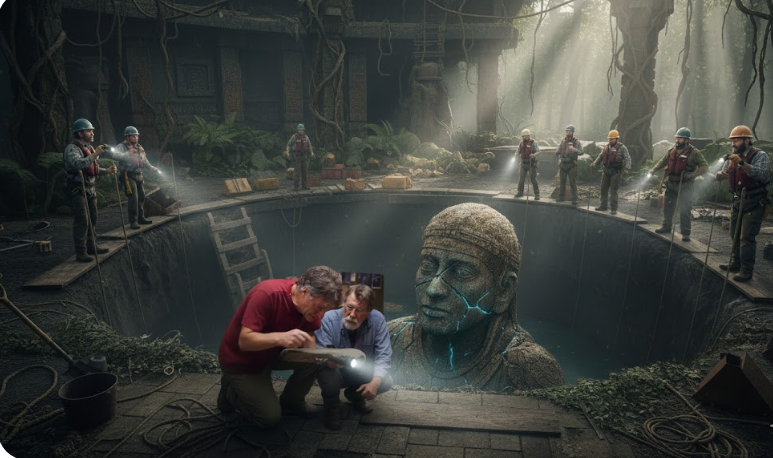
For more than two centuries, Oak Island has been defined by what lies beneath it rather than what rests on its surface. Tunnels, shafts, flood systems, and fragments of worked stone have long suggested deliberate human activity far older and more complex than once assumed. Now, reports of an ancient statue discovered deep inside a rock cave beneath the island may represent one of the most consequential developments yet in the history of The Curse of Oak Island.
Unlike coins, tools, or scattered artifacts, a statue is not incidental. It implies intention, symbolism, and cultural meaning. If verified, such a find would move Oak Island beyond a site of hidden wealth and into the realm of ritual, belief, and long-term occupation.
Why a Statue Changes Everything
Small artifacts have always played an outsized role in the Oak Island narrative. Beads, metal fragments, and worked stones have repeatedly suggested European contact centuries earlier than official records acknowledge. A statue, however, would represent a categorical shift.
Statues are rarely transported casually. They require effort, planning, and often serve a purpose beyond utility. In archaeological terms, they are typically associated with ritual spaces, markers of authority, or symbolic guardianship. If an ancient statue exists within a sealed cave system beneath Oak Island, it raises a critical question: was the island merely a hiding place, or was it once a site of ceremonial importance?
From an analytical perspective, this possibility aligns with a growing body of evidence suggesting Oak Island functioned as a constructed environment, not a random location chosen for concealment.
The Cave System Context
Caves beneath Oak Island have long been suspected but rarely confirmed in detail. Geological surveys and drilling anomalies have hinted at voids, while water movement patterns suggest interconnected underground spaces. A statue located within such a cave would support the theory that subterranean chambers were deliberately used, not accidentally formed.
If the statue was found in situ—embedded, placed, or anchored rather than loose—this would strongly suggest the cave predates modern excavation and was intentionally accessed in the distant past. The depth of the cave is equally important. A find located far below known search levels would point to engineering capabilities beyond simple hand-dug pits.
Cultural Origins: What Could the Statue Represent?
Speculation about origin must remain cautious, but certain possibilities immediately arise. A carved statue could indicate religious or fraternal symbolism, potentially linked to medieval European groups, early Christian orders, or pre-modern seafaring cultures. The Knights Templar theory, long debated on the programme, would inevitably resurface if iconography matched known medieval motifs.
Alternatively, the statue could predate European contact entirely. While less likely, an indigenous origin would force historians to reconsider the island’s significance long before recorded settlement. Either outcome would dramatically reshape the academic conversation surrounding Oak Island.
How the Team Is Likely to Respond
Based on past seasons, the reaction from Rick Lagina and the investigative team would be methodical rather than impulsive. A statue discovery would likely trigger:
-
Immediate suspension of heavy excavation near the site
-
Involvement of external archaeological specialists
-
Non-invasive documentation, including photogrammetry and material analysis
-
Context-first excavation, prioritising surrounding features over removal
The team has consistently demonstrated a preference for preservation over speed when cultural significance is at stake, and a statue would represent the highest level of archaeological sensitivity encountered on the island so far.
What This Means for the Treasure Narrative
A statue does not negate the presence of treasure—it reframes it. Rather than focusing solely on gold or valuables, the search could pivot toward why something was hidden and who deemed it necessary to protect knowledge, symbols, or beliefs beneath layers of stone and water.
In this scenario, treasure becomes secondary to intent. The island may have functioned as a vault not just for wealth, but for ideas, records, or traditions considered too important—or too dangerous—to leave exposed.
Predictions for Upcoming Episodes
If the discovery is confirmed on-screen, viewers can expect several developments:
-
A renewed emphasis on symbolism and interpretation, not just recovery
-
Heightened debate within the War Room regarding historical timelines
-
Increased involvement of academic consultants
-
A slower, more deliberate pace of exploration beneath the island
This shift may frustrate some viewers hoping for rapid breakthroughs, but analytically, it represents a maturation of the search. Oak Island’s mystery has always been less about speed and more about meaning.
Conclusion: A Turning Point Beneath the Island
The potential discovery of an ancient statue deep within a rock cave beneath Oak Island may mark a turning point in the series. It suggests that the island was not merely used to hide something—but to represent something.
If validated, this find would reinforce the idea that Oak Island was shaped by human hands with purpose, belief, and long-term planning in mind. Gold may still lie hidden below, but the true value of the island may increasingly be found in understanding why it was chosen in the first place.
For analysts and fans alike, this development hints that the story of Oak Island is evolving from a search for buried riches into a deeper investigation of forgotten history—and that may be the most meaningful discovery yet.