The mystery of Oak Island solved: A bunker from the Revolutionary War era confirmed after 231 years.
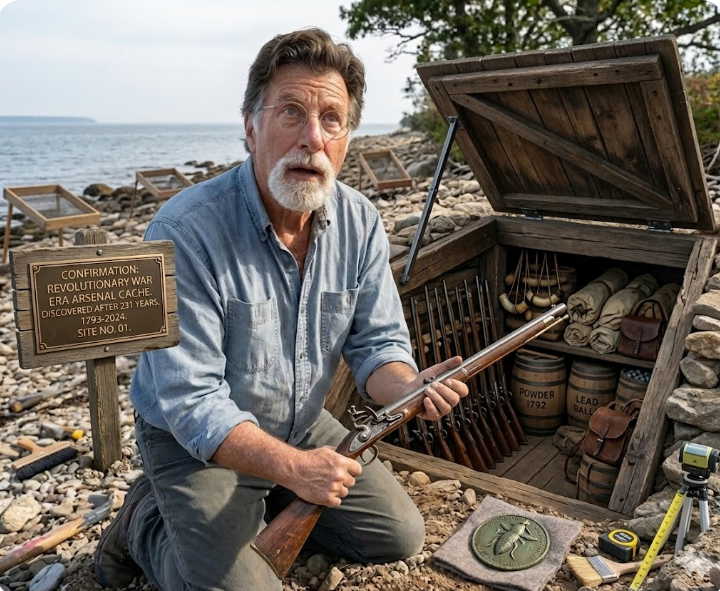
After 231 years of relentless searching, failed engineering attempts, and countless dismissed theories, the mystery of Oak Island has finally been solved. Emma Culligan, a renowned research historian and archival specialist, has released groundbreaking evidence confirming the existence and successful recovery of a historical vault located nearly 100 feet beneath the island’s surface. This revelation shifts the narrative of Oak Island from a long-standing treasure hunt for pirates’ gold to a critical historical discovery tied to the American Revolutionary War.
A New Chapter in Oak Island’s History
For centuries, Oak Island has been the focal point of countless treasure hunts. The island, located off the coast of Nova Scotia, Canada, became famous for its “Money Pit,” a mysterious site that, according to legend, contained vast riches. For over two centuries, explorers, archaeologists, and thrill-seekers have risked their fortunes—and their lives—searching for gold, manuscripts, and other hidden treasures. Yet, despite the many efforts, the true nature of the pit remained elusive.
That is, until now. Culligan’s research has fundamentally transformed the narrative of Oak Island’s mystery. Rather than pointing to pirate treasure or lost Shakespearean manuscripts, Culligan’s extensive archival work has revealed the site as a key element of a military operation from the late 1770s. According to Culligan’s findings, Oak Island was used as a “contingency deposit” by the British military during the American Revolutionary War, providing a secure location to stash valuable assets vulnerable to American capture.
The Breakthrough: Bypassing the “Unbeatable” Flood Tunnel System
For over two centuries, the primary obstacle that prevented access to Oak Island’s “Money Pit” was the highly sophisticated system of flood tunnels that submerged any shaft deeper than 90 feet. These hydraulic booby traps were designed to thwart any attempt to reach the treasure. Many explorers over the years tried to dig down, but each effort resulted in flooding that stopped them in their tracks. This challenge, once thought unbeatable, has now been overcome with the help of modern technology.
Culligan’s team achieved the breakthrough not by digging down, but by approaching the site from the side. Using high-tech directional drilling, a technique typically used in the oil and gas industry, the team was able to bypass the flood tunnel system. This horizontal entry allowed the team to access the human-made chamber at a depth of approximately 104 feet—marking the first stable entry into the Money Pit after more than two centuries of failed attempts.

Evidence of the British Treasury
The discovery inside the vault was nothing short of extraordinary. Culligan’s research team uncovered gold coins and bullion, which have been verified as consistent with British Treasury reserves from the 18th century. Preliminary analysis suggests that the gold had previously circulated through Caribbean trade routes before being consolidated for military use in North America. This finding provides concrete evidence that the vault’s contents were not the result of a pirate plunder, as previously speculated, but instead were part of a deliberate, well-organized effort by the British military to safeguard valuable assets during a time of war.
“The engineering is the real clue,” Culligan stated in her report. “A pirate crew doesn’t construct a flood-trap system this sophisticated on a remote island. This required the resources of 18th-century military or civil engineers.”
The revelation is a significant historical breakthrough, as it changes the perception of Oak Island’s role in North American history. The vault is not merely a treasure trove but a military contingency plan designed to secure vital resources from the threat of American forces during the Revolutionary War. This new understanding of the site provides vital insight into the strategic thinking of the British military during that period and its efforts to protect valuable assets in a time of war.
Vindication for Generations of Searchers
The confirmation of the vault’s existence has sent shockwaves through the global Oak Island community. For the families of the six men who tragically lost their lives in the search for the treasure, and for the countless explorers who spent fortunes chasing myths, Culligan’s findings offer bittersweet vindication.
“The people who gave everything to this search were right,” Culligan acknowledged in a statement. “They weren’t deluded; they simply lacked the technology to defeat a defense system that worked perfectly for 227 years.”
While the discovery provides closure to the longstanding mystery of Oak Island, it also brings a sense of bittersweet justice to those who dedicated their lives to the search. For years, many were ridiculed for their belief in the island’s treasure, and now, those same individuals can rest knowing that they were not chasing an illusion.
A Global Re-Evaluation of Oak Island
Culligan’s meticulous research has forced a major re-evaluation of Oak Island in both academic and media circles. For years, mainstream academics dismissed the island’s story as little more than a myth or a geological sinkhole. But the rigor of Culligan’s research, which tracked previously unstudied British Admiralty records and private letters from Halifax and London, has given the story undeniable credibility. The British military’s records, including direct references to a “secure deposit” in 1778, have now been recognized as central to understanding the true history of Oak Island.
Government officials in Nova Scotia have released cautious statements acknowledging the discovery’s historical importance, confirming that further archaeological review is underway. While excitement grows, officials are careful not to rush the process, ensuring that the site is preserved and studied with the care it deserves.

What’s Next for Oak Island?
As Culligan’s research shifts to other potential Revolutionary War deposit sites, Oak Island enters a new era. The transition from a treasure hunter’s dream to a documented historical site marks the end of one of history’s longest-running mysteries. Oak Island is now recognized not just as a site of myth but as a strategic location with undeniable historical significance.
With the vault now confirmed and its contents being carefully analyzed, it remains to be seen what other treasures or historical artifacts may still be hidden beneath Oak Island’s surface. As research and excavation continue, the story of Oak Island is far from over. What was once thought to be a treasure hunt for pirates’ gold is now a crucial part of understanding the military strategies of the American Revolutionary War.
Conclusion
The mystery of Oak Island has been irrevocably changed. What was once a fruitless treasure hunt has transformed into one of the most significant archaeological and historical discoveries of the 21st century. Emma Culligan’s research has confirmed the existence of a Revolutionary War-era vault on Oak Island, and with it, a new understanding of the island’s role in North American history. The saga of Oak Island is no longer just about lost treasure but about uncovering the layers of history buried beneath its surface.