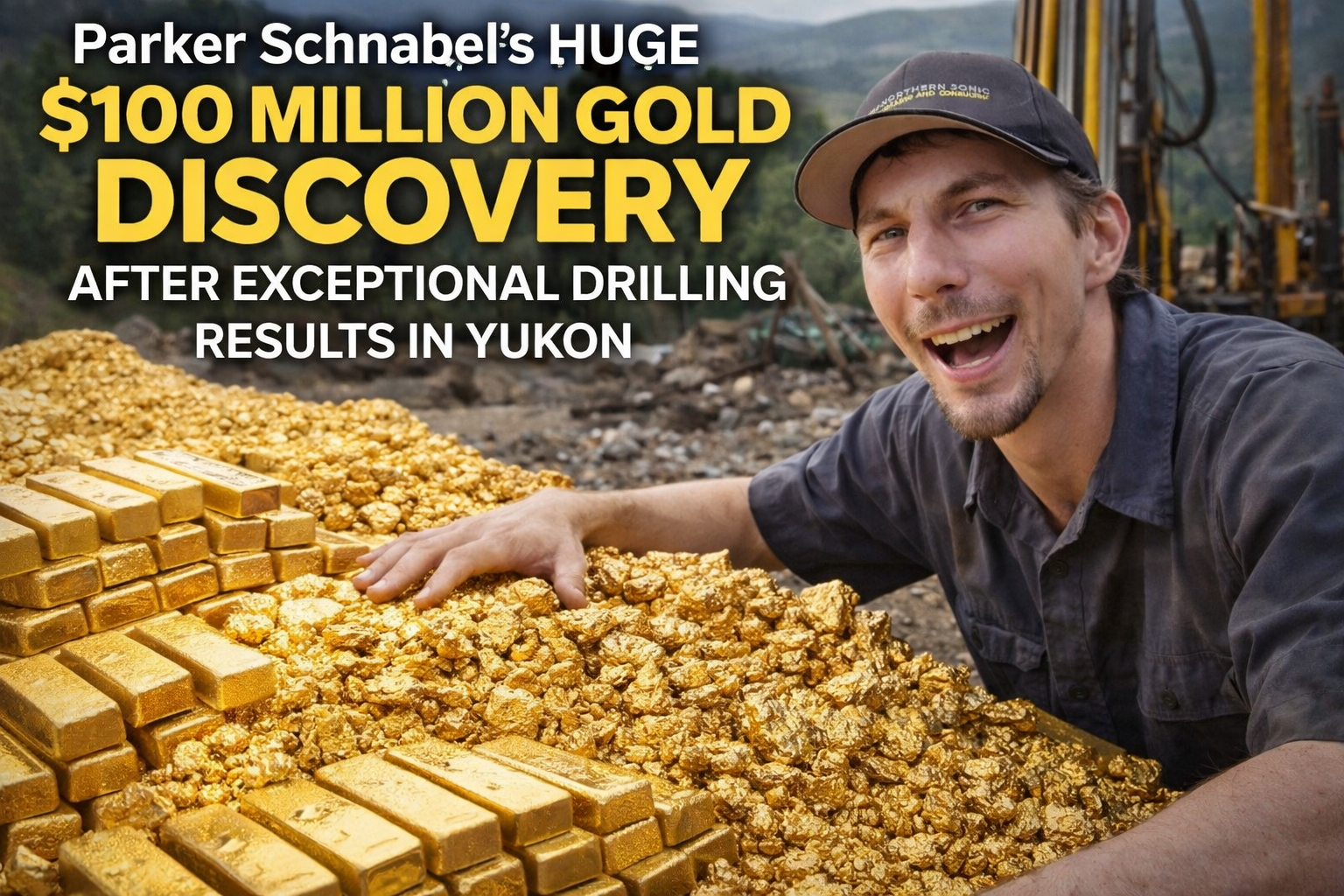
A pivotal turning point in the Gold Rush era: Parker Schnabel discovers historic gold mine, reshaping the future of the Gold Rush.

The mining world is rarely shaken by single discoveries anymore. Modern operations are dominated by data, heavy machinery, and incremental gains rather than sudden breakthroughs. Yet the reported discovery of a historic gold mine by Parker Schnabel has disrupted that expectation entirely.
From an analyst’s perspective, this event—if fully validated and commercially viable—does not simply represent a successful season for a television miner. It signals a structural shift in how gold exploration, investment flows, and small-scale mining operations may evolve over the next decade.
The phrase “historic gold mine” is doing heavy conceptual lifting here. In industry terms, it implies a deposit that is not only high-grade but geologically significant enough to reshape regional extraction models. For Schnabel, whose career has been defined by aggressive ground turnover and calculated risk-taking, this would represent the most consequential discovery of his mining life.
PARKER SCHNABEL’S POSITION IN MODERN MINING ECONOMICS
To understand the magnitude of this development, one must first understand Parker Schnabel’s unique position in the mining ecosystem.
Unlike major corporate miners such as Barrick Gold or Newmont, Schnabel operates in a hybrid space between independent placer mining and industrial-scale production. His operations function as a real-time case study in high-risk, high-efficiency extraction economics.

Historically, Schnabel has excelled in:
- Rapid ground evaluation and rotation
- Aggressive overburden removal strategies
- High-throughput wash plant optimization
- Crew efficiency under seasonal pressure
A discovery of a “historic mine” implies a step-change beyond these parameters. It suggests not just profitable ground—but legacy-grade geological concentration zones that may have been overlooked or underutilized for decades, possibly centuries.
In industry terms, this moves Schnabel from operator to potential “district influencer,” a role typically reserved for major mining corporations.
THE RIPPLE EFFECT ON GLOBAL GOLD MARKETS
Gold markets are notoriously sensitive to perception rather than immediate supply shifts. A discovery of this magnitude would not instantly flood global supply chains—but it would influence capital behavior almost immediately.
Analysts would expect three immediate ripple effects:
- Exploration capital inflow
Venture-backed mining exploration funds would likely increase stakes in underdeveloped regions similar to those operated by Schnabel. - Equipment demand surge
High-capacity wash plants, excavators, and transport fleets would see increased demand as mid-tier miners attempt to replicate his success model. - Speculative land rush
Historical mining districts would be reassessed, especially areas previously considered “worked out.”
If Schnabel’s mine proves sustainable, it may trigger what analysts describe as a “second gold mapping era”—a renewed geological reassessment of legacy mining zones.
OPERATIONAL CHALLENGES BEHIND THE HEADLINES
While headlines tend to focus on discovery, the reality of mining is defined by extraction continuity.
Even a historic deposit presents serious operational constraints:
- Water management and ground stability risks
- Seasonal weather limitations in northern regions
- Equipment breakdown under high-output conditions
- Labor retention under extended operational pressure
From a Gold Rush analytical standpoint, Schnabel’s biggest challenge will not be discovery—it will be scalability. Many historically rich deposits fail commercially because extraction costs outpace yield consistency once initial “bonanza zones” are depleted.
The transition from discovery to sustainable production is where mining empires are either built—or broken.
WHAT THIS MEANS FOR THE GOLD RUSH MODEL
Televised mining operations have always walked a fine line between entertainment and industrial realism. Schnabel’s discovery pushes that boundary further.
If the mine proves economically transformative, it will reinforce a key narrative shift:
Gold mining is no longer just about scraping remaining placer deposits—it is about reinterpreting historical geology using modern technology.
This would mark a conceptual evolution in the “Gold Rush model”:
- From seasonal mining → multi-year district development
- From crew-based output → infrastructure-based scaling
- From individual operators → semi-industrial hybrid enterprises
In effect, Schnabel’s operation could become a blueprint for a new generation of independent mining ventures operating at near-corporate scale.
INDUSTRY REACTION: CAUTIOUS OPTIMISM
Within mining circles, reactions to such discoveries are typically tempered. Experienced operators understand that early-stage gold excitement often overestimates long-term yield stability.
However, Schnabel’s track record adds credibility to the development. He has repeatedly demonstrated the ability to identify productive ground under high-pressure conditions, often outperforming expectations set by geological surveys.
Still, senior analysts emphasize caution: until multi-season data confirms consistent output, the term “historic mine” remains speculative rather than proven economic classification.

FUTURE SCENARIOS: THREE POSSIBLE PATHWAYS
From an analytical forecasting standpoint, three primary outcomes emerge:
1. CONSOLIDATION SCENARIO
The mine produces strong early returns but stabilizes at moderate yield levels. Schnabel integrates the site into a broader multi-location strategy.
2. EXPANSION SCENARIO
The deposit proves extensive and high-grade, transforming Schnabel into a major regional mining operator with long-term infrastructure investment.
3. PEAK-AND-DECLINE SCENARIO
Initial production is exceptional but rapidly declines as the richest zones are depleted, forcing a strategic retreat or relocation.
Each scenario carries different implications not only for Schnabel, but for investor sentiment across the small-to-mid mining sector.
CONCLUSION: THE BEGINNING OF A NEW GOLD ERA?
Whether this discovery ultimately proves transformative or transitional, its symbolic weight is already significant.
Parker Schnabel represents a new archetype in modern mining—data-driven, risk-tolerant, and operationally adaptive. If his historic mine lives up to its early promise, it may redefine what independent mining success looks like in the 21st century.
For now, the industry watches closely.
Because in gold mining, history is not just something you discover.
It is something you extract.