A decayed mast and traces of ancient ships were discovered during excavations at Oak Island Swamp.
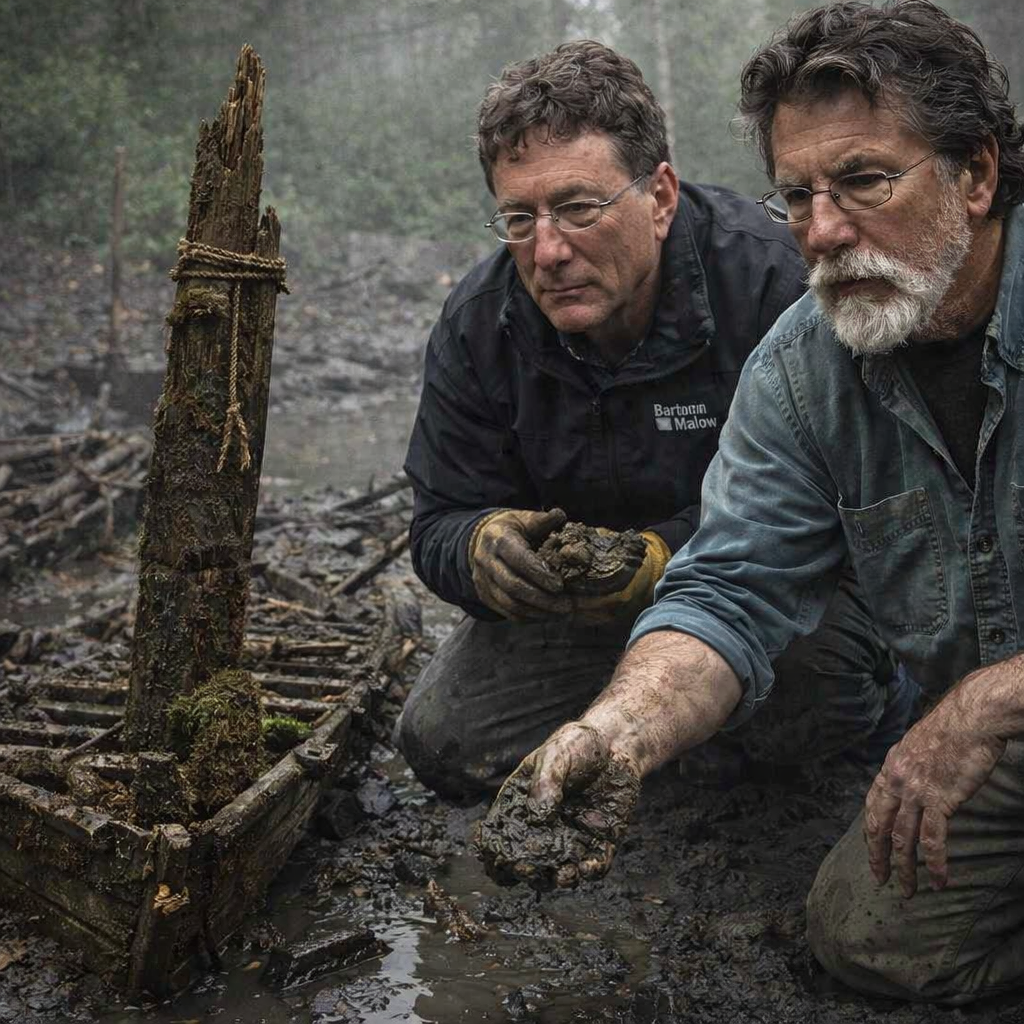
A major excavation effort in the southeast corner of the Oak Island swamp has produced a concentrated series of historically significant finds, including iron spikes, fasteners, chain segments, and ship-related hardware. The discoveries, recovered near the suspected stone road feature, are now being interpreted as possible evidence of a constructed maritime loading zone buried beneath centuries of sediment.
From an analytical standpoint, the clustering of artifacts suggests more than random deposition. Instead, it points toward a structured operational environment—possibly a wharf, dock system, or engineered transport corridor.
A FOCUSED DIG YIELDS HIGH-DENSITY ARTIFACT FINDS
The excavation team, led by Rick Lagina, Gary Drayton, Billy Gerhardt, and Alex Lagina, resumed targeted digging in a region long considered one of the most promising areas of the swamp. Early morning operations quickly escalated into a significant archaeological recovery effort.
Within a short period, the team uncovered multiple iron chains, embedded fasteners, and wood-locked metal components. One particularly notable find included a heavily corroded iron spike still lodged within timber fragments.
Gary Drayton described the material as “definitely not factory-made,” noting its crude construction and heavy oxidation consistent with pre-industrial manufacturing techniques.


The artifact density has led investigators to describe the site as “a shipload of finds,” reinforcing the theory that this location may have functioned as a loading or unloading zone.
IRON CHAIN SEGMENTS AND STRUCTURAL HARDWARE
Among the most compelling discoveries were interconnected iron chain fragments recovered from within the swamp’s southeastern excavation zone. The team noted that the chain pieces appeared structurally linked rather than randomly scattered.
Analysis suggests that different sizes of chain components may have served distinct functions:
- Larger chain links potentially used for anchoring
- Smaller segments possibly used for cargo handling or rigging
- Corroded hardware consistent with maritime environments
Rick Lagina observed that such materials would logically be required if the area had been used for loading heavy cargo from vessels.
The presence of multiple interconnected elements strengthens the interpretation that this was not a natural deposition site but rather a working industrial or maritime surface.
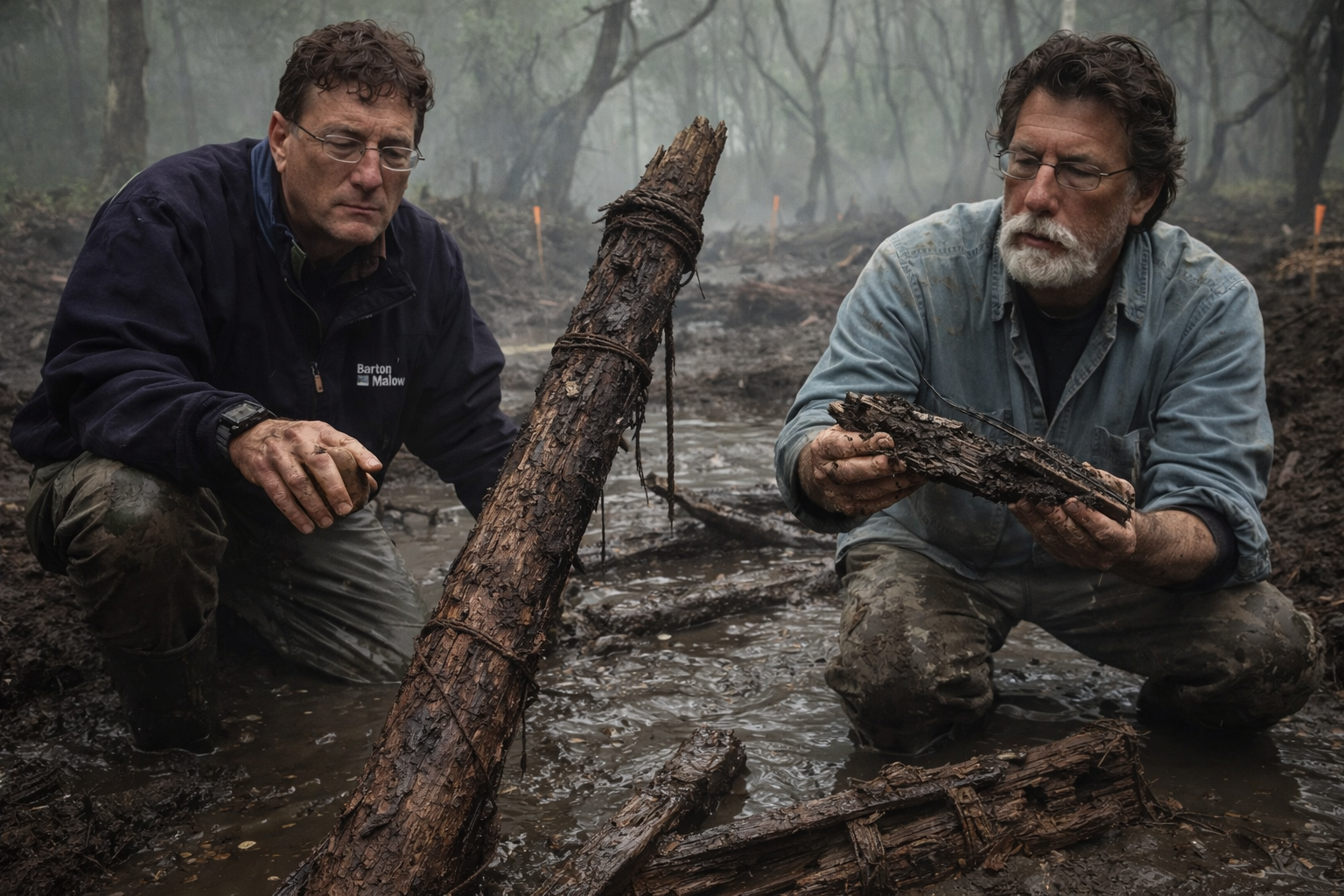
THE DISCOVERY OF A BURIED IRON SPIKE IN WOOD
One of the most significant breakthroughs came with the recovery of an iron spike embedded within wooden remains. Metal detection confirmed multiple signals beneath the surface before excavation revealed the artifact in situ.
The spike, heavily oxidized and partially preserved within timber, has been identified as potentially dating back to the 1700s or earlier. Experts suggest it may be a ship’s structural fastener or wharf pin, used in maritime construction.
Gary Drayton noted the distinctive bevel and shape of the spike head, suggesting it may be consistent with early shipbuilding techniques.
The combination of iron and wood in such a preserved state has raised the possibility that a larger structural element remains buried beneath the excavation zone.
EXPERT ANALYSIS: POSSIBLE MARITIME CONSTRUCTION ROLE
Blacksmithing expert Carmen Legge was brought in to evaluate several recovered artifacts, including fasteners and structural iron components. His assessment provided critical insight into the possible function of the materials.
Legge suggested that certain embedded nails and iron fixtures may have been used in conjunction with wooden frameworks designed for heavy lifting or illumination in confined spaces.
More significantly, he identified one large iron piece not as a simple spike, but as a potential structural tool used in timber construction—possibly ship-related.
He estimated that the artifacts likely date between the mid-16th century and late 18th century, placing them firmly within a historical maritime construction period.
THE DAM THEORY AND FREDD NOLAN’S ORIGINAL HYPOTHESIS
The discoveries have revived interest in earlier theories proposed by legendary investigator Fred Nolan, who suggested decades ago that the swamp may have been artificially created through damming or controlled flooding.
According to Nolan’s theory, the swamp was not a natural formation but a deliberately engineered feature designed to conceal or protect underlying structures.
The newly recovered iron hardware and structural artifacts appear to align with this interpretation, particularly given their concentration near suspected engineered terrain features.
The possibility that the swamp itself was constructed or modified to support maritime operations is now being reconsidered with renewed seriousness.
STRUCTURAL PATTERN EMERGING FROM THE SEABED
From a broader analytical perspective, the southeast swamp excavation is beginning to reveal a consistent pattern:
- Embedded iron fasteners within timber
- Chain systems consistent with cargo handling
- Possible ship-related structural components
- Proximity to suspected stone road alignment
- Historical dating consistent with early maritime activity
This clustering strongly suggests a functional zone rather than random artifact dispersion.
If confirmed, the site may represent one of the most intact examples of early engineered maritime infrastructure yet discovered in North America.
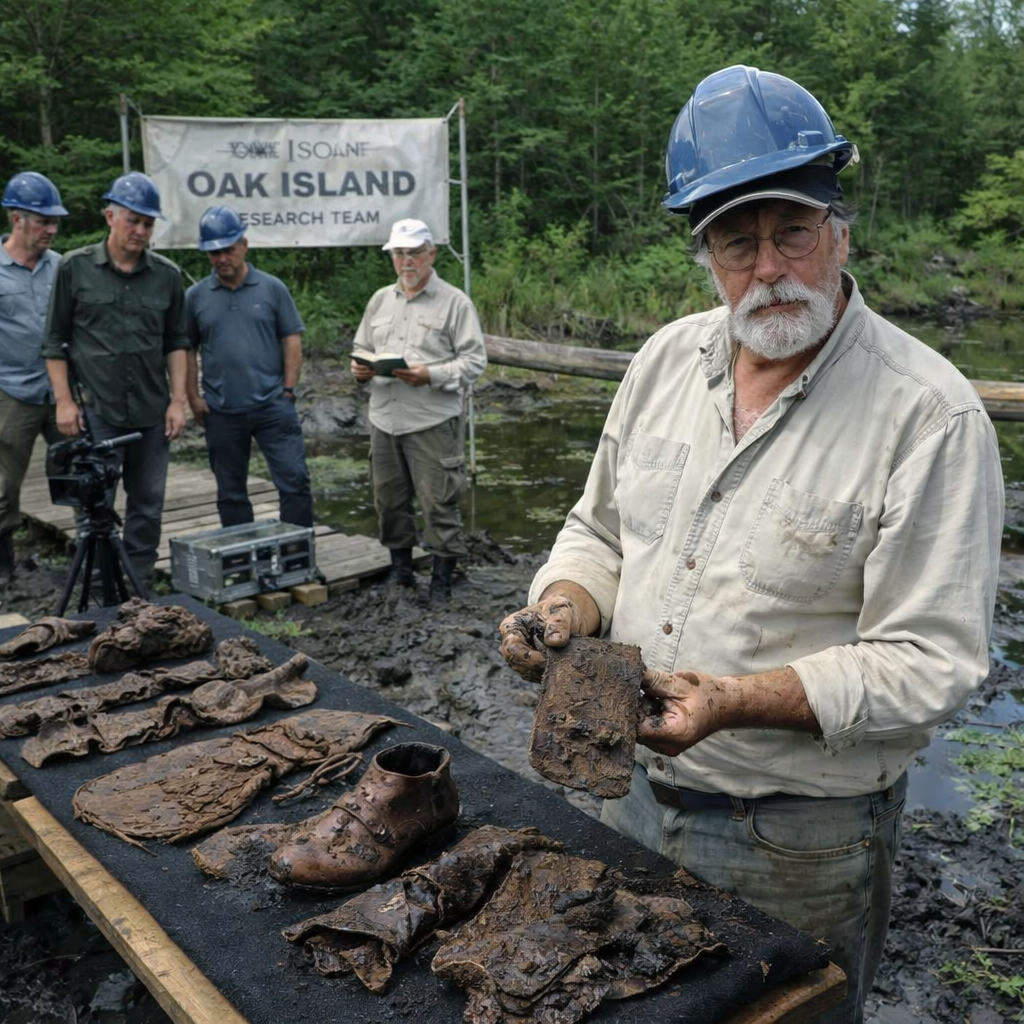
ANALYST INTERPRETATION: WHARF, SHIP, OR ENGINEERED COMPLEX?
Three primary interpretations are now under consideration:
1. SHIPWRECK-ASSOCIATED DEPOSIT THEORY
Artifacts may originate from a vessel that broke apart and settled in the swamp.
2. CONSTRUCTED WHARF SYSTEM THEORY
The site may have functioned as a deliberate loading dock for cargo transfer operations.
3. ENGINEERED SWAMP COMPLEX THEORY
The swamp itself may have been modified to conceal or facilitate structured maritime activity.
Each theory carries significant implications for understanding Oak Island’s historical use.
CONCLUSION: A SWAMP REVEALING INDUSTRIAL INTENT
The southeast corner of the Oak Island swamp continues to produce findings that increasingly point toward deliberate human construction and maritime activity. The combination of iron hardware, embedded structural wood, and chain systems suggests a highly organized operational environment rather than natural deposition.
While final conclusions remain pending laboratory analysis, the excavation team is now facing a compelling possibility: that the swamp was not merely a geographical feature, but a carefully engineered system designed for transport, concealment, or maritime logistics.
As Rick Lagina and his team continue to expand excavation efforts, one question becomes increasingly difficult to ignore:
Was this swamp ever truly natural—or is it the surviving footprint of a long-hidden industrial harbor system buried in time?