PARKER SCHNABEL’S TEAM DISCOVERS ANCIENT GOLD CASH CACHE IN KLONDIKE — A GAME-CHANGING FIND THAT COULD REDRAW THE MAP OF MODERN MINING
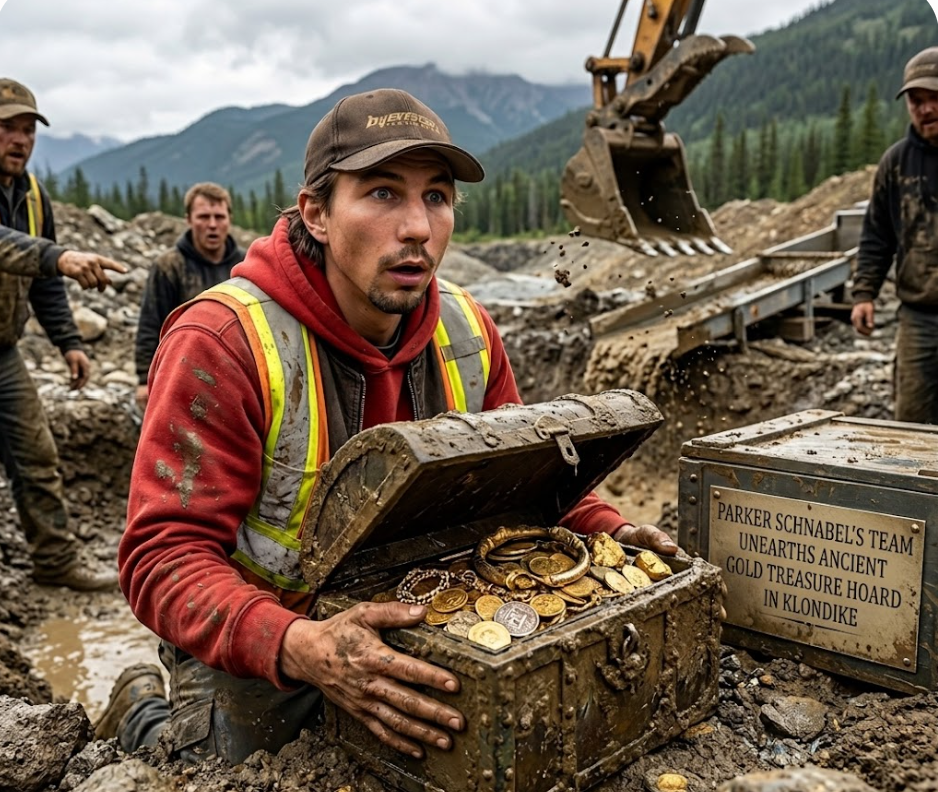
A newly reported discovery by Parker Schnabel’s crew in the Klondike has sent ripples through the Gold Rush mining community: the unearthing of what is being described as an “ancient gold cash cache,” a buried concentration of gold deposits or stored material believed to predate modern placer operations in the region. While details remain limited, the implications of such a find—if verified—could fundamentally alter both the operational trajectory of Schnabel’s season and broader geological assumptions about historic gold movement in the Yukon.
From an analytical standpoint, this development sits at the intersection of two long-standing themes in Gold Rush: the unpredictability of Klondike ground composition, and the recurring possibility that modern miners are reworking terrain previously influenced by earlier, undocumented extraction or deposition activity.
A DISCOVERY THAT CHALLENGES THE STANDARD MODEL
Parker Schnabel’s mining strategy has traditionally been grounded in precision sampling, aggressive ground stripping, and rapid scaling once pay dirt consistency is confirmed. However, the emergence of a concentrated “cash cache” structure suggests a departure from typical alluvial gold dispersion patterns.
In conventional placer mining theory, gold is distributed gradually through erosion and water movement, forming streaks or pay channels rather than compact clusters. A dense accumulation resembling a cache implies either an unusual geological trapping mechanism or historical human intervention.
Analysts familiar with Klondike geology have noted that while natural gold concentration zones do exist, they rarely present as discrete, cache-like formations unless constrained by bedrock traps, ancient river bends, or glacial deposition anomalies. The possibility that this deposit represents a sealed or semi-contained gold pocket raises immediate questions about its origin and stability.
STRATEGIC IMPLICATIONS FOR SCHNABEL’S OPERATION
For Parker Schnabel, whose mining model relies heavily on throughput efficiency and rapid ground validation, a discovery of this nature introduces both opportunity and operational complexity.
On one hand, a concentrated deposit could significantly reduce stripping ratios and increase yield per cubic yard processed. If the cache is continuous rather than isolated, it may represent a high-grade zone capable of dramatically improving seasonal output metrics.
On the other hand, such formations often require careful extraction strategies. Over-aggressive mining could fracture or disperse the deposit, reducing overall recovery efficiency. This would force Schnabel’s team to balance speed against precision—a tension that has defined many of his past high-output seasons.
Internally, crews may also need to reassess sequencing at the cut. Equipment allocation, wash plant calibration, and haulage logistics could all be adjusted to prioritize controlled extraction over bulk movement.

GEOLOGICAL QUESTIONS AND HISTORICAL IMPLICATIONS
The term “ancient gold cash cache” has sparked debate among field observers. While not a formal geological classification, it is being used to describe a tightly concentrated gold accumulation that appears structurally distinct from surrounding material.
There are three leading interpretations under consideration:
First, the natural trap hypothesis, which suggests that bedrock formations created a natural basin where gold particles accumulated over thousands of years without dispersal.
Second, the reworked channel theory, which proposes that the cache is a remnant of an older river system that once carried high-density gold loads before shifting course and burying the deposit under later sediment layers.
Third, a more speculative but increasingly discussed historical disturbance model, which considers whether earlier, undocumented mining activity in the Klondike may have concentrated or displaced gold into engineered or semi-controlled deposits.
While the latter theory remains unverified, it has gained traction in online mining forums due to recurring reports of unusually compact gold pockets in nearby claims over recent seasons.
OPERATIONAL RISKS AND LOGISTICAL PRESSURE
Despite the excitement surrounding the find, mining analysts caution that such discoveries often introduce new risks. Concentrated gold zones can be structurally unstable, especially if located near frozen ground transitions or waterlogged sediment layers.
If the cache is shallow or unevenly distributed, excavation could lead to slumping or dilution of material. Additionally, unexpected variability in gold particle size or purity could complicate recovery rates at the wash plant stage.
For Schnabel’s operation, already known for high-pressure production schedules, any slowdown in processing could create downstream bottlenecks. Equipment downtime, if required for recalibration or controlled digging, would further compress the already narrow seasonal mining window.
PREDICTED NEXT PHASE OF THE SEASON
Based on established patterns in Gold Rush operations, three likely scenarios emerge:
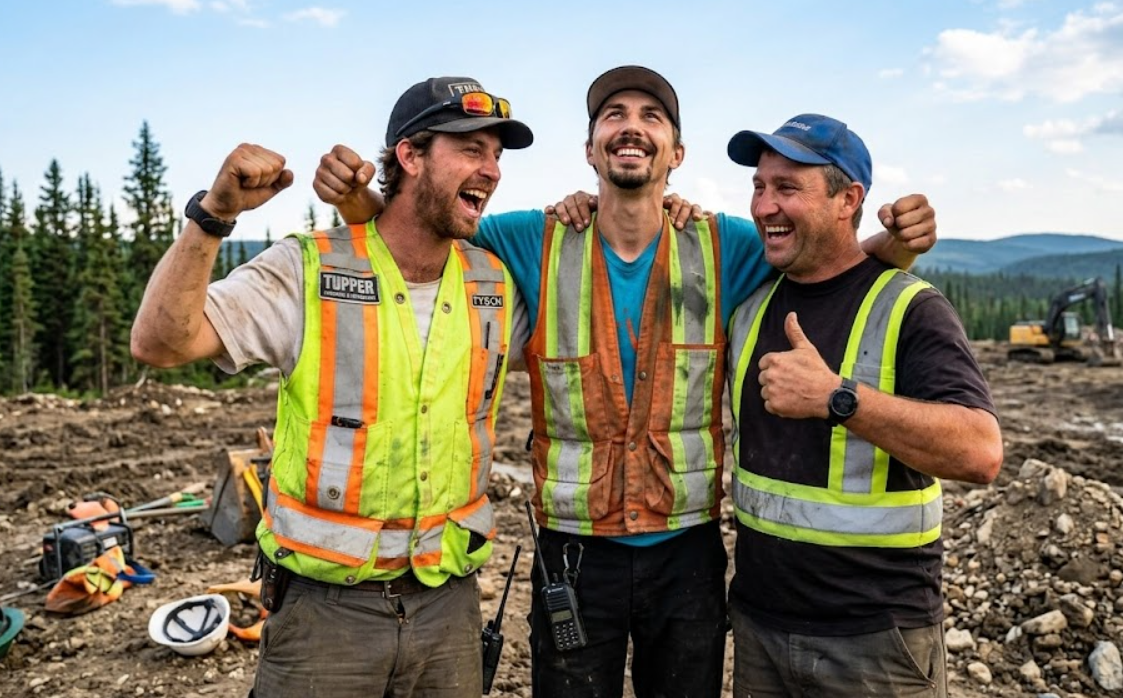
The first is rapid validation and expansion, where the cache proves consistent and the team accelerates extraction, potentially turning it into a cornerstone of the season’s gold total.
The second is selective mining strategy, where Parker’s crew isolates high-grade sections while avoiding lower-yield surrounding ground, prioritizing efficiency over volume.
The third, and most cautious, is controlled excavation with re-evaluation, where the team slows operations significantly to fully map the extent and structure of the deposit before committing to full-scale production.
Historically, Schnabel has shown a willingness to adapt quickly when confronted with unexpected ground behavior, often favoring data-driven decisions over initial optimism. That approach will likely define how this discovery is handled in the coming weeks.
CONCLUSION: A POTENTIAL TURNING POINT IN THE KLONDIKE SEASON
Whether this “ancient gold cash cache” proves to be a geological anomaly or a sustained high-grade zone, its discovery marks a pivotal moment in Parker Schnabel’s current campaign. In a mining environment where margins are measured in ounces per yard and timing determines profitability, any shift in ground quality can redefine an entire season’s trajectory.
For now, the Klondike once again reinforces its reputation as one of the most unpredictable mining regions in the world—where even experienced operators like Schnabel can suddenly find themselves standing on ground that refuses to behave according to expectation.
As analysis continues and excavation progresses, one question remains at the center of attention: is this a lucky break in the earth—or the beginning of something far more significant buried beneath the Yukon?