Miriam Amirault’s remarkable discovery is a massive 110-foot-tall stone statue at Smith’s Cove.
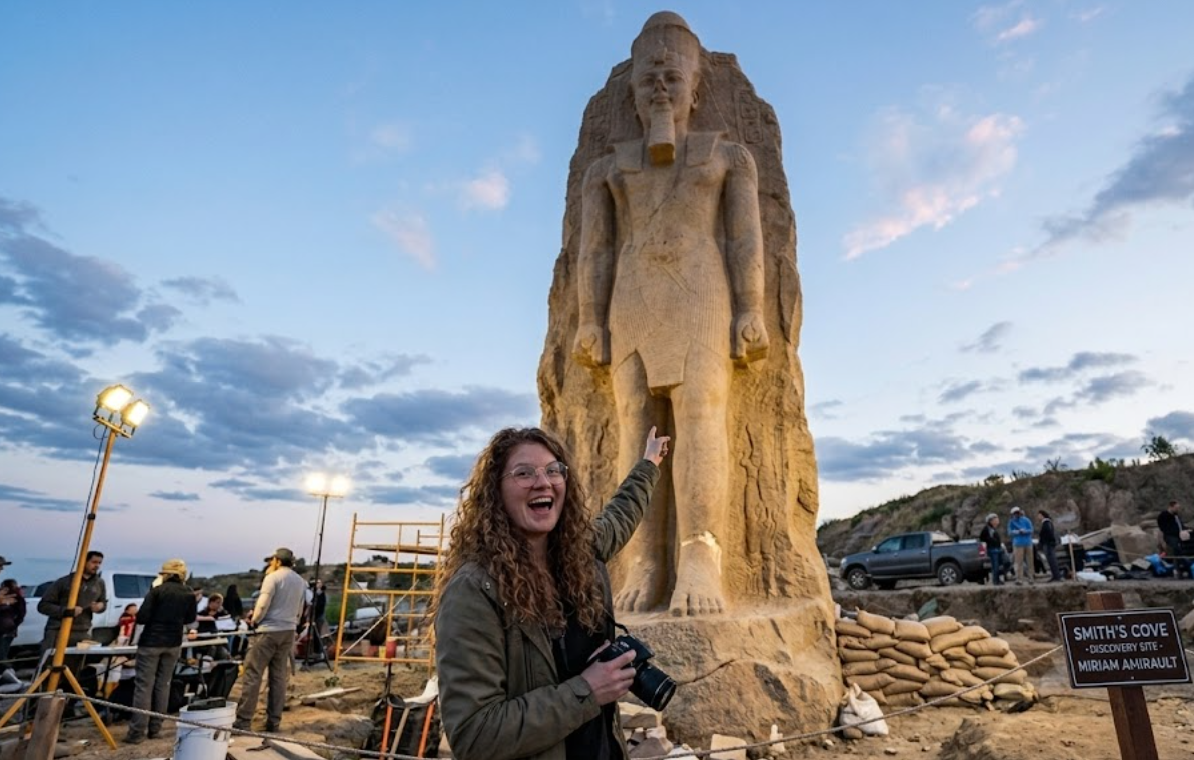
A stunning new narrative emerging from The Curse of Oak Island analytical community suggests that Miriam Amirault may have uncovered one of the most extraordinary alleged findings in the island’s long investigative history: a massive 110-foot-tall stone statue located beneath Smith’s Cove. If validated, the claim would represent a seismic shift in how researchers interpret the island’s underground landscape, potentially reframing it as a deliberately constructed symbolic environment rather than a purely functional treasure site.
According to the circulating theory, the discovery is not being treated as a typical artifact or isolated anomaly, but as a monumental engineered structure embedded within the deeper geological framework of Smith’s Cove.
A Monument Hidden Beneath the Surface
At the center of the discussion is the alleged presence of a colossal stone formation resembling a human or symbolic statue, extending approximately 110 feet in height beneath layered sediment and coastal deposits. Unlike previously reported findings on Oak Island—such as wooden structures, tunnels, or flood systems—this supposed discovery introduces an entirely different category of interpretation: monumental construction.
Analysts examining the narrative suggest that if such a structure exists, it would require an unprecedented level of engineering capability and long-term planning. A stone formation of this scale could not plausibly be the result of natural geological processes alone, reinforcing the theory that Smith’s Cove may contain intentional human-made architecture dating far further back than previously assumed.
Smith’s Cove Reframed as a Constructed Landscape
Traditionally, Smith’s Cove has been interpreted as part of Oak Island’s flood tunnel system, designed to protect or obscure deeper excavation targets. However, the emergence of the statue hypothesis challenges this long-standing assumption.
Instead of functioning solely as a defensive water-control system, the area may represent a structured ceremonial or symbolic zone integrated into a broader underground network. The alleged statue, in this interpretation, could serve as a central marker or anchor point within that system.
This perspective aligns with broader theories suggesting Oak Island is not a random accumulation of buried objects, but a carefully designed landscape incorporating both engineering and symbolic intent.

Scale and Engineering Implications
If the reported dimensions are accurate, the implications are significant. A 110-foot vertical structure beneath coastal terrain would require advanced planning, material control, and excavation capability far beyond conventional historical expectations for the region.
Such a structure would also raise critical questions about construction purpose. Analysts propose several possibilities within the narrative framework:
- A symbolic marker representing authority, identity, or ritual significance
- A structural anchor tied to deeper underground chambers
- A directional monument integrated into a larger navigational or coded system
Each interpretation shifts Oak Island further away from a simple treasure burial site and closer toward a deliberately engineered cultural or strategic environment.
Connection to Broader Oak Island Patterns
One of the most compelling aspects of the theory is its potential alignment with other reported anomalies across Oak Island. Over the course of multiple seasons, investigators have identified geometric stone alignments, flood tunnels, and deep shaft systems that appear unusually coordinated.
If the statue hypothesis is placed within this broader context, it may represent a central “keystone” structure linking multiple underground features into a unified design. This would support the idea that Oak Island is not a series of disconnected discoveries, but a single interconnected system built with layered intent.
Miriam Amirault’s Role in the Narrative
Within the circulating storyline, Miriam Amirault is positioned as the figure associated with identifying or interpreting the significance of the structure. While the nature of her involvement varies across versions of the narrative, her role consistently centers on recognizing the importance of what others may have overlooked.
In analytical discussions, this reflects a broader theme common in Oak Island interpretations: that breakthroughs often emerge not from new excavation alone, but from re-evaluating existing evidence through alternative frameworks.
From Treasure Site to Symbolic Structure
Perhaps the most transformative implication of the theory is the shift in how Oak Island itself is conceptualized. Rather than a hidden vault containing material wealth, the island may instead represent a constructed symbolic landscape—one in which structures like the alleged statue serve communicative, ceremonial, or navigational purposes.
In this model, the value of the site is not defined solely by physical treasure, but by encoded meaning embedded in its architecture. The statue, if real, could therefore function as a message, a marker, or even a gateway within a larger system of underground design.

Skepticism and Interpretive Limitations
Despite the intensity of speculation, it is important to note that the current theory remains unverified and exists primarily within narrative and interpretive frameworks. No independently confirmed archaeological evidence has been presented to substantiate the existence of a 110-foot stone statue beneath Smith’s Cove.
As with many Oak Island theories, the challenge lies in distinguishing between geological interpretation, historical possibility, and narrative amplification generated by ongoing interest in the mystery.
Conclusion: A Theory That Rewrites the Scale of the Mystery
The idea of a massive underground stone statue beneath Smith’s Cove represents one of the most ambitious reinterpretations of Oak Island to date. If even partially accurate, it would dramatically expand the perceived scale and complexity of the island’s underground features.
Rather than a localized search for buried treasure, Oak Island would increasingly resemble a vast engineered or symbolic system—one that integrates structure, geography, and possibly coded meaning into a single unified design.
For now, the statue remains a theory. But in the evolving world of Oak Island analysis, even theories of this magnitude continue to reshape how investigators—and audiences—understand the island’s enduring mystery.