A Night That Signals the Future: What Diddly Squat’s New Year Celebration Tells Us About Clarkson’s Farm
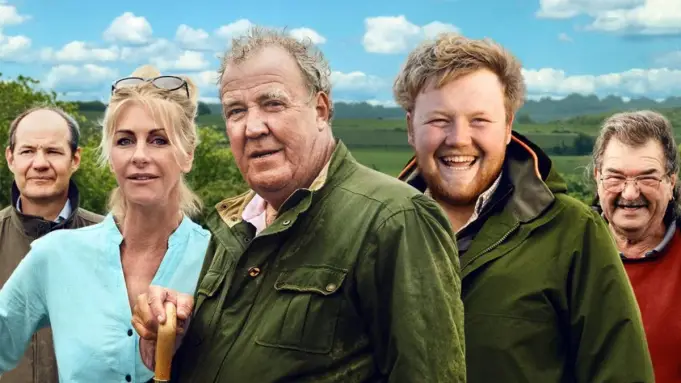
From an analyst’s perspective, the New Year’s Eve celebration at Diddly Squat Farm was far more than a festive gathering. It was a carefully timed public moment that revealed where Clarkson’s Farm is heading next—and how the show is repositioning itself after a turbulent year marked by health concerns, production delays, and mounting pressure on its central figure, Jeremy Clarkson.
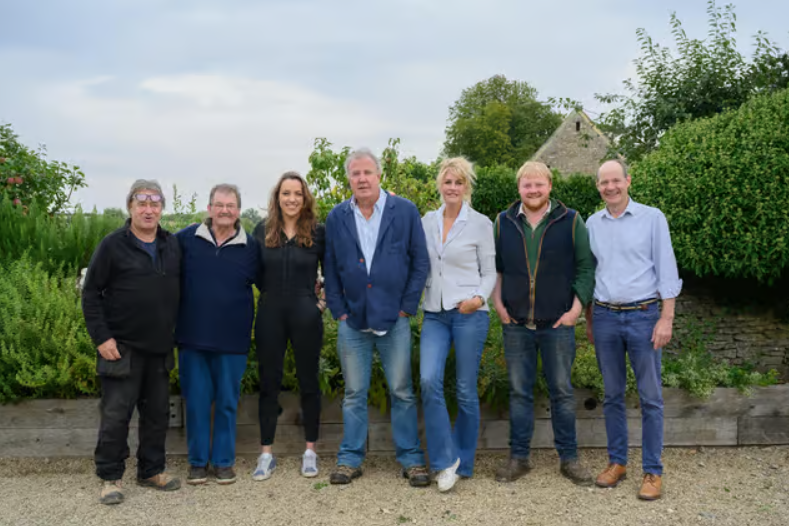
The event, hosted in the winterized “Big Barn” beside the famous farm shop, brought together the full on-screen team for the first time since Clarkson’s recent health scare. For viewers and industry observers alike, that alone made the evening significant. But beyond the fireworks and Hawkstone lager, the night functioned as a soft reset for the series—one that hints strongly at the tone and structure of Season 5.
A Deliberate Public Reappearance
Jeremy Clarkson’s arrival behind the wheel of his Lamborghini tractor was not accidental symbolism. From a production standpoint, it reinforced two essential messages at once: continuity and defiance. Clarkson was not easing back into public life quietly; he was reclaiming the narrative on his own terms.
For a show built around stubborn resilience, this matters. Clarkson’s recent hospitalization had raised legitimate questions about how much longer he could physically sustain the demands of farming, filming, and constant public scrutiny. By placing him front and center—healthy, joking, and visibly energized—the production sent a clear signal: Clarkson remains the gravitational force of the series.
From an analytical angle, this moment strongly suggests that Season 5 will not shy away from addressing his health, but will instead frame it as part of a broader arc about limits, aging, and adaptation.
Lisa Hogan’s Growing Strategic Role
If Clarkson remains the show’s emotional engine, Lisa Hogan is increasingly its stabilizing force. Her role in organizing the event was not merely logistical; it reflected her expanding influence within the Diddly Squat ecosystem.
By transforming the barn into a curated “Cotswold Chic” venue using farm-produced food and drink, Lisa reinforced a key theme likely to dominate future episodes: diversification done properly. Where earlier seasons often portrayed diversification as chaotic trial-and-error, this event showed a more confident, refined approach—one grounded in brand identity rather than improvisation.
Expect Season 5 to lean more heavily into Lisa’s perspective, particularly as the show balances entertainment with the realities of sustainable rural business.
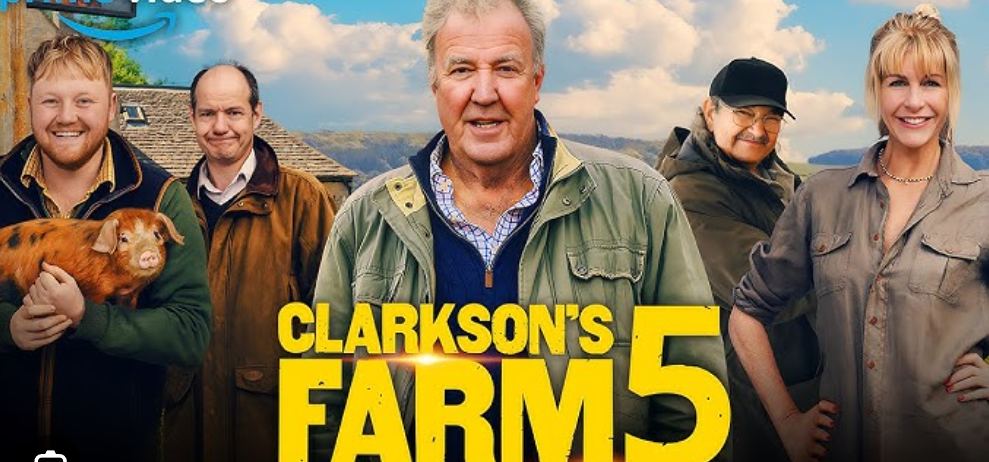
Kaleb Cooper: From Comic Relief to Operational Backbone
Perhaps the clearest narrative shift signaled during the night involved Kaleb Cooper. His mock “Farmer of the Decade” award may have been played for laughs, but analytically, it underscored something important: Kaleb is no longer just the youthful foil to Clarkson’s bluster.
During Clarkson’s absence earlier in the year, Kaleb effectively carried the day-to-day operation of the farm. That experience is likely to translate directly into Season 5, with Kaleb positioned less as a side character and more as a co-lead in the farm’s future.
This shift aligns with broader audience expectations. Viewers have increasingly responded to Kaleb as the embodiment of modern British farming competence—practical, informed, and emotionally invested. The show would be wise to lean into that evolution.
Charlie and Gerald: Continuity and Credibility
The presence of Charlie Ireland and Gerald Cooper reinforced the show’s core strength: contrast.
Charlie’s ever-watchful eye on compliance remains essential as regulatory pressure continues to be a central theme. His interactions at the party—half professional, half personal—suggest that Season 5 will further explore the tension between regulation and rural reality, but with a slightly warmer tone.
Gerald, meanwhile, represents continuity. His heartfelt, barely decipherable toast was more than comic relief; it reminded viewers that Clarkson’s Farm works best when it celebrates tradition rather than mocking it. Expect future episodes to deepen that respect.
Season 5: What the Signals Suggest
The looping of unseen bloopers and confirmation that the party itself will feature in Season 5 offers a strong clue about narrative direction. This was not just a celebration—it was a framing device.
From a production analysis standpoint, Season 5 is likely to emphasize:
-
Recovery and resilience after disruption
-
The farm as a collective effort rather than a one-man crusade
-
A more reflective Clarkson, without losing his edge
-
Business maturity replacing chaotic experimentation
The decision to end the season with a communal moment rather than a crisis is telling. It suggests the producers are consciously steering away from escalation fatigue and toward emotional payoff.
Looking Ahead to 2026
Jeremy Clarkson’s final toast—celebrating failures as much as successes—was perhaps the most revealing moment of the night. It encapsulated the thesis of Clarkson’s Farm: that progress in agriculture is messy, personal, and deeply human.
As an analyst, the conclusion is clear. This New Year’s celebration was not an indulgence; it was a narrative reset. It positioned the cast as a resilient unit, acknowledged the year’s hardships without dwelling on them, and set expectations for a more grounded, character-driven season ahead.
If Season 5 delivers on what this night promised, Clarkson’s Farm is not winding down—it is quietly evolving into its most confident phase yet.