Oak Island Dig Hits a New Nerve as Drilling Strikes an Unexpected Solid Layer.
At 10:47 a.m., the mood on Oak Island shifted from routine to alert.
For hours, drilling had followed a familiar rhythm: steady noise, muddy spoil, the usual mix of wood fragments and saturated soil that has kept treasure hunters returning for more than two centuries. Then the sound changed — a sharper, metallic note that suggested contact with something far more solid than the surrounding ground.
The operator paused. Readings were checked again. On an island where false alarms are a regular feature of the search, the team’s reaction was telling: this did not behave like rock, and it did not behave like ordinary debris.
For the Fellowship of the Dig, featured in The Curse of Oak Island, moments like these are the thin line between another disappointing day and the possibility of a genuine breakthrough. The island has absorbed vast sums of money, years of effort, and multiple failed strategies. The narrative is old and well-known: booby-trap theories, engineered flood systems, collapses, and an underground puzzle that refuses to resolve neatly.
But in Season 13, Episode 16, the team’s focus appears to sharpen around one central idea — that the island’s most persuasive clues may not sit at the famous Money Pit alone, but in the broader network of suspected structures around it.
A Mystery That Refuses to Stay Still
Oak Island’s modern obsession dates back to 1795, when a depression in the ground under a tree triggered digging that would become legend. Early searchers described layered materials appearing at set intervals — including wood and unusual fibres — and later accounts linked the story to a carved stone said to reference treasure at a deeper level.
Over time, the mythology grew: pirates, privateers, secret societies, and religious orders all became candidates. Theories multiplied because physical confirmation remained elusive. Even now, much of Oak Island’s public identity rests on a tension between evidence and imagination: each new find answers one question while raising two more.
The Lagina-led effort has tried to move beyond “guess-and-drill” by leaning on surveying, scanning and targeted excavation. In the latest narrative arc, the team shifts attention to an area framed as overlooked in earlier efforts — ground between lots where new data suggests something structured below.
New Tools, New Targets
The language of the hunt has changed. Instead of relying on old maps and intuition alone, the team is portrayed using techniques such as ground-penetrating radar, magnetometer surveys, and detailed 3D mapping to identify unusual signatures underground.
In the story presented, multiple scanning methods converge on the same implication: a straight, flat surface beneath the soil, suggestive of a human-made feature rather than a natural formation. The team treats that kind of geometry as significant — right angles, consistent lines, and repeated patterns are difficult to explain as random geology, particularly in wet ground where natural layers often appear uneven.
The careful approach described is also deliberate. Instead of aggressive excavation, they work layer by layer, documenting soil changes and recovering material for analysis. The aim is to avoid damaging whatever might be there — a point repeatedly emphasised on the show when a promising feature is considered fragile or historically important.
The Wall-Like Surface and the Question Behind It
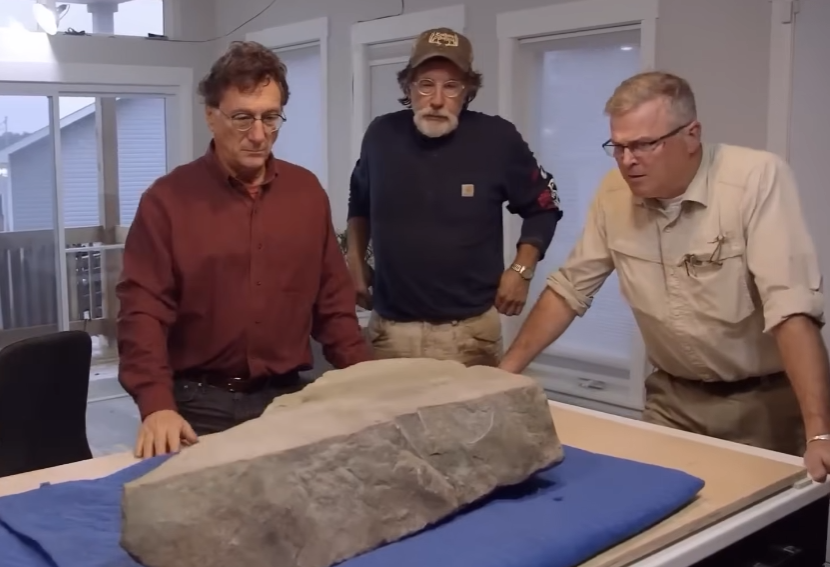
When excavation reveals what appears to be a cement-like or stone surface, the tone becomes more intense. The team reads the emerging edges and corners as structural — the outline of something planned, measured and built.
From there, the narrative leans into the classic Oak Island dilemma: is this a wall, a cap, a corridor, or merely a convincing natural slab? The difference matters. A wall suggests containment. A corridor suggests access. Either way, it implies intent — and intent is the one thing treasure hunters have chased since 1795.
The story then introduces details designed to strengthen the “built, not born” argument: consistent stone sizing, uniform gaps, and marks interpreted as tool work. Wood appears in association with the feature, described as old and possibly connected to supports, a threshold, or a sealed section.
In Oak Island terms, that combination — stone, wood, and an apparent engineered boundary — is the recipe that keeps the team pressing forward.
A Narrow Void, a Camera, and a New Layer of Uncertainty
The most compelling element is not the wall itself, but the suggestion of a hollow space behind it. A tiny camera is used to probe a gap, and the imagery is framed as showing a narrow passage-like void with flat sides and timber supports.
If accurate, that would be a meaningful development: voids, tunnels and chambers are the island’s enduring promise. Yet the show’s history also demands caution. Underground cavities can be natural, partially collapsed, or misleading on camera. Timber can drift, settle, or be introduced by earlier searchers. Each possibility alters what the discovery means.
Still, in narrative terms, this is a turning point. The team is not simply recovering isolated objects; it is confronting what appears to be architecture.
What It Could Mean and What It Does Not Yet Prove
The script layers in familiar candidates — medieval orders, secret societies, coded symbols — but the most responsible reading remains the simplest: something in this zone looks constructed, and the team believes it warrants controlled follow-up.
Even in the show’s most dramatic moments, the “what” often arrives before the “who” or “why.” A tunnel does not automatically confirm treasure. A carved mark does not automatically confirm a specific group. And a solid hit on a drill does not automatically mean a sealed vault.
What it does do is refocus momentum. It gives the team a physical target that can be mapped, tested, and compared against prior anomalies elsewhere on the island.
For viewers, that is the real shift. After years of chasing signals, the team appears to be tracking form: edges, corners, materials, and voids that resemble planned construction. Whether it becomes the long-awaited answer or simply another layer in Oak Island’s enduring puzzle, Episode 16 frames one message clearly — the island still has the power to change the direction of the search in a single moment.