From an Ornate Ring to a Seafloor Triangle — Are the Pieces Finally Connecting.

The swamp on Oak Island has long been regarded as one of the most puzzling features in the centuries-old treasure hunt. This week, a series of discoveries — from an ornate silver ring to underwater stone formations and 19th-century military-style boot fragments — has added new layers to a mystery that refuses to settle into a single narrative.
Metal detection expert Gary Drayton and Rick Lagina returned to the triangle-shaped swamp area determined to build on earlier finds connected to a massive stone-paved structure uncovered this year. With water levels finally low enough to permit access along the banks, Drayton began a careful zigzag sweep.
“I love that sound,” he said as his detector signaled.
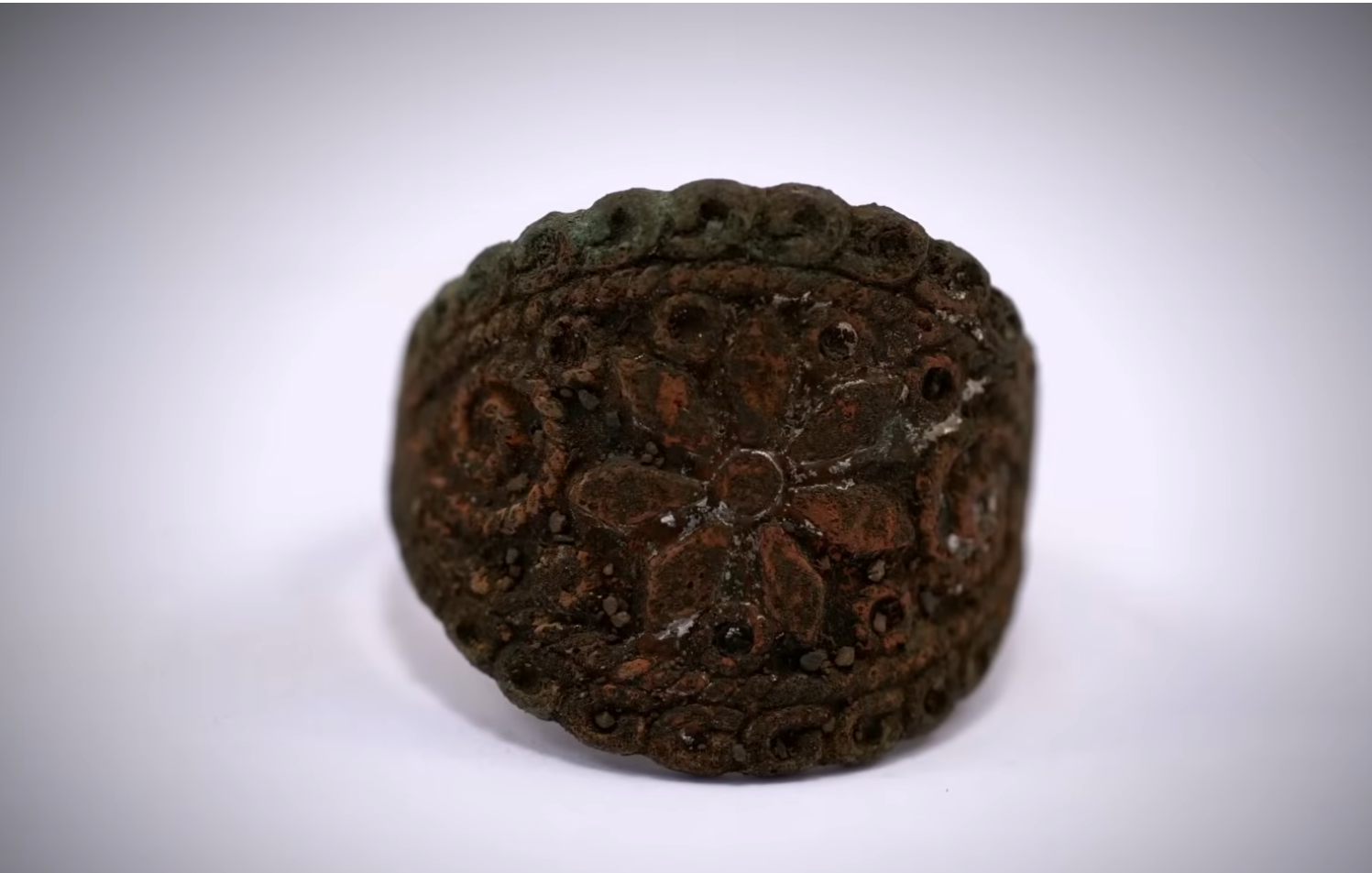
After clearing away a modern tin can lid, the team uncovered something far more intriguing: an intricately patterned ring, thick and perfectly circular, its surface decorated with a hand-cut floral design.
“It’s a ring, mate,” Drayton exclaimed, holding up what he immediately called a “top pocket find.”
A Ring With European Roots
Back in the War Room, photographs of the ring were reviewed by Charles Lewton-Brain, a professional gemologist and master goldsmith with more than three decades of experience. His analysis offered both clarity and intrigue.
The ring, he explained, appeared to be handmade. The floral motif on its surface was not cut with a jeweler’s saw — a tool not widely available until the mid-18th century — but likely carved using chisels. That detail alone suggested a date prior to approximately 1730.
Even more compelling was the design influence.
“The floral pattern reads European to me,” Lewton-Brain said, adding that it could be Spanish in origin.
The piece also showed evidence of at least two repairs — one to enlarge and another to reduce the ring’s size — suggesting it was valued enough to be altered rather than discarded.
The possible Spanish connection echoes a previous find in the swamp: a Spanish Maravedí coin dated 1652. The timing raises fresh questions about whether European visitors, possibly Spanish, may have been present on Oak Island far earlier than traditionally assumed.
Offshore Anomalies Raise New Questions
While analysis of the ring unfolded, another thread of investigation developed offshore.
Data collected by the Centre for Geographic Sciences (COGS) revealed several sonar anomalies off the island’s southern shore. Among them: a triangular formation on the seabed appearing to align with the direction of the Money Pit.
Professional diver Tony Sampson joined Alex Lagina for a dive to investigate.
Though heavy vegetation complicated the search, the divers confirmed the existence of a triangular rock arrangement. Using a compass, they determined its orientation appeared to point toward the Money Pit area.
If deliberate, the formation could function as a navigational marker — potentially associated with a secondary flood tunnel system believed to lie offshore.
The team has previously identified possible vent locations near Smith’s Cove, thought to be connected to the island’s engineered flood defenses. Confirmation of a second offshore system would significantly expand the scope of those defensive structures.
Signs of 19th-Century Activity
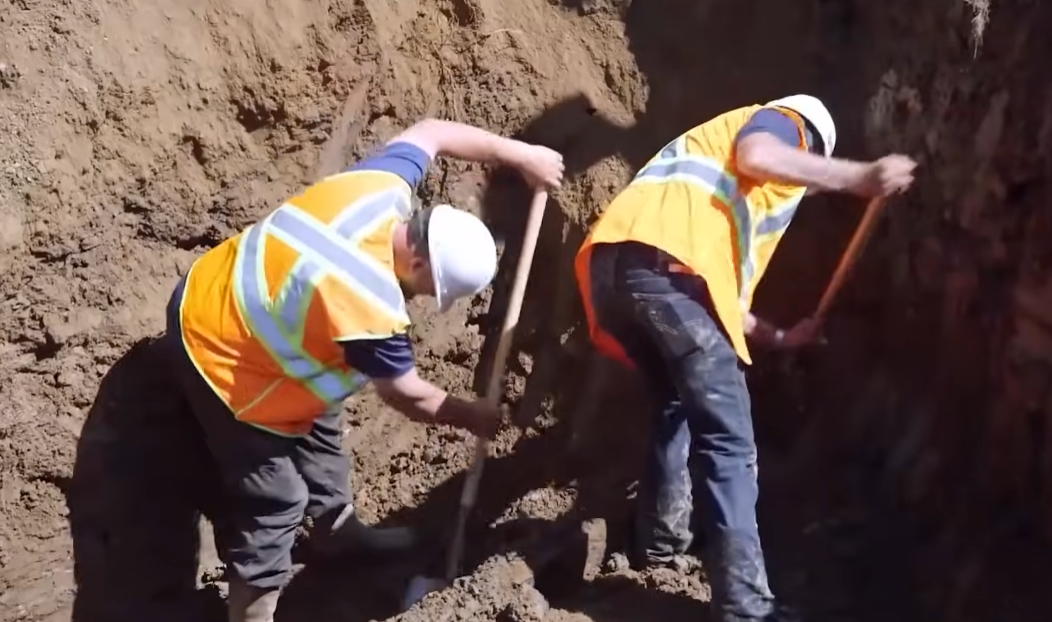
Back in the swamp, excavations just north of a previously discovered slate-and-brick vault-like structure yielded additional artifacts.
Axe-cut wooden survey stakes emerged first — similar to others found along a cobblestone pathway uncovered earlier this season. Then came iron spikes and what appeared to be a hand-hammered chisel.
Most revealing, however, were fragments of thick leather.
Ancient leather specialist Joe Landry examined the pieces at the Oak Island Research Center. He identified one as the sole of a heavy boot, likely oak-tanned, with stitching patterns suggesting durability and prolonged wear.
Landry estimated the leather dated between 1830 and 1900.
“This almost gives the impression of being like a military boot,” he noted.
The timeline aligns with the period of Anthony Graves, a farmer who purchased much of Oak Island in 1857 and built his homestead near the swamp.
Curiously, while Graves did not formally participate in treasure hunts at the Money Pit, historical accounts suggest he later spent Spanish silver coins in nearby Mahone Bay — coins that have never been conclusively linked to a known source.
Could the empty vault-like structure uncovered in the swamp have been accessed during Graves’s residency? And if so, might it explain his mysterious wealth?
Layers of Occupation
The convergence of artifacts from different eras complicates the narrative.
The ring suggests pre-1730 European presence, possibly Spanish. The boot fragments point to mid-19th-century activity. Survey stakes and cobblestones hint at coordinated engineering efforts.
Taken together, the evidence suggests the swamp was not a passive landscape but a site of repeated occupation, construction and perhaps concealment.
Rick Lagina summarized the team’s approach succinctly: “We’re looking for treasure, but we’re also looking for clues to the treasure.”
Each artifact, whether jewelry, footwear or ironwork, contributes to the broader puzzle of who was on Oak Island — and why.
The Road Ahead
The team awaits permits to expand excavations at Smith’s Cove while continuing investigations in the swamp and offshore.
If the triangular seabed formation proves artificial and connected to flood tunnels, it may indicate a more elaborate defensive perimeter than previously understood.
If additional sections of the cobblestone pathway are uncovered, they may lead to further vault-like features.
And if coins follow the leather, as Gary Drayton optimistically predicts, they may help bridge the timeline between early European artifacts and 19th-century settlers.
For now, Oak Island’s swamp remains a landscape of layered stories — where each clue leads not to certainty, but to deeper inquiry.
As Rick Lagina put it, “Each clue leads to another clue.”
And in the bog, the search continues.