The discovery of ancient pottery from the 18th century has transformed Lot 5 into a new highlight of Oak Island.
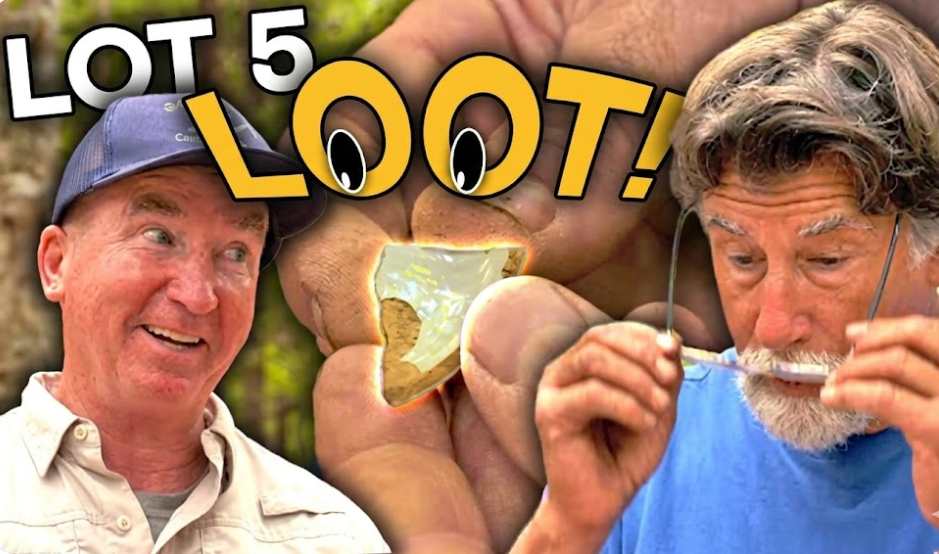
For years, Lot 5 on Oak Island remained just out of reach — a parcel long associated with the late researcher Robert Young, whose meticulous but limited excavations hinted at untold secrets. Now, with access finally secured, Rick Lagina and the team behind The Curse of Oak Island may have uncovered evidence that reshapes the island’s historical timeline.
What began as a long-awaited return quickly evolved into one of the most compelling days of the season.
A Coin That Changes the Conversation
Metal detection expert Gary Drayton wasted little time identifying a promising signal. Within moments, he and Rick uncovered what appeared to be a thin, hand-struck coin fragment.
“Look at the patina on that,” Drayton said as the small disc emerged from the soil. “That ain’t no modern coin.”
The object bore the hallmarks of hammered coinage — one of the earliest forms of metal currency production, in use from antiquity through the medieval period. Its thinness and irregular shape suggested it was not machine-minted, placing it potentially prior to the 15th century.
To determine composition and age, the team brought the coin to the interpretive center for XRF (X-ray fluorescence) analysis under archaeometallurgist Emma Culligan.
The results were revealing. The coin was composed primarily of copper, with traces of tin and arsenic — a composition consistent with arsenical bronze. According to Culligan, this alloy was commonly used in Europe during the 16th century and largely disappeared by the 1700s.
“We don’t see arsenical bronze past a certain date,” Culligan noted. “Coins of that size are usually 16th century — pre those later dates.”
The find mirrors a previously discovered token from nearby Lot 7, also composed of arsenical bronze and potentially predating the 1500s. The geographic proximity between the two lots raises the possibility of coordinated early activity in this section of the island.
Rick Lagina described the moment as both exhilarating and puzzling.
“Arsenical bronze dating from as early as 1500 — that’s quite remarkable,” he said. “But what does it mean?”
Tools and Depth Raise Questions
The discoveries did not stop with the coin. As Drayton continued scanning flagged targets across Lot 5 — 42 in total — additional artifacts began to surface.
Among them was a thick, blade-like iron tool buried unusually deep. Its age and purpose remain under analysis, but the depth at which it was found suggests deliberate deposition rather than casual loss.
“If it’s a tool, why is it that deep?” Rick asked. “That makes no sense.”
The depth factor is critical. Surface metal detectors typically identify objects within a limited range. Deep placement may indicate either later soil disturbance or intentional burial — both scenarios with historical implications.
Pottery From Before the Money Pit
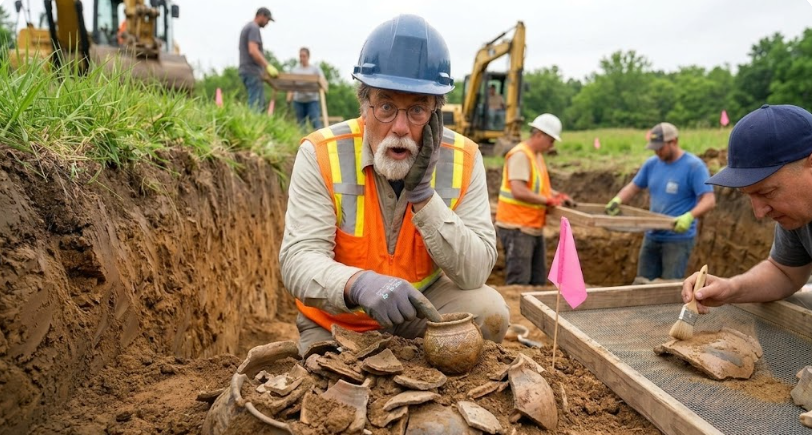
Perhaps most significant were the ceramic fragments uncovered in a rock-filled feature on the lot. The team recovered press-molded English pottery dating to the early 18th century — specifically around 1720 to 1740.
According to archaeologist Laird Niven, press molding of this style began around 1740, while the ceramic type itself dates to approximately 1720.
“That’s pretty cool,” Niven remarked. “It’s English.”
These dates are striking. The famed Money Pit was first documented in 1795. The presence of English pottery predating that discovery by more than 50 years suggests established activity on the island well before its legendary treasure hunt began.
Further excavation yielded Delftware — a blue-and-white tin-glazed ceramic common in mid-18th-century England. The team had never previously discovered this type of pottery on Oak Island.
“Two early ceramic types we’ve never seen anywhere else on the island,” Niven confirmed.
The rock-filled feature itself may represent a structural or functional installation from that era. Its layout and artifact concentration imply purposeful activity rather than random discard.
Evidence of Maritime Activity
Adding another layer to the emerging narrative was the discovery of a heavy, hand-forged copper nail. Unlike iron, copper resists corrosion in saltwater environments, making it a preferred material in shipbuilding.
“It suggests boat building,” one archaeologist observed. “Copper nails resist corrosion in salt water.”
Over the past decade, the Oak Island team has uncovered multiple ship-related artifacts in the swamp, including decking spikes and wooden fragments. Some of those finds have ranged in age from the 18th century to significantly earlier.
If Lot 5 reveals further maritime evidence, it could reinforce theories that Oak Island functioned as a staging area for ship-based operations — whether for trade, military movement, or something more secretive.
A Lot That Rewrites the Map
The cumulative weight of these discoveries is altering the investigative focus. Lot 5, once peripheral to the Money Pit narrative, is emerging as a potentially foundational site in Oak Island’s broader history.
“We’re just getting a hint right now that perhaps we’re into something substantial and important,” Niven said.
For Rick Lagina, the implications are profound.
“The really bizarre thing to me is that this is a lot we know nothing about,” he reflected. “And all of a sudden we’re transported back to the middle of the 1700s. It changes the game completely.”
As excavation continues, archaeologists are carefully screening soil layers and expanding the dig area. The rock-filled feature remains under investigation, and further XRF analysis is planned for additional metal artifacts.
If the evidence continues to cluster around pre-1795 activity, Lot 5 could represent a missing chapter in the island’s story — one that predates the Money Pit and reframes the question from “Who buried treasure?” to “What was happening here decades before the legend began?”
For a mystery nearly 230 years old, the newest clues may lie not in the famous pit, but in a parcel that until recently remained just beyond reach.