Core Samples at 120 Feet Offer New Evidence of Engineered Structure Beneath the Money Pit.
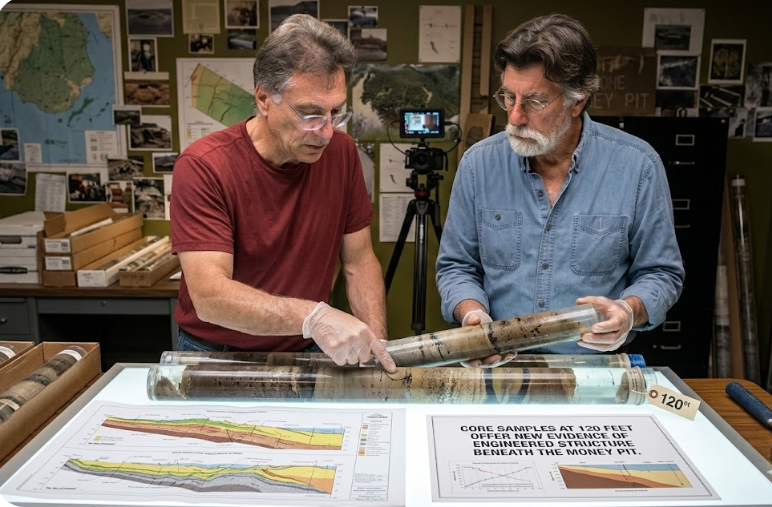
At 4:47 a.m. on a late summer morning, after more than two decades of systematic investigation, the Oak Island team reached a depth that for generations had acted as a barrier between speculation and data.
For over 200 years, the so-called Money Pit has resisted attempts to dig beyond roughly 90 feet. Searchers dating back to the 18th century encountered sudden flooding, collapsing walls, and what many believed to be an elaborate network of flood tunnels connected to the sea. That depth became, in practical terms, a ceiling — a point at which excavation routinely failed.
This season, Rick Lagina and his engineering team pushed beyond it.
Using a precision drilling protocol refined over three years, the crew advanced to 120 feet without triggering a catastrophic water surge. The breakthrough did not produce glittering treasure in a bucket. Instead, it produced something arguably more consequential: core samples that geologists say provide clear evidence of human construction at depth.
Structural Timber at 115 Feet
According to the team’s field report, the drill encountered preserved structural timber at approximately 115 feet below surface level. The wood was found in what experts describe as an anaerobic environment — an oxygen-free condition that significantly slows decomposition.
Such preservation is not impossible underground, but the context is critical. The timber was embedded within a stratigraphic sequence that does not appear consistent with natural deposition.
Independent consultants reviewing the core data have noted the presence of organized layering and what has been described as “engineered backfill” — a mixture of soils not native to the immediate Money Pit area. That suggests deliberate placement rather than random collapse.
Rick Lagina, who has led the modern search for 23 years, framed the moment cautiously.
“This is not a treasure announcement,” he said on site. “It is an evidence announcement. We now have physical data indicating something was constructed at a depth and in a manner that does not occur naturally.”
The Geochemical Signature
While the drill has not yet recovered visible gold or artifacts, laboratory analysis of the 120-foot core has produced what geochemists are calling a significant metallic signature.
Samples show elevated oxidation patterns and trace chemical indicators associated with prolonged contact between organic material and precious metals. Through specific gravity measurements and volumetric modeling, consultants have estimated that the anomaly could correspond to a substantial metallic mass.
Using conservative assumptions, analysts have suggested a theoretical midpoint value equivalent to approximately $290 million in precious metals.
Experts are quick to stress that this figure is not a confirmed valuation of recovered treasure. Rather, it reflects a modeled estimate based on chemical “fingerprinting” — the kind of residue a large metallic object might leave after centuries in a sealed environment.
One geologist involved in the analysis summarized the conclusion in blunt terms: “This did not form here naturally.”
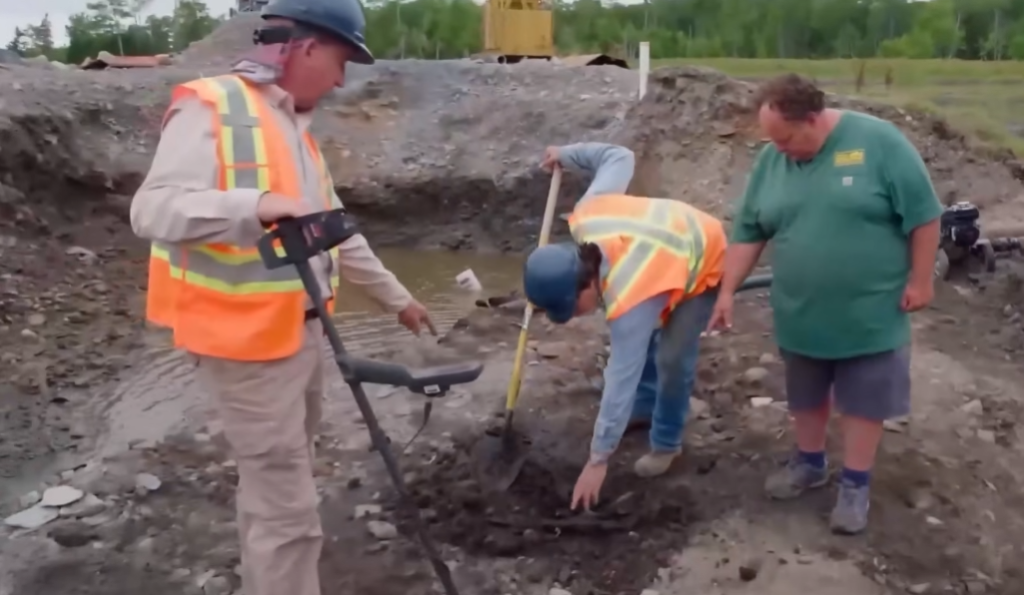
Rethinking the Flood Tunnel Theory
The implications extend beyond monetary estimates.
For decades, many researchers assumed that any treasure associated with the Money Pit would sit within or just below the flood tunnel network — an elaborate hydraulic system believed to connect the shaft to the sea.
The new data challenges that assumption.
The discovery of structural timber and engineered fill beneath the traditional flood depth suggests that the tunnels may have served as a defensive ceiling rather than the primary vault itself. In this model, the flood system would function as a protective barrier shielding a deeper installation.
If correct, that would represent a significant shift in understanding. It would imply not merely concealment, but long-term preservation — potentially of documents, artifacts, or materials whose importance extends beyond bullion.
A Search Driven by Process
For Rick Lagina, now 65, the moment represents the culmination of a personal quest that began in childhood after reading about the Oak Island mystery.
Unlike earlier searchers, the modern effort has emphasized documentation, scientific testing, and controlled excavation over rapid digging. Each borehole, sonar scan, and soil test has been cataloged to build a layered model of the island’s subsurface.
“I wasn’t committed to finding treasure,” Lagina has said in previous interviews. “I was committed to understanding what happened here.”
At 4:47 a.m., in the quiet light before dawn, that understanding advanced.
The breakthrough has not ended the mystery. No chest has been raised. No chamber has been opened. But the shift from legend to measurable evidence marks a turning point.
For skeptics who have long dismissed the Oak Island story as folklore, a 120-foot cylinder of earth containing preserved timber and metallic chemical signatures presents a more complicated picture.
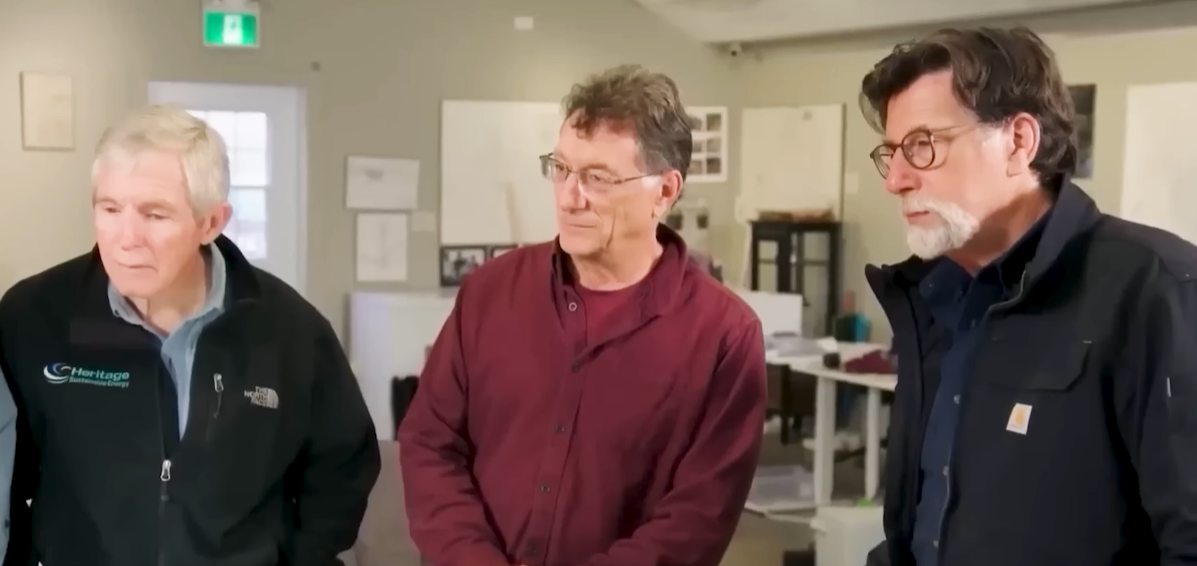
The next phase will involve deeper drilling, expanded imaging, and potentially controlled excavation below the flood layer. Each step will carry technical and financial risks, but the team insists the process will remain methodical.
After 227 years of speculation, the island has yielded something tangible — not treasure in hand, but proof that someone, at some point in history, built something significant deep beneath its surface.
Whether that “something” ultimately justifies centuries of pursuit remains to be seen.
But for the first time, the argument is no longer about belief.
It is about data.