ANOMALIES AT LOT 8: 40,000-Pound Boulder Lifted, Reveals “Unnatural” Soil and Trace Silver

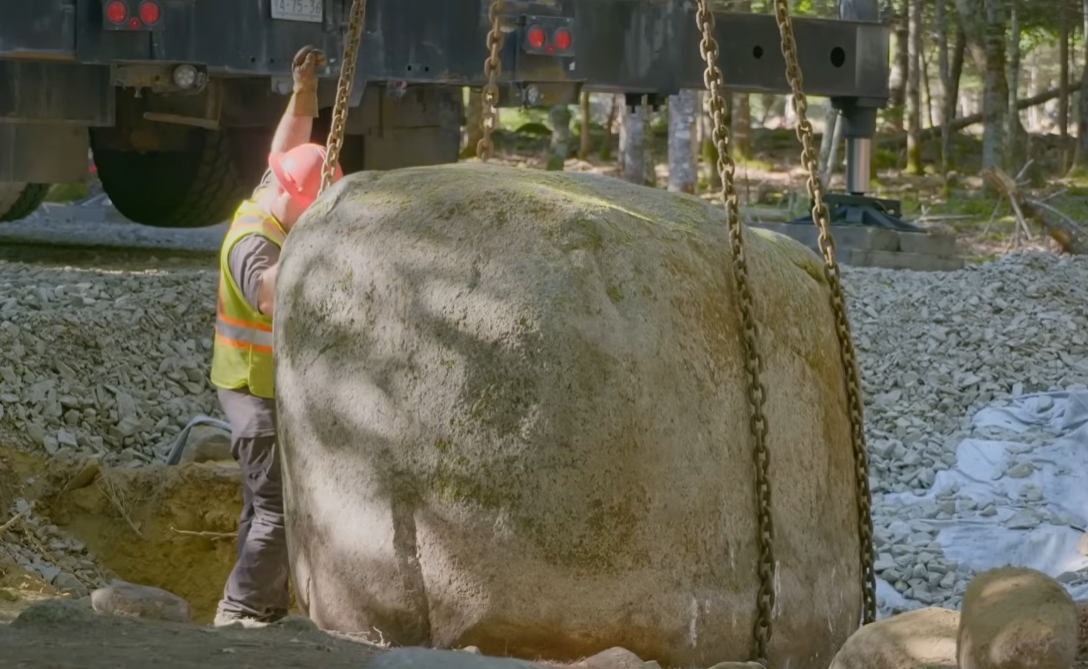
In a high-stakes operation on the western side of Oak Island, the Lagina brothers and their team have successfully removed one of the most formidable obstacles in their decade-long search: a massive, 20-ton boulder. The removal of the “Lot 8 monolith” has immediately yielded scientific evidence of human intervention, including “introduced” organic soils and anomalous metal readings that point toward a deeper, hidden structure.
The “Emboldened” Lift
For weeks, the fellowship has been methodically hand-excavating around the 40,000-pound feature. Preliminary investigations beneath the rock’s edge had already teased the team with glimpses of a “gold-colored substance” and soil samples containing 140 parts per million of lead.
Under the supervision of archaeologist Laird Niven, a 130-ton crane was brought to the site to finally answer the question: Was the rock placed by nature or by design? As the heavy chains tensioned and the boulder rose, the answer became clear. The underside of the rock revealed a backfilled void and a series of stones that appeared to have been used as “shims” to level the massive weight.
“Every scientist who has looked at it says this was moved into position,” Marty Lagina noted. “People don’t do that even today for no reason.“
Scientific Anomalies: Silver and Copper
Once the boulder was clear, Dr. Ian Spooner and archaeologist Fiona Steele conducted an immediate analysis of the exposed ground. The “sterile subsoil” typical of the island’s geology was notably absent. Instead, the team found dark, organic matter that had been “introduced” to the site—a telltale sign of a filled-in hole or shaft.
Dr. Spooner utilized a Vanta XRF spectrometer to scan the fresh earth in real-time. While Gary Drayton’s metal detector did not yield an immediate “surface hit,” the XRF—which detects chemical signatures at a molecular level—produced startling results.
“It’s showing some silver and copper,” Dr. Spooner announced to the gathered team. Crucially, these traces were found in the lower soil layers, suggesting that the metals may be “leaching” or “seeping” upward from a source buried much deeper.
Lot 8 Soil Analysis (Field Results):
| Element Detected | Concentration/Location | Potential Source |
| :— | :— | :— |
| Lead | 140 ppm (Organic Layer) | Mining/Smelting tools |
| Silver | Trace (Lower Layer) | Speculated Treasure Cache |
| Copper | Trace (Lower Layer) | Coins/Artifacts |
A Hidden Mine Shaft?
The presence of “supersaturated air” and anomalous metals has led the team to speculate that the boulder was used as a cap for an ancient mine shaft or air vent. Fiona Steele suggested that the silver signatures could be the result of “mists” carrying metallic particles from a flooded chamber far below.
The discovery echoes the famous “Pitblado Coin”—a silver and copper artifact found on the island decades ago. “Silver is just as exciting as gold when you’re talking about a treasure hunt,” Marty Lagina remarked.
While the “aha moment” of a glittering chest was not immediate, the team remains undeterred. The next phase of the operation involves a meticulous archaeological excavation of the dark soils to determine exactly how far down the “filled hole” extends.