HISTORY UNEARTHED: Engineered Swamp and 17th-Century Spanish Coin Shatter North American Timeline

For over two centuries, the mystery of Oak Island was confined to a single, booby-trapped shaft known as the Money Pit. However, startling discoveries made early this year have shifted the world’s attention to the island’s massive, triangle-shaped swamp. New evidence suggests the wetland is not a natural formation, but a gargantuan, 300-year-old engineering project designed to conceal a maritime secret that predates the accepted history of European settlement in North America.
The 1652 Breakthrough
The catalyst for this historical reckoning was the recovery of a 1652 Spanish copper coin. Found deep within the muck of the recently drained swamp by metal detecting expert Gary Drayton, the coin’s date proves that highly skilled European groups were operating on the island more than 140 years before the Money Pit was “discovered” in 1795.
Geoscientist Dr. Ian Spooner has confirmed the team’s suspicions: the swamp was intentionally engineered. “Human beings dug out this earth and flooded the zone to hide something massive,” the team reported. This “deliberate cover-up” involved altering the local water table to create an artificial wetland, acting as a “giant front door” to a hidden vault.
A Highway Beneath the Mud
As excavators peeled back layers of ancient silt, they hit a solid, flat surface that nature could not have produced. Hidden beneath the water was a massive, perfectly paved stone road. The interlocking stones, laid without mortar, match 15th and 16th-century Portuguese construction methods.
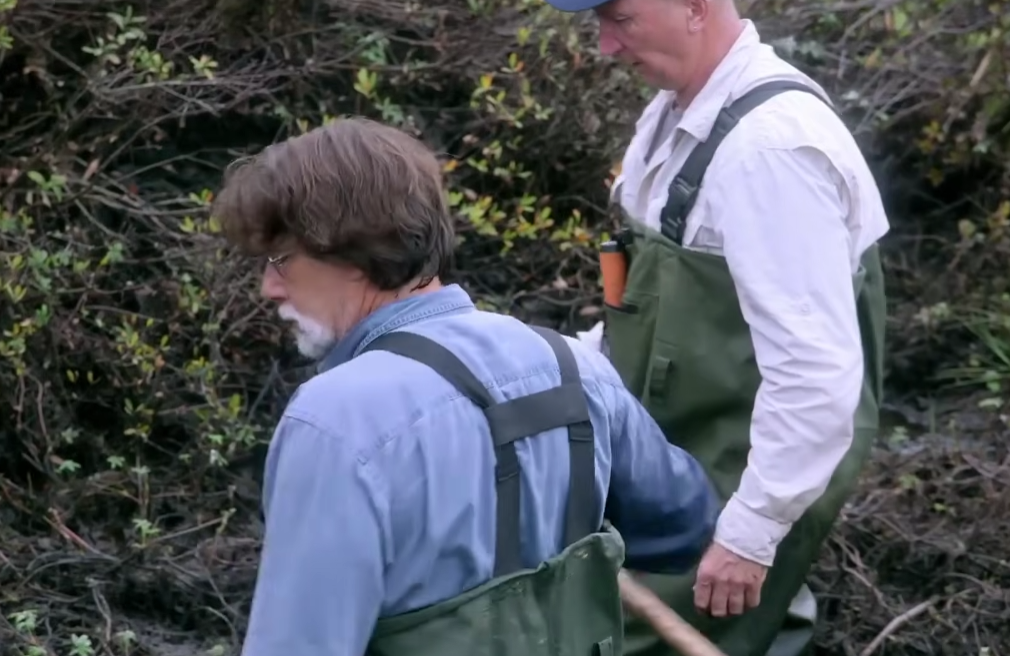
The road is littered with ox shoes and ring bolts, indicating it was a heavy-traffic highway used by oxen hauling massive carts. Stretching across the swamp floor, the road points directly toward the Money Pit, suggesting it was the primary artery for transporting the original treasure.
The “Ship in the Swamp” Anomaly
Perhaps the most “explosive” discovery is a ship-shaped anomaly detected by sonar in the thickest part of the basin. Measuring dozens of feet long, the data outlines a curved wooden structure that experts believe is a sunken galleon.
The theory, originally proposed by the late Fred Nolan, suggests that depositors sailed a vessel into a coastal inlet, offloaded its cargo, and then intentionally sank the ship to serve as the foundation for the artificial swamp. Carbon dating on wood samples recovered from the area returned a 70% to 80% probability of dating between 1640 and 1810, though some samples hint at much older, medieval origins.
Table: Artifacts Recovered from the Swamp Basin (2025-2026)
| Artifact | Estimated Date | Historical Link |
| :— | :— | :— |
| Spanish Copper Coin | 1652 | Early European Presence |
| Lead Cross | ~1300s-1400s | Knights Templar (Southern France) |
| Paved Stone Road | 15th-16th Century | Portuguese Engineering |
| Preserved Ship Timber| 1640-1810 | Intentional Maritime Burial |
The 2026 Endgame
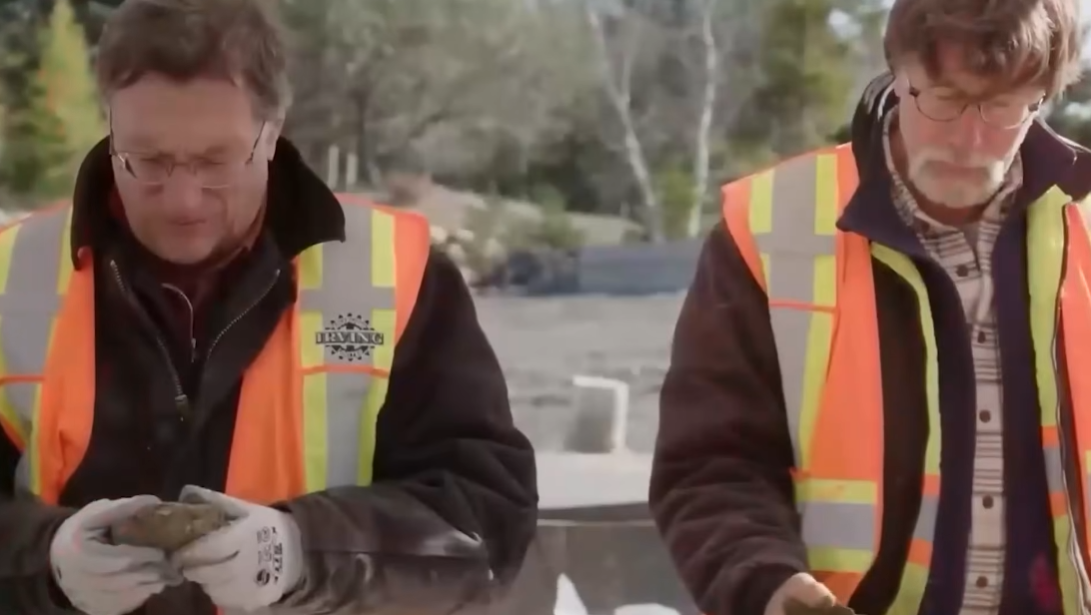
As of early 2026, the operation has entered its most industrial phase. Marty Lagina has authorized the construction of a massive steel coffer dam around the “Eye of the Swamp”—a circular stone formation believed to be a landmark for the vault. Giant metal sheets have been driven into the earth to hold back the Atlantic, allowing excavators to reach the suspected cargo hold of the buried vessel.
Trace amounts of gold and silver detected in scientific core samples 60 feet down provide the “hard proof” the team has sought for a decade. As the world watches, the muddy secrets of Oak Island are being rinsed away, one bucket at a time, revealing a shadow history of Knights Templar and rogue Spanish fleets that textbooks can no longer ignore.