BEYOND THE CURVE: Circular Stone Feature on Lot 5 Yields 17th-Century Latch and Roman Coins
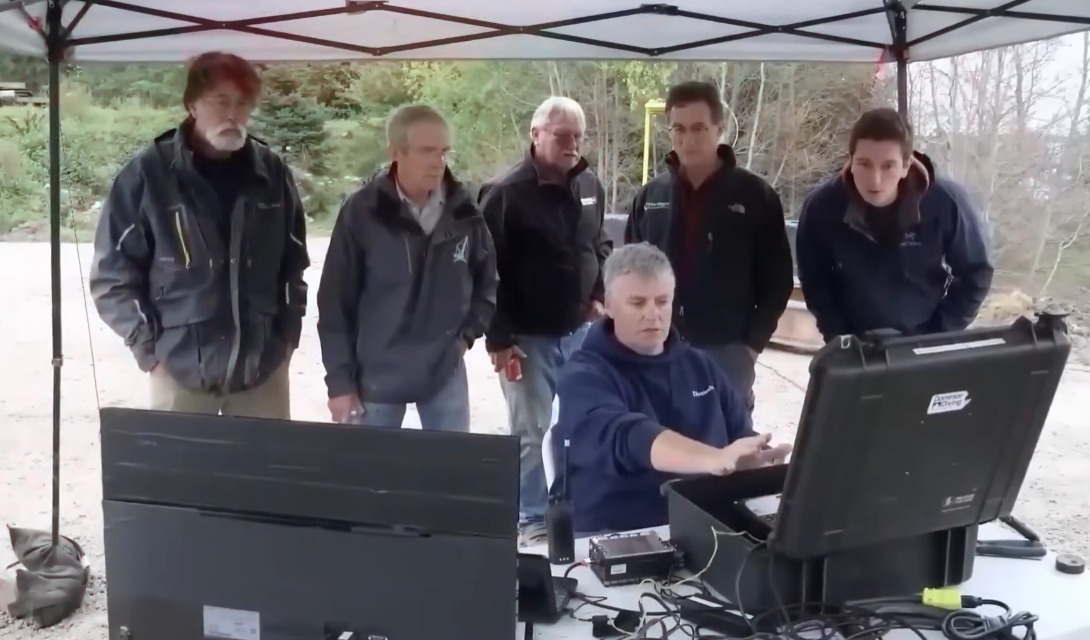
As rumors of a “seventh victim” and the temporary withdrawal of Rick Lagina from the public eye swirl across the North Atlantic, the actual work on the ground has reached a fever pitch. This week, archaeologists on Lot 5 uncovered a series of artifacts that suggest the island was inhabited and engineered at least a century before the 1795 discovery of the Money Pit.
The “Latch” to the Deep
The focus of the current excavation is a mysterious circular stone depression on Lot 5. Archaeologists Laird Niven and Fiona Steel recovered an iron artifact that Marty Lagina initially identified as a door knocker. However, CT scans and elemental analysis performed by Emma Culligan revealed a “100% match” to artifacts associated with Sir William Phips, the 17th-century treasure hunter and colonial administrator.
The artifact, now identified as a river raft spike or a structural latch, shows a flattened top—indicative of being hammered into a heavy wooden structure. “If there is a latch, there is a hidden structure,” Marty Lagina noted. The presence of such a heavy-duty fastener in a “circular feature” suggests a cellar or trapdoor leading to a subterranean vault far removed from the traditional Money Pit site.
A “Shower of Coins”
The metal detecting team of Rick Lagina and Gary Drayton reported an unprecedented “cluster” of ancient currency on Lot 5. Four hand-hammered coins were recovered in a single afternoon. Preliminary assessments suggest Roman origins for at least one, while others feature a distinctive “woven” or “chain-link” pattern.
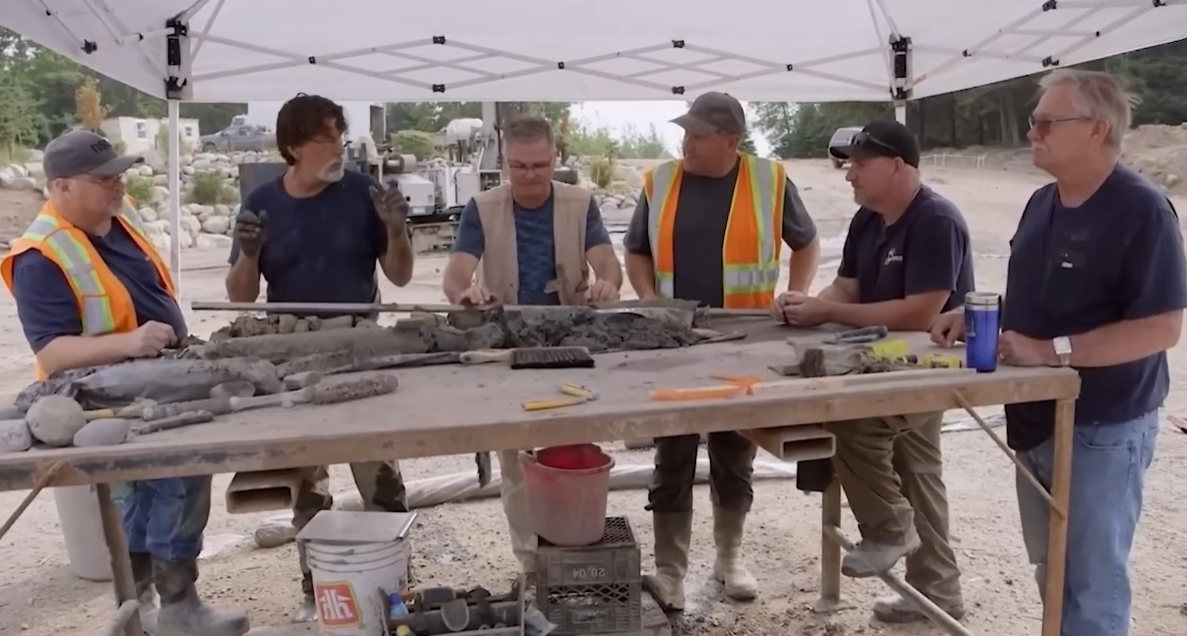
The proximity of these coins to the circular stone feature has led to a new “Path Theory.” Researchers believe Lot 5 may have served as a staging area or a transit route for moving treasure, with these coins being dropped by the original depositors.
Aladdin’s Cave and the Muon Breakthrough
While the land team sifts through Lot 5, the “Money Pit” operation has turned to space-age technology. Using advanced Muon Tomography—which measures subatomic particles passing through the earth—the team has identified a massive high-density anomaly 85 feet west of the Garden Shaft, sitting at a depth of 230 feet.
This aligns with a low-density “void” discovered at borehole L-15, colloquially known as Aladdin’s Cave. The Muon data suggests that these voids are not natural limestone caverns but are instead part of a multi-level engineered system.
Military Secrets and Lead Seals
The military history of the island was further reinforced by the discovery of a lead “bag seal.” While initially thought to be a simple fastener, the inscription was traced back to “John Parker of London,” a cloth packer known for supplying military uniforms and supplies around 1808. However, the use of the letter “I” in place of “J” suggests the seal’s design follows a tradition dating back to the 1500s.

Combined with the recovery of lead musket shot and a scissor handle matching a 17th-century Spanish design, the evidence points toward a significant military presence—possibly the 1746 French naval expedition—using the island as a secret base of operations.
The Legend of the Seventh
Regarding the sensationalist reports of Rick Lagina’s “disappearance,” site officials maintain that the slowing of public appearances is due to the intense logistical demands of the new deep-drilling phase. While the legend states a seventh person must die before the treasure is found, the fellowship remains focused on the physical evidence.
As the team pushes deeper into the stone foundation of Lot 5, the question is no longer if something was hidden on Oak Island, but who possessed the 16th-century engineering skill to bury it so effectively.