Roman Coin Discovery on Oak Island Raises New Questions About the Island’s Ancient Connections
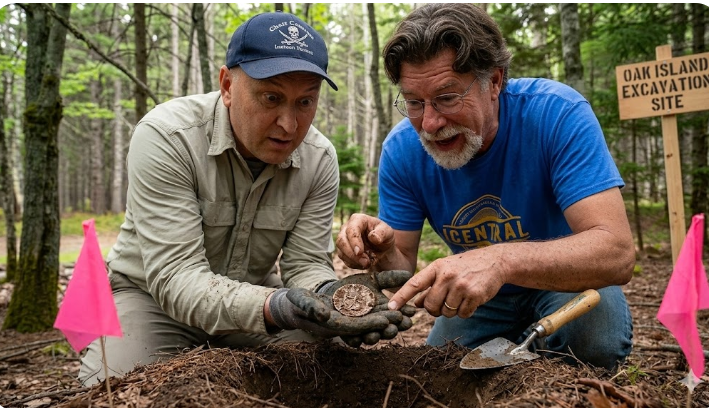
A remarkable discovery on Oak Island is once again expanding the timeline of the island’s mysterious past. During a recent analysis session in the research laboratory, members of the investigation team confirmed that a coin discovered on Lot 5 dates back to the Roman Empire, potentially placing it more than 1,700 years old.
The finding has sparked intense discussion among historians and researchers involved in the ongoing search for answers about Oak Island’s long-standing mystery.
The coin was initially uncovered by metal detection expert Gary Drayton and his daughter Katya while examining an area of Lot 5 that has produced a number of intriguing artifacts in recent seasons. The site has become one of the most active areas of investigation, with excavations revealing items linked to several different historical periods.
At first glance, the coin’s unusual design immediately caught the team’s attention.
To learn more about the object without damaging it, materials specialist Emma Culligan placed the coin into a CT scanner to study its features in greater detail. The scan revealed distinct markings that helped identify both the coin’s origin and approximate age.
According to Culligan, the images showed a standing figure on one side along with the word “officina,” which refers to a workshop designation used by Roman mints. The letter “N” indicated the ninth workshop responsible for producing the coin.
On the opposite side, faint but recognizable features appeared to show a portrait of a Roman emperor wearing a crown.
The facial characteristics—particularly the sharply defined nose and chin—pointed to a specific historical figure: Claudius II.
Marcus Aurelius Claudius, commonly known as Claudius II Gothicus, ruled the Roman Empire from 268 to 270 AD. His reign took place during a turbulent period of Roman history marked by military conflicts and political instability.
The coin’s identification places its origin somewhere around the late third century.
“This is a Roman coin,” Culligan confirmed during the laboratory session, drawing excitement from the assembled team members.
While Roman coins have occasionally been discovered in various parts of the world, finding one on Oak Island presents a particularly puzzling scenario.
To gain further insight, the team invited coin expert Sandy Campbell to examine the artifact.
After inspecting the coin, Campbell quickly confirmed its authenticity and agreed with the Roman dating.
“This is clearly Roman Empire period,” Campbell said. “It’s in remarkable condition for something that has been buried for such a long time.”
However, the discovery raises a critical question: how did a Roman coin end up on a small island off the coast of Nova Scotia?
According to Campbell, Roman coins continued to circulate as currency long after the Roman Empire itself had declined. In parts of Europe, coins from earlier centuries were still used in trade well into the medieval period.
Because of this extended circulation, the coin may have reached Oak Island centuries after it was originally minted.
“You could walk into a merchant anywhere in the world with one of these coins and it still had value,” Campbell explained.
This possibility opens the door to several historical scenarios.
One theory discussed by members of the Oak Island team suggests that workers involved in constructing the island’s legendary Money Pit may have carried Roman coins as currency or personal items.
If true, the coin could represent a small but tangible connection to the people who built the mysterious underground structures that have fascinated treasure hunters for generations.
Another intriguing possibility involves links to the Knights Templar.
During the medieval period, the Templar order developed an extensive financial network across Europe and the Mediterranean. Some researchers believe that members of the order accumulated wealth and artifacts from many different regions.
Doug Crowell, a member of the Oak Island research team, noted that Roman coins have occasionally been discovered at sites associated with Templar activity.
In previous research trips to Europe, the Oak Island team examined Roman coins found in locations where the Templars are known to have operated. Similar discoveries have even been reported in Iceland.
These parallels have encouraged some investigators to consider whether the Roman coins discovered on Oak Island could have arrived through the movement of wealth and artifacts during the medieval period.
While this theory remains speculative, the presence of multiple Roman coins on the island makes the discovery difficult to dismiss as coincidence.
The newly identified coin is not the first of its kind found on the island. In earlier excavations, the team uncovered several additional Roman coins in the same general area of Lot 5.
Each new discovery adds to a growing collection of artifacts that appear to originate from widely different time periods.
Alongside the Roman coins, archaeologists working on Lot 5 have also uncovered pottery fragments, glass trade beads, and decorative buttons that may date from the seventeenth century.
These findings suggest that the island may have experienced multiple waves of activity involving different groups over the centuries.
Archaeologist Fiona Steele, who has been leading excavations on Lot 5, believes the evidence increasingly supports the idea that the site was used repeatedly for different purposes.
“The artifacts we’re finding show signs of multiple occupations,” she explained during the excavation. “Each piece adds to the puzzle.”
Fragments of an ornate earthenware bowl discovered nearby provide another example of this layered history. The pottery, which may date from the 1600s or 1700s, indicates that people were using the area for everyday activities such as preparing food.
If confirmed, the bowl fragments would represent a period long after the Roman coin was minted.
For researchers, this mix of artifacts from different centuries makes Oak Island even more intriguing.
Rather than pointing to a single historical event, the discoveries suggest that the island may have played a role in several different stories over time.
As Rick Lagina reflected after the latest findings were presented, the discovery of Roman coins only deepens the mystery.
“It’s incredibly interesting,” he said. “It just adds another layer to what happened here.”
With further excavations planned on Lot 5 and nearby areas, the team hopes additional artifacts will eventually provide clearer answers about who visited Oak Island—and why.
For now, the Roman coin stands as yet another fascinating clue in a mystery that continues to stretch back further in time than many investigators ever expected.