THE LOT 8 ANOMALY: Discovery of Ancient “Roman-Style” Cement Points to Templar Map

The investigation into Lot 8 has taken a startling turn as archaeologists on Oak Island have uncovered a “megalithic stone structure” that may validate one of the most controversial theories in the island’s 230-year history. What began as the excavation of a massive 40,000-pound boulder has evolved into the discovery of a deliberate, mosaic-like stone foundation held together by a mysterious, ancient mortar.
A Purposeful Construction
The discovery occurred after the team removed a multi-ton boulder, expecting to find natural glacial till. Instead, they revealed a “cradle-like” formation of hand-placed stones. Archaeologist Fiona Steele and lead researcher Rick Lagina noted that the labor required to position such a massive weight atop a delicate stone mosaic suggests a level of engineering far beyond a simple landmark.
“I’ve worked with stone most of my life,” Lagina remarked while surveying the site. “This was definitely purposeful. The labor you see in front of you—it was quite laborious. It meant something to someone.“
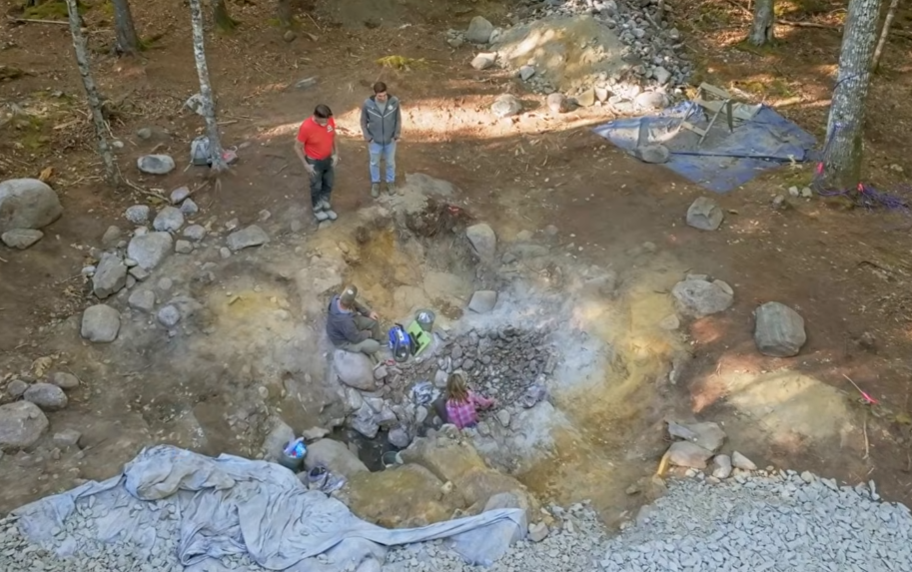
Further excavation revealed that the feature is composed of multiple layers of tightly “locked” stones. Beneath the primary layer, the team detected elevated levels of silver and lead—elements often associated with precious artifacts or the proximity of a hidden shaft.
The “Blue Clay” Connection
One of the most significant finds within the structure is a deposit of hand-worked blue clay. To the uninitiated, this might seem like a geological quirk, but to Oak Island researchers, it is a “fingerprint” of the original builders.
Historically, blue clay was discovered in 1804 at the 40-foot level of the Money Pit, where it was believed to have been used as a waterproof sealant to protect a deeper treasure. Similar deposits have recently been found in the swamp and Lot 5. The presence of this material on Lot 8 suggests a coordinated, island-wide engineering project designed to hide something of immense value.
Testing the “Cement of the Ages”
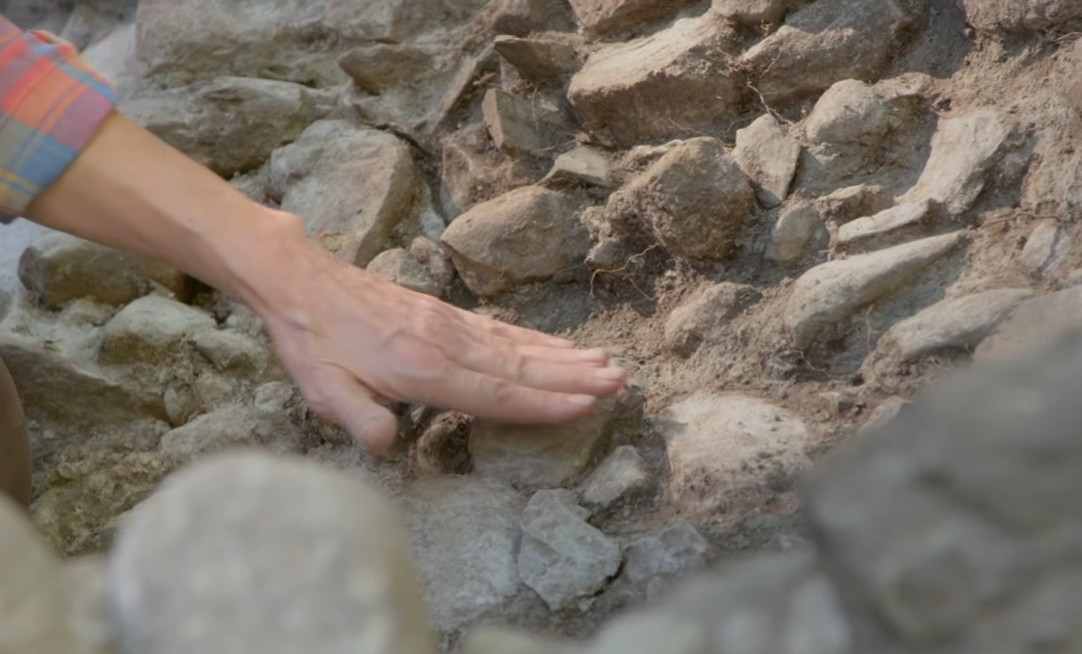
As the team struggled to remove stones that seemed “firmly affixed” to the base, they discovered a gritty, mortar-like substance. Preliminary field tests by Rick Lagina and Jack Begley revealed that the material, when reconstituted with water, behaves like a sophisticated cement.
“When you compare this elementally to cement through the ages—from Roman cement on forward—I think you’re going to get a fairly accurate date,” Lagina stated. The team has sent samples to the laboratory for X-ray diffraction (XRD) analysis. If the chemical signature matches ancient European concrete, it would provide a definitive “when” for the island’s construction, potentially dating it back centuries before the 1795 discovery of the Money Pit.
The Templar Alignment
The discovery has reignited interest in the “Zena Halpern Map,” a 14th-century document allegedly created by the Knights Templar. The map features a location known as the “December Triangle.” Peter Fornetti noted that the Lot 8 boulders were arranged in a distinct triangular pattern, pointing directly toward the stone cradle.
“I’ve puzzled about whether this area could be referencing the so-called December Triangle,” Lagina admitted. If the structure aligns with the Templar map, it suggests the 40,000-pound boulder was not a obstacle, but a marker for an underground vault or tunnel system.
As the archaeological process continues, the focus has shifted from the “how” to the “why.” With silver detected in the soil and ancient cement locking the stones in place, the team is convinced that Lot 8 is no longer a peripheral site, but a primary lead in the hunt for the Oak Island treasure.