BEYOND THE SINKHOLE: Emma Culligan’s Geometric Proof Reveals $85M “Shield” Shaft

For decades, skeptics and geologists alike dismissed the infamous “$85 Million Shaft” on Oak Island as nothing more than a natural geological quirk—a common sinkhole formed by the island’s volatile limestone and gypsum base. However, a groundbreaking three-year forensic audit of forgotten excavation records has flipped the narrative.
Archaeometer Emma Culligan has presented a “geometric proof” that the shaft was not a natural collapse, but a highly sophisticated piece of pre-industrial engineering designed to act as a decoy and structural “shield” for the original Money Pit.
The Death of the “Natural Collapse” Theory
Culligan’s investigation began with a discrepancy in historical handwritten notes. While previous researchers accepted the “chaos” of a sinkhole, Culligan identified a repeating, intentional pattern in wall angles and soil density that nature simply does not produce.
“Nature produces chaos; pattern means intention,” Culligan noted during a briefing at the Oak Island Research Center. Her data overlay revealed that the shaft does not widen as it descends—a hallmark of natural sinkholes. Instead, it maintains a remarkably precise vertical alignment, with small “stress adjustments” appearing exactly where an engineer would calculate load redistribution.

The “Engineered Seal”
One of the most startling finds in Culligan’s report is the presence of a dense clay layer at the 90-foot mark. Geological samples indicate the clay was “manually compressed” while still pliable, effectively creating an underground gasket.
This layer does not behave like sediment; it regulates pressure and isolates the lower chambers from moisture. “This clay functions like a hydraulic seal,” Culligan explained. “It was placed there to ensure that while the upper layers might look unstable and discourage diggers, the structure below remains bone-dry and secure.”
A Theater of Deception
Culligan’s most controversial conclusion is that the shaft’s upper instability was actually staged. By analyzing “inversion layers”—where loose fill sits atop compacted, solid structures—she suggests the builders created a “facade of failure.”
For over a century, search teams abandoned the site, citing “unstable ground” and “natural collapse.” Culligan argues this was the intended result: a theatrical trick designed to make experienced miners walk away, convinced there was nothing but a dangerous hole in the ground.
The Connection to the Money Pit
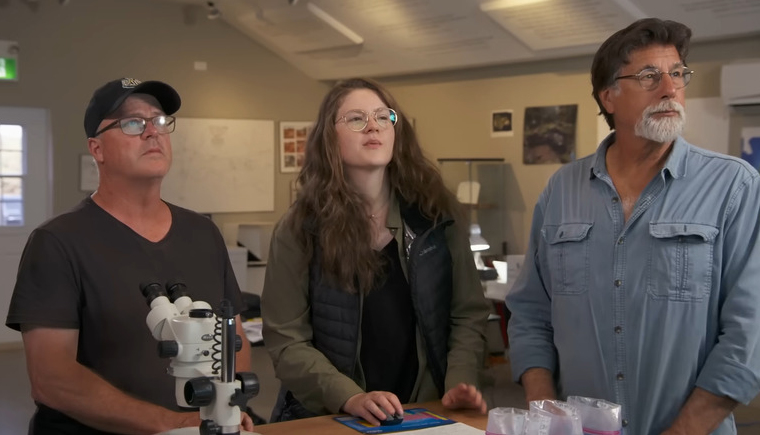
When Culligan overlaid the $85 million shaft’s depth markers with the original Money Pit records, the alignments were “impossible to dismiss.”
-
Identical Intervals: Resistance layers and oak platforms (historically noted) appear at nearly the same depths in both structures.
-
The Chisel Find: A metal fragment recovered from the shaft spoils was confirmed by Culligan to be a high-potassium “clean iron” chisel, matching tools used in 14th-century “charcoal manufacturing” processes.
This evidence suggests the two shafts are part of a single, integrated network. The $85 million shaft isn’t the treasure vault; it is the sacrificial shield. It was designed to fail inward during a breach, redirecting the weight of the earth and the force of the Atlantic flood tunnels away from the primary treasure chamber.
“We’ve been looking at the shield and calling it a failure,” Culligan concluded. “In reality, it’s a 300-year-old security system that is still working perfectly.”