THE CHAPPEL VAULT REVEALED? Ancient Concrete and Portuguese “Stoneshot” Unearthed in Money Pit
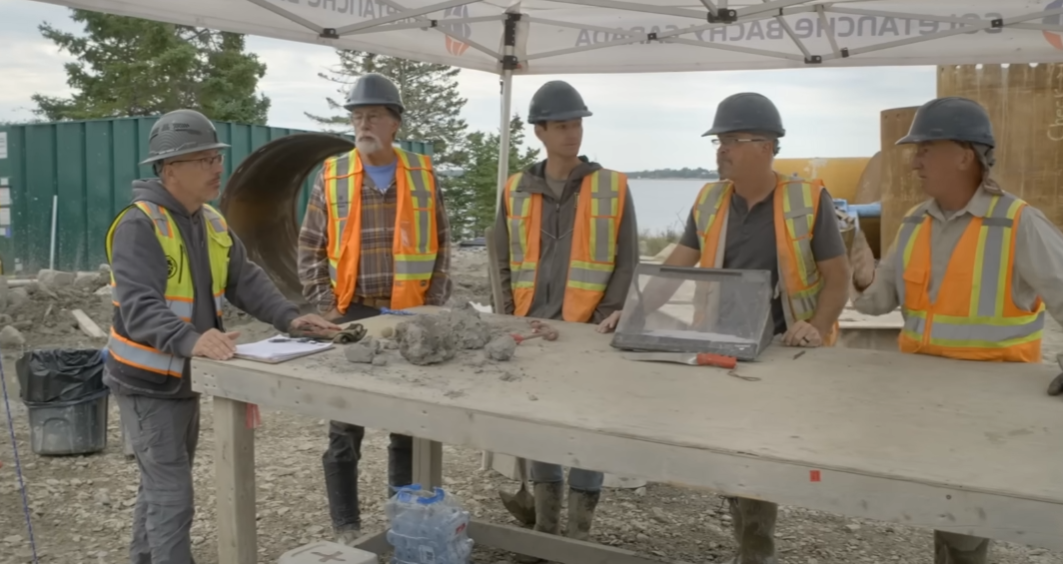
As the 2026 excavation season nears its conclusion, the team at Oak Island has reported a series of high-stakes finds within the Peacock-1 caisson that may finally validate a century-old legend. Recovered from a depth of 170 feet, a fragment of ancient cement has reignited hopes that the team has breached the elusive “Chappell Vault”—a seven-foot-high treasure chamber first reported by explorers in 1897.
The discovery was made by Charles Barkhouse on the wash plant, who noted that the material appeared identical to the concrete reported by Frederick Blair and William Chappell over 120 years ago. According to historical logs, the 1897 team drilled through a concrete-encased wooden vault at 153 feet, extracting traces of gold and a piece of parchment bearing the letters “V-I.”
“My mind went right to the vault,” Rick Lagina remarked during the evaluation. “That needs to go to the lab immediately.”
A Projectile from the Past
While the concrete has provided a target for the drill bit, a second discovery has provided a timeline. At a depth exceeding 100 feet, the team recovered a hand-carved stoneshot—a ballista or swivel-gun projectile used by early European militaries.

This marks the third stoneshot found on the island, with previous specimens discovered on Lot 15 and elsewhere in the Money Pit area. Emma Culligan, the team’s lead researcher, conducted a preliminary CT scan on the artifact, identifying distinct “peck marks” left by a stonemason’s chisel. These marks differentiate the object from natural river-worn stones, confirming it as a man-made weapon.
The Portuguese Connection
The significance of the stoneshot lies in its obsolescence. Scientific data suggests that such projectiles were phased out by the 1450s in favor of cast-iron cannonballs. If the stoneshot originated in the 1300s or 1400s, it provides physical evidence of European presence in North America significantly predating the accepted historical record.
During a 2021 research trip to the Military Museum in Lisbon, the Laginas confirmed that these stoneshots are a perfect match for 15th-century Portuguese swivel guns. This links the find to the Order of Christ, the successors to the Knights Templar, who possessed the maritime technology required to reach the New World during the medieval period.
A Frustrating Final Act
Despite these “remarkable” clues, the mood remains one of cautious frustration. In a videoconference with his brother Marty, Rick Lagina admitted that while the Peacock-1 shaft has reached the bottom of the “solution channel”—a natural underground waterway—the definitive treasure cache remains elusive.

“The island is just the most frustrating thing I’ve ever been involved in,” Marty Lagina stated from Michigan. “But we did prove that the solution channel played a huge role. I still think there’s a decent chance what we seek is down there.”
The team has now reached out to Dr. Raeside at Acadia University to conduct a mineralogical analysis of the newest stoneshot. If the stone is found to match the volcanic rock of the Portuguese Azores, it will serve as an undeniable smoking gun for a pre-colonial European operation on Oak Island.