The Everest-Oak Island Connection: Mallory’s Boot Unearthed in the Money Pit
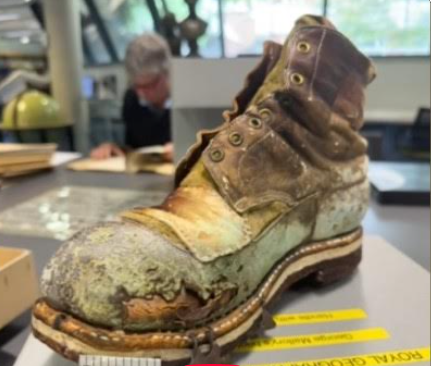
In a staggering turn of events that has left both the mountaineering world and treasure hunters speechless, the mystery of George Mallory and the enigma of Oak Island have collided. Rick and Marty Lagina, the tenacious brothers behind History Channel’s The Curse of Oak Island, have reportedly made the “find of a lifetime” at the bottom of the infamous Money Pit. But it wasn’t gold or Shakespearean manuscripts they recovered; it was a weathered, frozen relic from the slopes of Mount Everest: George Mallory’s boot.
A Chilling Discovery in the Deep
For over a decade, the Lagina brothers have utilized state-of-the-art technology, heavy machinery, and sheer willpower to excavate the swamp and the Money Pit on Oak Island, Nova Scotia. During a deep-bore operation in a previously unexplored shaft of the Money Pit, the drill brought up a mass of organic material preserved in the anaerobic mud.
Upon cleaning the debris, the team discovered a rugged, early 20th-century leather boot. The shock intensified when a name tag sewn into the wool lining was revealed, clearly reading: G. Mallory.
“We came here looking for the Chappel Vault or the French Crown Jewels,” Rick Lagina said, visibly emotional. “To find a piece of the Everest 1924 mystery 100 feet underground on a Canadian island is beyond anything we could have imagined. It defies every law of logic and history.”
The Story the Boot Tells
The boot itself is a “chilling” piece of evidence. In the context of Everest history, George Mallory and Andrew “Sandy” Irvine disappeared in June 1924 while attempting to be the first to reach the summit. When Mallory’s body was eventually found in 1999, his clothing and equipment provided clues to his final moments, but many questions remained.
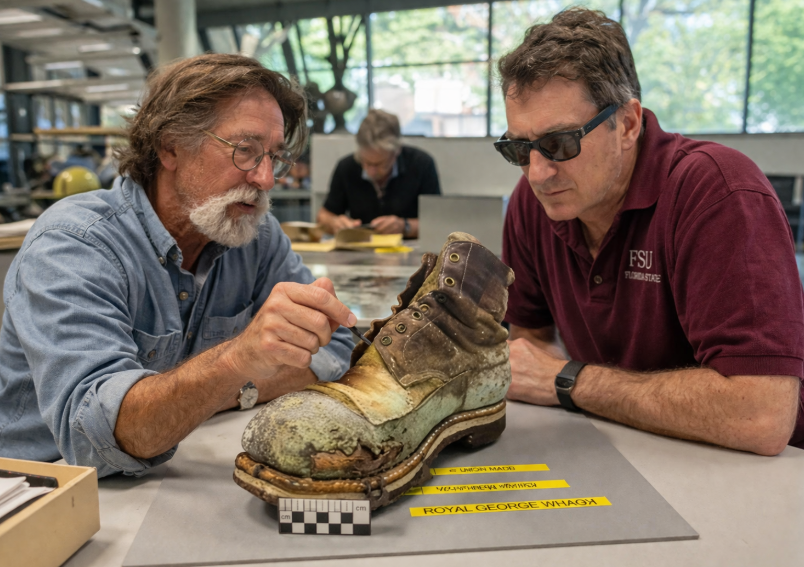
This specific boot, recovered from the Money Pit, tells a story of extreme hardship. The leather is scored with deep abrasions, consistent with the sharp limestone of Everest’s “Second Step.” More hauntingly, the state of the boot suggests it was violently separated from its wearer. Historians and forensic experts featured on the show suggest that the wear patterns confirm Mallory was involved in a high-altitude fall, but how it migrated from the Himalayas to an island in the North Atlantic is a riddle that has sent the “Oak Island Theorists” into a frenzy.
The Theory of Global Relics
Marty Lagina, ever the skeptic turned believer, proposed a radical theory during the latest “War Room” meeting. “We know the Knights Templar or other secret societies involved with Oak Island had global reach,” Marty explained. “If someone found Mallory’s remains or equipment decades ago and believed they held some ritualistic or symbolic value—perhaps as a symbol of the ultimate human ‘quest’—is it possible they brought it here to be buried with the rest of the world’s greatest secrets?”
The discovery has drawn experts from around the globe. Mountaineer Conrad Anker, who discovered Mallory’s body in 1999, was reportedly flown to Nova Scotia to examine the boot. “The stitching, the hobnails, the specific wool blend—it’s an exact match for the equipment used in the 1924 British Expedition,” Anker noted. “It’s a chilling relic that carries the DNA of Everest’s greatest mystery.”
A New Chapter for Oak Island
As the season progresses, the Lagina brothers are shifting their focus to determine if other Everest relics are hidden within the Money Pit. Does Sandy Irvine’s missing Kodak camera lie just a few feet deeper? If found, it could finally prove whether Mallory and Irvine reached the summit before their deaths.
The discovery of Mallory’s boot has effectively merged two of the greatest mysteries of the 20th and 21st centuries. Whether it was placed there by human hands or through some inexplicable rift in history, the boot stands as a silent witness to tragedy. For Rick and Marty Lagina, the quest continues, but the stakes have never been higher. The Money Pit has finally yielded a treasure, not of gold, but of a story that remains as cold and haunting as the peak of Everest itself.