THE TEMPLAR TRAIL: Scientific Proof Links Medieval Cross to Southern France
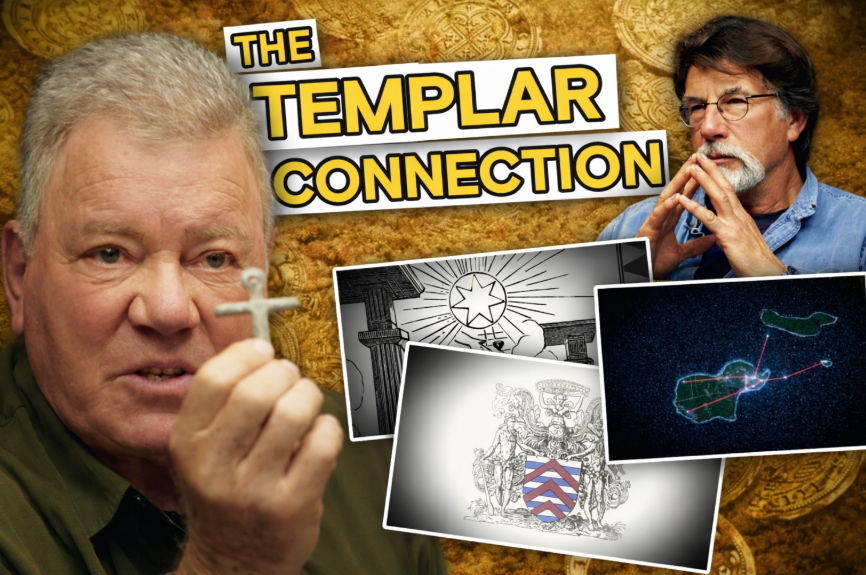
The centuries-old mystery of Oak Island has taken a profound turn toward the medieval as a team of researchers and scientists confirmed a direct link between a lead cross found on the island and a historical Knights Templar stronghold in France. The discovery, detailed in a series of scientific briefings this week, provides what Rick Lagina calls “the most historic evidence ever found in North America.”
The artifact in question—a small lead cross with a distinct square loop—was discovered by Rick Lagina on the shores of Smith’s Cove. While initially dismissed by skeptics as a modern trinket, new data from the University of New Brunswick and the German Mining Museum suggests otherwise.
The Science of Antiquity
Geochemist Tobias Skronic of the German Mining Museum used laser ablation and isotope analysis to pinpoint the origin of the lead. The results were startling: the lead was not mined in North America, but in the Cévennes and Montagne Noire regions of Southern France.
“The metal is related to European deposits where medieval mining took place,” Skronic stated, dating the material to pre-15th century. This timeline places the cross’s creation squarely within the era of the Knights Templar, a wealthy and powerful military order that was suppressed by King Philip the Fair in 1307.
The cross bears a striking resemblance to carvings found in the Domme Prison in France, where Templar knights were held captive. Researchers noted that the cross’s geometry “lines up perfectly” with spiritual carvings etched into the prison walls by knights awaiting execution.
The “Star Map” Hypothesis
Further complicating the mystery, aerospace engineer Dr. Travis Taylor presented a theory linking the island’s geography to ancient archaeoastronomy. Using a Freemason drawing template as a guide, Taylor overlaid the constellation Taurus onto a map of Oak Island.
The “As Above, So Below” theory suggests that the island’s original depositors used the stars to mark their treasures. In a field test of Taylor’s map, the team discovered massive, singular boulders at three separate “star points” on the island, including a human-made stone triangle on Lot 13. “Two for two… three for three,” Marty Lagina remarked as the team located the landmarks. “The answer is, of course, these could be markers put there to correspond with a star map.”
French Connections and Ship’s Spikes
While the Templar theory gains scientific weight, a secondary 18th-century French connection has also emerged. On Lot 32, blacksmithing expert Carmen Leg identified a massive iron “rock stake” or ship’s spike, dating it between 1710 and 1740.

This spike was found near an ancient cargo bag seal, supporting a theory found in a 1746 ship’s log belonging to the Duke d’Anville. The log describes a mission to bury a “great quantity of treasure” in a “deep pit” with a “secret entrance by a tunnel from the shore.”
For the Fellowship of the Dig, these two theories—one medieval and one 18th-century—may not be mutually exclusive. Whether the treasure was deposited by Templars fleeing persecution or a French fleet protecting the crown’s wealth, the evidence suggests Oak Island was a focal point for European powers for over 600 years.