Jeremy Clarkson DESTROYS Ed Miliband Over ‘NET ZERO’: Why are British agricultural practices at odds with climate policy?

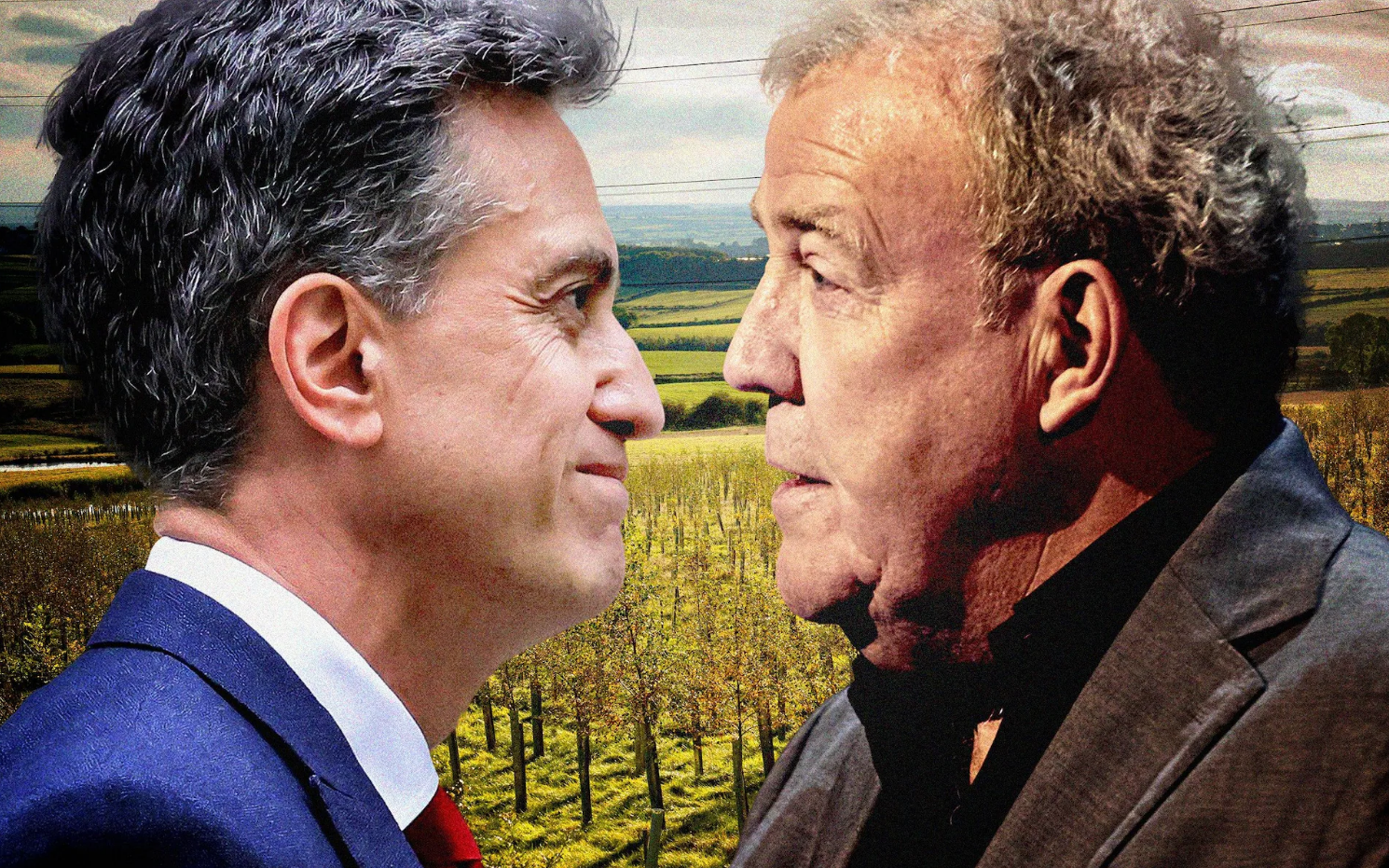
By any measure, the recent committee exchange between Jeremy Clarkson and Ed Miliband was not another piece of political theatre. It was a collision between policy language and lived reality — one that exposed a widening gap between how farming actually works and how it is increasingly being regulated.
Clarkson entered the room knowing the discussion would not be theoretical. For farmers, policy never is. It arrives in the form of fuel bills, machinery limits, compliance costs, and decisions that determine whether a harvest succeeds or fails. His message to the committee was blunt: agriculture does not operate on optimism, targets, or future promises. It operates on time, weather, and tools that must work now.
At the heart of the debate was machinery — a deceptively simple issue that revealed much deeper problems. In peak harvest season, tractors routinely run 12 to 14 hours a day. That is not excess; it is necessity. Weather windows are narrow, and missed days can destroy an entire crop. Clarkson’s criticism of current electric machinery proposals was not ideological but practical. Under real-world conditions, today’s electric alternatives cannot sustain those hours, nor can they be recharged quickly enough to remain viable during critical periods. In farming, waiting six to eight hours for a battery recharge while rain approaches is not inconvenience — it is failure.
This led to the broader emissions argument, one rarely discussed with precision. British agriculture accounts for roughly nine per cent of national emissions. It is significant, but it is not dominant. Yet farming is being targeted early and aggressively in the net zero transition. Clarkson highlighted the uncomfortable arithmetic policymakers often avoid: squeezing domestic farms does not reduce food consumption. It shifts production abroad.
As regulations tighten at home, imports rise — beef from South America, vegetables from southern Europe, grain from Eastern Europe. These products are often produced under looser environmental standards and transported over long distances. Crucially, their emissions do not count against the UK’s domestic targets. On paper, emissions fall. In reality, they are merely displaced. This is not environmental progress; it is accounting.
When support and transition funding entered the discussion, the gap widened further. Government figures cited £2 billion over five years for agricultural transition. That headline number quickly dissolved under scrutiny. Spread across the entire sector, it amounts to roughly £40 million per year. For context, converting a single large farm to meet new environmental and machinery standards can cost hundreds of thousands — sometimes millions — of pounds. The funding does not enable transition; it gestures at it.
Farmers, Clarkson argued, are not resistant to change. They adapt constantly — to weather, markets, technology, and disease. What they resist is being asked to rebuild an entire operating model without the financial capacity to do so. When policy demands large-scale investment while offering limited support, failure becomes predictable rather than accidental.
The conversation then moved to compensation — a word Clarkson treated with visible unease. Compensation suggests closure has already been accepted. It implies that farms can be dismantled, paid off, and replaced without consequence. But farming is not a relocatable industry. It is land-specific, generational, and knowledge-based. When a farm closes, the loss is not just output; it is expertise, resilience, and continuity. Once gone, it rarely returns.
This is where trust begins to erode. Farmers are audited, regulated, and penalised for small compliance failures. Policy architects, by contrast, operate above the system they design. That imbalance feeds resentment not because farmers oppose environmental goals, but because they are expected to absorb risks that policymakers themselves do not face.
The credibility issue became unavoidable when the discussion turned to personal adoption of net zero practices. When Clarkson asked how policymakers themselves live under these targets — heating, transport, energy costs — the answers were hesitant. Hybrids instead of full electric vehicles. Gas heating for reliability. Practical exceptions quietly acknowledged. These same practical limits, Clarkson noted, apply even more sharply to those whose livelihoods depend on machinery and narrow margins.

This is not about hypocrisy in a personal sense. It is about policy asking others to move faster than its designers are willing or able to do themselves. In farming, where seasons are unforgiving and failure carries permanent consequences, that matters.
The underlying problem is not climate ambition but policy detachment. Net zero has been framed as a behavioural transition rather than an industrial one. Agriculture, however, is infrastructure. It feeds a nation. Treating it as a policy lever rather than a production system risks weakening food security while achieving little for the climate.
As Clarkson left the committee room, the conclusion was not dramatic but stark. Net zero, as currently structured, asks farmers to shoulder disproportionate risk while offering insufficient support and uncertain tools. It measures success by domestic statistics while ignoring global impact. And it is written largely by people who have never had to bet an entire year’s work on whether a machine lasts long enough to finish a field.
If policy continues to value targets over outcomes, the result will not be a greener farming sector, but a smaller one — increasingly replaced by imports and stripped of its generational strength. That is not transition. It is attrition, quietly unfolding one field at a time.