“Jeremy Clarkson’s Farm” – The first licensed commercial advertisement at Hawkstone.
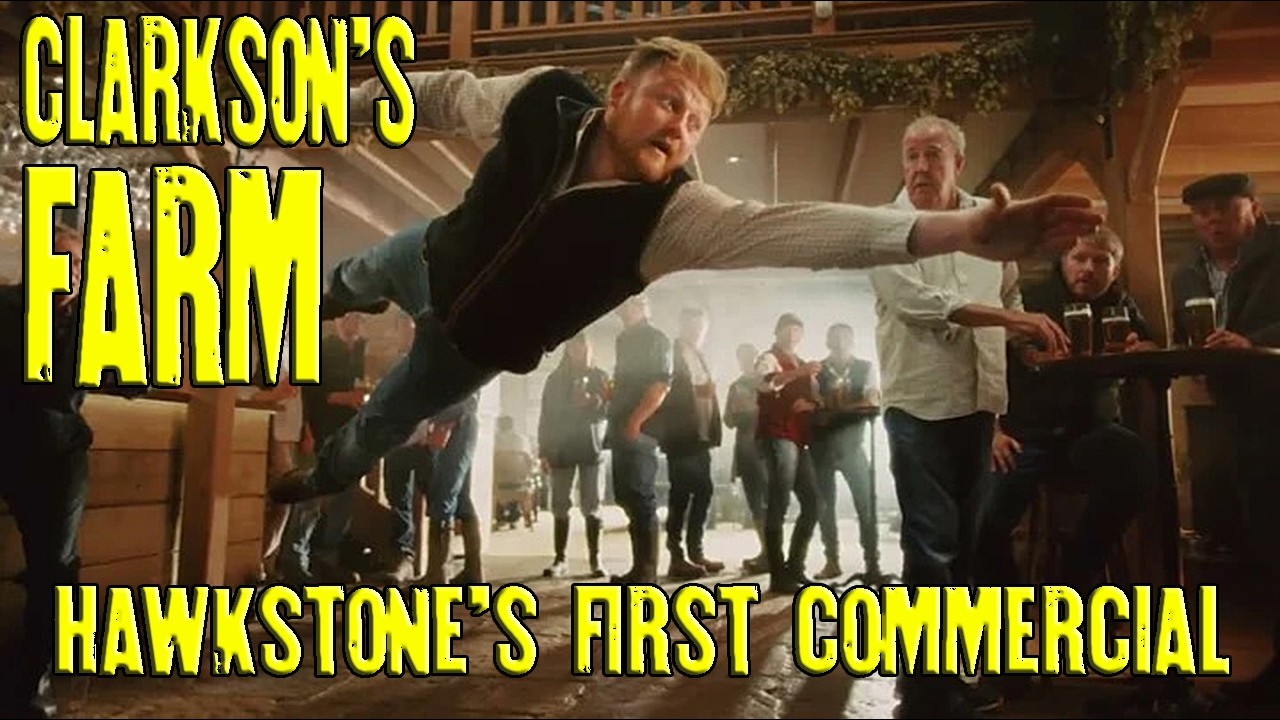
From an industry analysis perspective, the launch of the first fully licensed commercial advertisement tied to Clarkson’s Farm and the Hawkstone brand marks a significant inflection point in how agricultural entertainment IP is being monetised in the UK media landscape. What was once a hybrid of documentary storytelling and farm-based experimentation is now evolving into a vertically integrated commercial ecosystem, where broadcast content, product branding, and advertising strategy are increasingly indistinguishable.
At the centre of this development is Clarkson’s Farm, the Amazon Prime documentary series that has transformed Diddly Squat Farm from a local agricultural operation into a globally recognised media-led enterprise. The series has consistently blurred the boundary between reality television and business documentation, and the Hawkstone beer line—produced from barley grown on the farm—has become the most commercially mature extension of that ecosystem. Hawkstone itself is no longer just a side venture; it functions as a fully fledged consumer brand embedded inside the show’s narrative structure.
The “first licensed commercial advertisement” at Hawkstone, particularly in its connection to a formally broadcast and compliant media placement, signals a strategic correction following earlier promotional attempts that leaned heavily on viral controversy and informal distribution. Previous Hawkstone adverts—featuring explicit humour and intentionally provocative messaging—were widely reported as being rejected from traditional broadcast channels due to compliance issues, even as they generated significant online attention . That phase effectively positioned Hawkstone within a guerrilla marketing framework: high visibility, low regulatory integration.
The new phase is structurally different. The involvement of regulated advertising slots, premium broadcast placement, and a more controlled creative direction suggests a pivot from “attention-first marketing” to “institutional brand consolidation.” This is reinforced by recent developments in which Kaleb Cooper has been positioned as a central figure in Hawkstone’s formal television advertising strategy, with Clarkson deliberately stepping back from overt on-screen promotion in certain campaigns . That decision is not cosmetic; it reflects a maturing brand architecture in which Clarkson functions more as an ecosystem architect than the primary spokesperson.
From an analytical standpoint, the integration of licensed advertising into the Clarkson/Hawkstone model represents three key shifts.
First, it signals regulatory normalisation. Moving into licensed broadcast advertising means Hawkstone is now operating fully within UK advertising compliance frameworks. This is important because it stabilises distribution risk. Rather than relying on viral circulation or controversial framing, the brand can now scale through repeatable, predictable media buys across premium time slots.
Second, it indicates a diversification of narrative authority. Within the Clarkson media universe, authority has traditionally been concentrated in the persona of Jeremy Clarkson. However, by elevating Kaleb Cooper and other farm figures into advertising roles, the brand is effectively decentralising its storytelling. This creates multiple entry points for audience engagement: Clarkson as founder, Cooper as operational voice, and the farm itself as a lived environment rather than a constructed set.
Third, it suggests a shift in the commercial lifecycle of farm-based content IP. Hawkstone is no longer simply a product “featured in a show”; it is becoming a standalone FMCG brand with its own marketing strategy that only partially depends on Clarkson’s Farm for narrative support. This is a classic maturation curve seen in entertainment-led brands that evolve into consumer goods platforms.
The strategic timing of this “first licensed ad” is also notable. It arrives at a moment when Clarkson-related ventures are increasingly interconnected: the pub business, the farm shop, and Hawkstone distribution are forming a unified commercial triangle. In this structure, advertising is no longer promotional—it is infrastructural. It supports a closed loop where viewers of the show are directly converted into consumers of the product, and consumers of the product are reinforced as viewers of the show.
From a media analysis perspective, the most important implication is that Clarkson’s model is beginning to resemble a “content-commerce hybrid network,” similar in structure to influencer-led direct-to-consumer ecosystems but scaled into broadcast television and retail distribution. This positions Hawkstone not merely as a beer brand, but as a media-enabled consumption node.
Looking forward, several developments are likely.
The first is expansion into seasonal, event-based advertising. Given the strong association between Hawkstone, British identity messaging, and rural authenticity, future campaigns are likely to align with sporting calendars, harvest cycles, and national events. This allows the brand to embed itself into culturally recurring moments rather than relying on one-off promotional bursts.
The second is deeper integration within Clarkson’s Farm narrative arcs. Future seasons may incorporate advertising development as a visible storyline, effectively making the marketing process part of the entertainment content itself. This would further blur the boundary between documentary realism and commercial production.
The third is geographic scaling. Once licensed broadcast advertising proves effective domestically, Hawkstone is likely to push into export markets where Clarkson’s Farm already has audience traction. The UK model functions as a proof of concept for international replication.
Finally, there is the question of sustainability. The challenge for Hawkstone will be maintaining authenticity while scaling into increasingly formalised advertising structures. The brand’s early success was built on informal tone, humour, and controlled chaos. Licensed advertising introduces discipline, but also risks diluting the raw identity that made the brand culturally resonant in the first place.
In conclusion, the first licensed commercial advertisement at Hawkstone is not simply a marketing milestone. It is a structural transition point in the evolution of Clarkson’s Farm from television series to integrated media-commerce ecosystem. The next phase will determine whether Hawkstone remains a personality-driven brand anchored in Clarkson’s persona, or evolves into a self-sustaining commercial entity capable of operating independently of its original television origin.