A breakthrough in depth: Rick Ness reaches a depth of 36 meters, discovering evidence of a $290 million gold deposit.
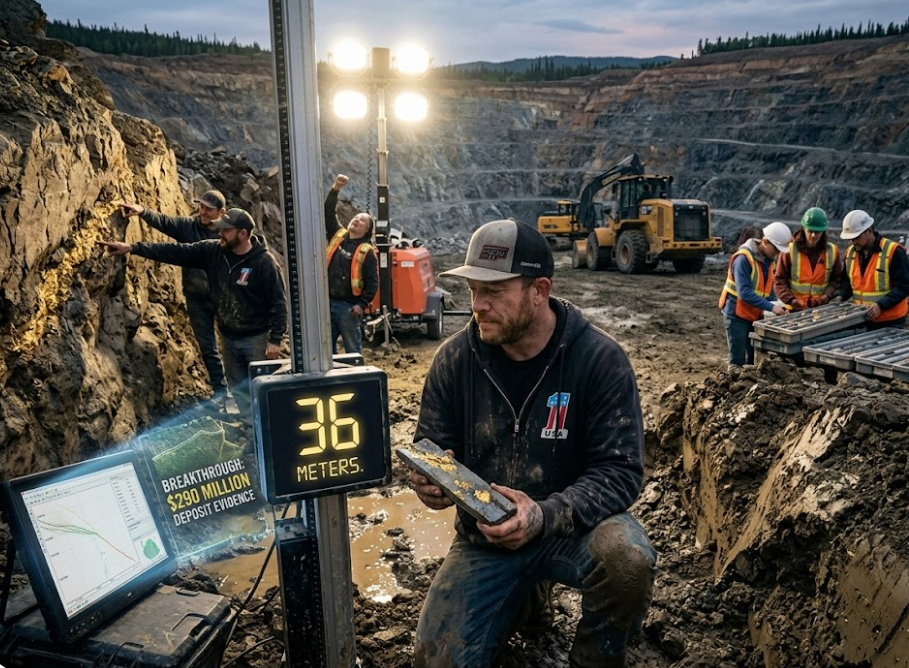
In a development that could redefine modern gold mining, Rick Ness has achieved a milestone that echoes the high-stakes drama seen in Gold Rush: he has reached a record depth of 36 meters and uncovered evidence of a potential $290 million gold deposit. This breakthrough not only demonstrates the technical and strategic prowess of Ness and his team but also provides a window into the challenges, risks, and opportunities that define contemporary gold exploration.
The operation that led to this discovery required precision, experience, and an unwavering commitment to risk management. Penetrating 36 meters of sedimentary layers is no small feat; these layers are notoriously compacted, unpredictable, and prone to collapse if improperly managed. Ness’s team relied on advanced drilling and excavation technologies, carefully balancing speed with safety to achieve the unprecedented depth. In Gold Rush, similar feats of endurance and technical expertise are common, where crews push equipment and personnel to their limits to uncover lucrative veins hidden beneath seemingly barren terrain.
The discovery of a mineral-rich layer at this depth is significant. Preliminary estimates suggest the deposit could be valued at $290 million, a figure that immediately draws attention from both investors and industry observers. While the precise composition and extractable yield remain to be verified, the initial evidence points to high-grade gold concentrations. In the context of Gold Rush, where even a single ounce can drastically alter a crew’s fortune, such a deposit represents an extraordinary opportunity and underscores the high-risk, high-reward dynamics of deep mining.
From a strategic standpoint, several implications emerge. First, the presence of gold at 36 meters challenges prior assumptions about vertical mineral distribution and the predictability of geological formations. In many Gold Rush operations, geologists’ predictions guide excavation efforts, but even detailed surveys cannot guarantee outcomes. Ness’s breakthrough suggests that further gold may exist in adjacent or deeper strata, encouraging a reassessment of exploration zones and drilling strategies. Analysts anticipate that the team may adopt phased drilling approaches to optimize yield while managing operational and financial risk.

Second, the discovery has immediate economic implications. Extracting gold from 36 meters of sediment involves significant investment in labor, equipment, and safety measures. Drawing parallels to Gold Rush, crews must consider the balance between operating costs and projected returns, factoring in both the potential for high revenue and the risk of unforeseen setbacks. A carefully staged approach is likely, where initial extraction focuses on the richest zones while gradually expanding to confirm the full extent of the deposit. The decisions made at this stage will likely dictate whether the discovery translates into a profitable operation or remains a tantalizing but unrealized opportunity.

Third, the human element remains central. Mining at such depths demands physical endurance, mental focus, and strong team coordination. In Gold Rush, crews frequently face extreme weather, equipment failures, and personal strain, all of which test leadership and decision-making. Ness’s success demonstrates not only technical competence but also effective team management and operational foresight. Analysts suggest that maintaining morale and clear communication will be as critical as the mechanical and geological challenges in ensuring the long-term success of the excavation.
Looking forward, several potential developments can be anticipated. Verification of the deposit’s composition will likely involve geochemical assays and core sampling to quantify gold content and determine extraction feasibility. Depending on these results, the team may scale operations, invest in specialized equipment, or seek partnerships to maximize yield. In Gold Rush, such decisions often define a season’s narrative, as crews navigate financial pressures, environmental constraints, and operational hazards. The discovery could similarly drive both strategic and storytelling developments in Ness’s ongoing work.
The regulatory and environmental context will also play a role. High-value gold deposits attract scrutiny from local authorities, particularly regarding land use, extraction methods, and environmental impact. Navigating these requirements will require careful planning, clear communication with stakeholders, and adherence to sustainable practices—challenges familiar to Gold Rush miners who often balance ambitious extraction goals with legal and environmental responsibilities.
Finally, the broader implications of Ness’s find touch on the psychology and culture of gold mining. The discovery reinforces the allure of deep mining and the concept of hidden wealth, themes central to the appeal of Gold Rush. It exemplifies the tension between speculation and evidence-based exploration, highlighting the delicate balance between taking calculated risks and managing expectations. Viewers and analysts alike can anticipate intense scrutiny of subsequent developments, from extraction techniques to yield reporting, as the operation unfolds.
In conclusion, Rick Ness’s achievement of reaching 36 meters and uncovering evidence of a $290 million gold deposit represents a landmark moment in modern gold exploration. From a Gold Rush analyst’s perspective, the breakthrough highlights the interplay between technical expertise, strategic decision-making, and human endurance. As the team proceeds with verification and extraction, the coming months promise not only potential financial rewards but also valuable lessons in operational strategy, risk management, and the pursuit of high-stakes mineral wealth. In the ever-unpredictable world of gold mining, Ness’s accomplishment stands as a testament to the rewards that await those willing to dig deeper, both literally and figuratively.