A Close Call Forces Mike Beets to Take Control on the Rock Truck Line
In the Klondike, leadership is rarely taught in a classroom. It is learned in moments when something almost goes wrong—and when the cost of failure is counted not in pride, but in machinery, safety, and trust. One such moment unfolded quietly on Paradise Hill, where Mike Beets found himself facing a challenge that had little to do with gold totals and everything to do with responsibility.
The incident began with a routine equipment check. A pump, recently serviced, was running with more engine oil than it should have. On paper, it was a small detail. In practice, it was a looming disaster. Overfilled oil systems build pressure, and pressure destroys engines. A blown head or crankshaft would not just stall production—it would wipe out a six-figure investment in seconds. Mike caught it in time, calling for help to drain the excess oil before damage was done.
What followed was more revealing than the mechanical save itself. Mike didn’t lash out. He didn’t assign blame. Instead, he acknowledged the reality of the situation: people had been placed into roles they were still learning, and the system around them had to adapt. “If you don’t know, you don’t know,” he admitted, making it clear that accountability doesn’t always mean punishment. Sometimes, it means recognizing gaps and fixing them before they become expensive.
That philosophy was tested again almost immediately.
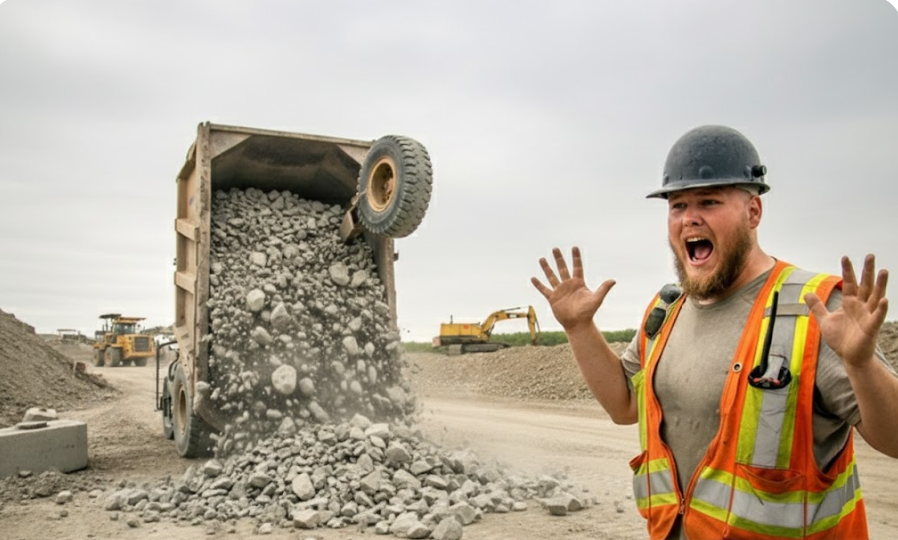
With operations shifting, Mike reassigned Kendra and Sienna to rock truck duties in the Super Pit—a move meant to simplify workflow and keep production steady. But in mining, changing roles doesn’t eliminate risk. It simply moves it. From a distance, Mike noticed something that made his stomach drop: two rock trucks running dangerously close together.
What happened next marked a turning point.
Mike didn’t hesitate. Over the radio, his voice cut through the noise, commanding one truck to stop. When it didn’t stop immediately, his tone hardened. He ordered the operator out of the cab and confronted the situation directly. This wasn’t about authority for authority’s sake. It was about preventing a scenario where a split-second delay could end in catastrophe.

His message was clear and uncompromising: spacing matters, radio communication matters, and instructions are not optional. Mining sites are unforgiving. A driver hitting the brakes unexpectedly, a radio on the wrong channel, or a moment of hesitation can trigger a chain reaction no one can stop once it begins.
Yet even in that tense exchange, Mike showed restraint. After confirming that the operator had switched channels and understood the mistake, he chose not to issue a formal write-up. Instead, he issued a final verbal warning—one that carried weight precisely because it came with explanation, not humiliation.
For the operator involved, the moment was intimidating. Fear crept in—not of punishment, but of losing the opportunity to stay. “I don’t want to go home,” she admitted. “I like it here.” That quiet confession speaks volumes about the environment Mike is shaping. People want to be there. They want to learn. They want to prove themselves.
And Mike understands that.
Later, reflecting on the incident, Mike offered one of the most telling statements of his season: “I try to be a good boss. I don’t say I am a good boss. That’s up to my employees.” It’s a line that separates inherited authority from earned leadership.
For years, Mike Beets has worked under the shadow of one of the toughest bosses in the Klondike. Tony Beets built his reputation on intensity, high standards, and relentless pressure. Mike absorbed those lessons, but moments like this show he is not simply copying them. He is refining them.
This was not a scene about gold recovery or weekly totals. It was about systems, communication, and the human side of heavy industry. It showed a young leader learning to balance caution with confidence, firmness with fairness.
In many ways, the avoided pump failure and the rock truck confrontation are connected. Both stem from the same principle: prevention beats reaction. Double-checking oil levels. Watching truck spacing. Listening to radios. These are the unglamorous details that keep operations alive long enough for gold to matter.
For viewers, this episode quietly reframed Mike’s storyline. He is no longer just proving he can run equipment or find pay dirt. He is proving he can run people—and that may be the harder test. Gold can be measured in ounces. Leadership is measured in moments when things almost go wrong and don’t.
Paradise Hill didn’t make headlines that day for a massive weigh-in or a record-breaking haul. Instead, it delivered something arguably more important: evidence that Mike Beets is growing into a boss who understands that keeping everyone safe, trained, and heard is the foundation on which every successful season is built.
In the Klondike, gold rewards effort. But leadership reveals itself under pressure. And in this moment, Mike Beets showed that he’s learning exactly what that pressure demands.