Kevin Beets Breaks NEW RECORD With Nearly Double the Gold

In the rugged mining fields of the Yukon, where winter arrives like a shutting door, Kevin Beets is confronting the most consequential chapter of his young mining career. For years, viewers have watched him work beneath the immense shadow of his father, Gold Rush icon Tony Beets. But in 2025, Kevin is no longer the apprentice — he is the boss. And with millions of dollars on the line, failing isn’t simply difficult to imagine; it is impossible to afford.
A Name, a Legacy, and a Mountain of Debt
This season marks Kevin’s first attempt at running his own fully independent mining operation. Together with his partner, Faith, he poured roughly $2 million into startup costs — machinery, fuel, labour, and new ground. To simply break even, they must recover nearly 1,000 ounces of gold. Anything less would push the entire venture into the red.
By early autumn, after five punishing months of work, Kevin’s crew had managed 470 ounces. In most seasons, that would be a respectable number. In this season, it was a crisis.
The Beets name carries enormous weight in the Yukon. Tony is known for his relentless push, his enormous operations, and a refusal to accept defeat. For Kevin, stepping out from beneath a legacy like that is both inspiration and burden.
“We really wanted to do something different than Tony,” Kevin explained. “Not chaotic. Do it once, do it right, and be done with it.”
But the Yukon has little sympathy for intentions. The frozen ground, mechanical failures, and endless repairs all threatened to collapse his season before it truly began. With only four weeks left before winter, Kevin needed a breakthrough — or he risked losing everything.
A Desperate Bet: Turning the Mine Into a 24-Hour Operation
In a decisive move, Kevin initiated an around-the-clock mining schedule. The logic was simple: if he could not increase the grade of his pay dirt, he would increase the hours spent running it.
“Double the hours, double the gold,” he told his exhausted team.
It was a dangerous gamble. Running machinery nonstop in the Yukon is not routine — it is punishment.
During the day, foreman Brennan Ruault attacked the pay ground, building enormous stockpiles of promising pay dirt from a newly identified extension of the claim. Test pans showed enough colour to spark hope: flecks of gold, maybe more.
When night fell, the operation shifted into its highest-risk period. Skilled plant operator Hunter Canning took control of the wash plant, while veteran miner Rick Johnson was brought in specifically to keep the tailings clear.
If either of them fell behind, the wash plant would stall, production would halt, and hours of gold could be washed away — literally.

Crisis in the Dark
For a time, the night shift moved like a well-oiled machine, with Hunter feeding 24 loads of material per hour. Then, disaster.
Rick’s loader sank into soft, unstable mud. He was completely stuck — and Hunter had only minutes before the hopper ran dry. If that happened, the water would force gold out of the sluice boxes in what miners dreadfully call whitewashing.
With no time to spare, Hunter quickly loaded enough dirt to buy eight minutes of run-time, grabbed a heavy-duty tow cable, and sprinted to the truck. In the dark cold, she attached the line, coordinating with Rick to pull his massive loader free.
It worked — barely. But the wash plant never stopped running.
It was a small miracle, and it kept Kevin’s season alive.
A Monster Week — and a Make-or-Break Cleanup
After the crisis, the team pushed harder than ever. Equipment jammed, rocks lodged in the grizzly, and fatigue set in, but they kept going.
Then, at last, cleanup day arrived.
The crew gathered around the gold room. Heavy silence filled the air. Everyone knew what this cleanup meant: the extension either held enough gold to rescue their season — or they were heading toward a financial disaster.
As Kevin poured the gold onto the scale, the numbers climbed rapidly.
50 ounces.
60.
100.
130.
150.
180.
190…
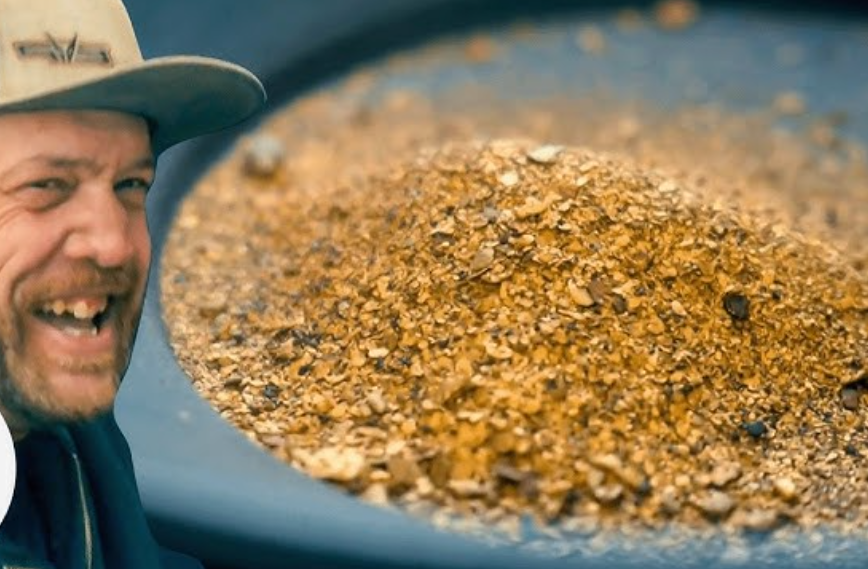
And then, finally: 205.58 ounces.
It was the largest weekly cleanup of their season — but the surprises weren’t over. Brennan stepped forward with a separate jar containing several large gold nuggets, together weighing another 4.14 ounces.
In total, the team achieved 209.72 ounces, worth more than $500,000 at current gold prices.
Their new season total: 680 ounces.
A Path Forward — But No Time to Celebrate
The extension ground had proven itself. Kevin’s gamble had paid off. But the clock is still ticking.
To reach their 1,000-ounce goal, the crew must produce another 320 ounces — in just a matter of weeks before the Yukon winter freezes operations solid.
Kevin knows the stakes better than anyone.
“If we really want to hit 1,000 ounces, we have to keep running 24s,” he said.
The season now hinges on endurance, luck, and a young mine boss’s ability to lead under crushing pressure.
Becoming His Own Beets
For fans, Kevin’s 2025 journey is one of the most compelling in years: a struggle between legacy and independence, risk and reward, youth and experience.
He’s no longer just Tony Beets’ son.
He’s the boss.
And this season may be the one that proves whether he can build his own Yukon legacy — one ounce at a time.