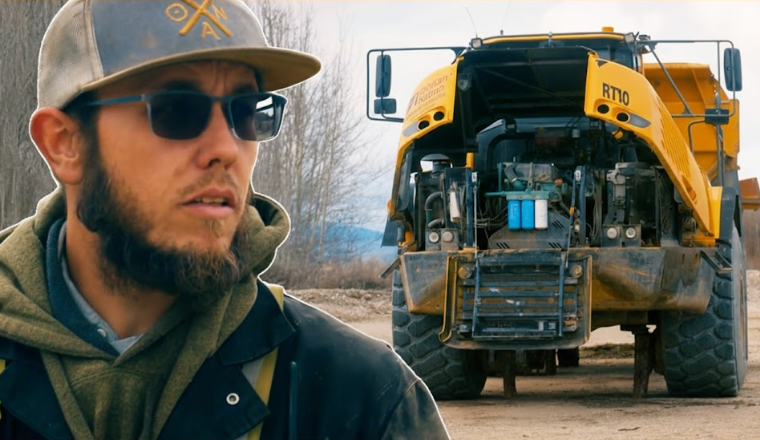
Kevin Beets’ new investment: he bought a $110,000 rock truck from Parker Schnabel!
Three miles east of Tony Beets’ long-running Paradise Hill empire, a new chapter is beginning at Scribner Creek. After 22 years working under his father, Kevin Beets has taken the leap into independent mining — and he is determined to do things differently.
Standing in front of a small but eager crew, Kevin laid out his vision for the season. His target: 1,000 ounces of gold. His approach: straightforward leadership, open communication, and a working environment where no one dreads coming to the cut.
“We’re starting a new mine,” he told the team during their first official meeting. “I’m hoping to run it a little bit different than what we’ve had to deal with in the past.”
At his side is partner Faith Teng, along with a crew that includes Brennan overseeing the cut, Hunter and Chase driving rock trucks, and Matt operating the excavator. The goal is ambitious, especially for a first-year operation built largely on borrowed machinery.
Kevin’s immediate task is to strip three acres of overburden from what he calls the Lynx cut — ground that must be cleared before reaching gold-bearing pay dirt. But the early days have been anything but smooth.
The equipment, much of it sourced from father Tony Beets, has already begun to show its age.

On one of the first major hauls, rookie rock truck driver Hunter Cannon ran into mechanical trouble climbing a muddy incline. The truck’s differential lock — a system designed to ensure wheels rotate at the same speed for better traction — failed due to broken air lines. The result was immediate: spinning wheels, lost time, and growing frustration.
Kevin diagnosed the issue quickly. “Some lines have busted,” he explained. It proved to be a relatively fast repair, replacing a damaged airline hose. But the incident underscored a larger concern.
“A lot of this is just Tony not fixing it,” Kevin remarked candidly. “When it finally gets to me and it grenades, it’s my problem.”
The repair allowed the team to resume stripping, but Kevin’s confidence in the reliability of the inherited fleet was clearly shaken. With a tight schedule and no spare trucks available, breakdowns could severely delay reaching pay dirt — and delay means money.
Mining operations at this scale carry heavy daily costs. Fuel, parts, wages and wear on machinery quickly accumulate. Kevin acknowledged that further delays were not affordable if the team hoped to begin sluicing in time to hit the 1,000-ounce goal.
That reality prompted a significant decision: invest in additional equipment.
Kevin turned to fellow miner Parker Schnabel, whose fleet includes several Volvo A40 articulated rock trucks. While new models can cost upwards of $300,000, Parker had a 2003 model available.
After inspecting the machine — checking for major leaks, reviewing wear and assessing the engine condition — Kevin concluded that despite its age, the truck appeared mechanically sound. Compared with the aging units borrowed from Tony, it offered more immediate reliability.
Negotiations were brief and firm.
“I don’t haggle,” Parker told him plainly, setting the price at $110,000.
Kevin attempted to lower the price to $105,000 but quickly realised Parker held the leverage. With his own operation under pressure and no viable alternative nearby, Kevin agreed to the $110,000 figure. Payment would come later in the season, but the commitment was binding regardless of the truck’s future performance.
“It’s a little more than I wanted to pay,” Kevin admitted, “but it’s here.”
The purchase marks a significant moment in Kevin’s first season as an independent mine boss. Unlike working within his father’s established system, every mechanical failure and financial decision now rests squarely on his shoulders.
Despite the early setbacks, Kevin’s tone remains optimistic. The stripping has begun in earnest. The newly acquired truck has returned to camp. Excavators are carving steadily into the overburden, and the operation is slowly building momentum.
“This is what I thought being a mine boss would be like,” Kevin said with a hint of irony. “It’s the exact same as Tony’s. I just don’t have anybody I’ve got to double check with.”
That independence comes with freedom — and risk.
The 1,000-ounce target represents both ambition and pressure. Achieving it would validate Kevin’s move out from under his father’s shadow and prove he can manage men, machines and money on his own terms. Falling short would raise difficult questions about timing, resources and leadership.
For now, the focus remains simple: move dirt efficiently, maintain equipment, and reach the pay layer as quickly as possible.
In the Yukon, success is rarely determined by a single bold decision. It is built through steady progress, careful budgeting and resilience when machinery fails. Kevin Beets’ first independent season is already testing all three.
As engines roar back to life at Scribner Creek, the young mine boss has made his opening move — investing heavily to stabilise his fleet. Whether that $110,000 truck becomes a cornerstone of his season or an expensive lesson remains to be seen.
What is clear is this: Kevin Beets is no longer working for Tony. He is writing his own chapter — and every ounce this season will carry his name alone.