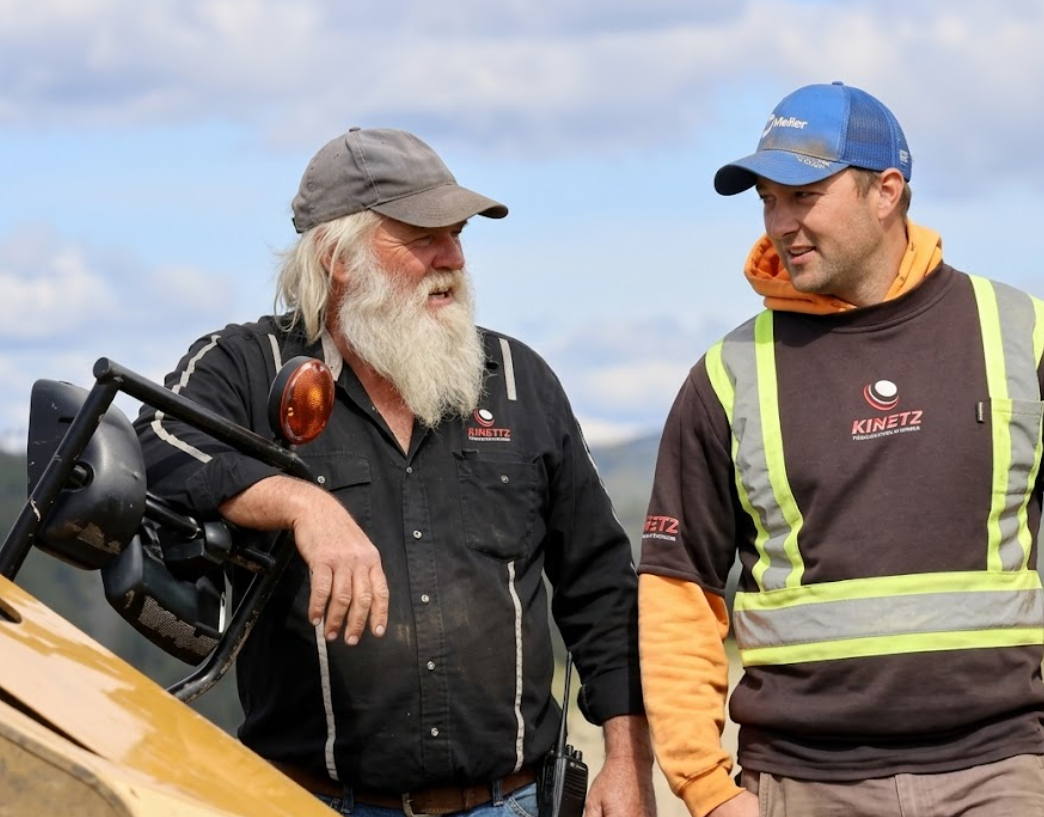
Tony Beets and Parker Schnabel are determined to invest all profits from season 16 into a business venture and have revealed some “surprising plans” for their future.

From the perspective of a long-time Gold Rush analyst, the latest developments surrounding Tony Beets and Parker Schnabel signal a clear strategic shift in the Klondike mining landscape: both operators are no longer simply chasing seasonal gold totals—they are actively converting short-term profits into long-term industrial positioning.
The core claim that both miners intend to reinvest all Season 16 profits into their businesses, combined with hints about “future plans,” is less a surprise and more a confirmation of where the series has been heading for several seasons. However, the scale and timing of this reinvestment phase could reshape competitive dynamics heading into the next cycle.
A Shift From Seasonal Mining to Industrial Expansion
Season 16 has already been framed as one of the most financially productive years in the franchise’s history, with combined operations across the main crews approaching the symbolic $100 million revenue threshold according to industry commentary tied to the show’s production narrative . Parker Schnabel’s operation alone has been described as burning through up to $250,000 per day in operating and acquisition costs during peak production phases , a figure that illustrates the capital intensity now defining modern placer mining.
Tony Beets, meanwhile, continues to operate on a scale that prioritizes infrastructure dominance—draglines, legacy equipment revival, and multi-claim coordination. His Season 16 performance, including a reported 11,231 ounces of gold, reaffirmed his position as the benchmark for high-output, high-complexity operations in the Yukon .
Against this backdrop, reinvestment is not optional—it is structural necessity. Both miners are effectively running industrial-scale enterprises in remote environments with narrow seasonal windows.


Parker Schnabel: Scaling Efficiency Into Aggressive Expansion
Parker’s reinvestment philosophy has always leaned toward aggressive scaling rather than conservative profit retention. The Season 16 pattern reinforces this: rapid deployment of multiple wash plants, simultaneous cut development, and continuous land stripping indicate a strategy built around throughput maximization rather than margin protection.
From an analytical standpoint, Parker’s decision to reinvest all profits suggests three likely priorities:
First, land consolidation. In modern Gold Rush operations, control of contiguous ground is more valuable than isolated high-grade cuts. Parker’s future trajectory likely involves locking down larger claim networks to reduce mobilization inefficiencies.
Second, fleet modernization. With operational burn rates already extremely high, marginal gains in fuel efficiency, machine uptime, and automation will have outsized financial impact. Expect increased adoption of higher-capacity wash systems and possibly semi-autonomous support machinery.
Third, labor system optimization. Parker’s long-term edge has consistently come from structured, disciplined crews. Reinventing incentive structures—bonus-linked output systems or rotational deployment models—would align with his historical management style.
In essence, Parker is likely transitioning from “high-output miner” to “regional mining operator.”
Tony Beets: Infrastructure Legacy and Asset Lock-In Strategy
Tony’s reinvestment approach is fundamentally different. Where Parker optimizes for speed and efficiency, Tony optimizes for durability and redundancy. His operational philosophy has always centered on controlling physical infrastructure that outlives individual seasons.
Reinvesting Season 16 profits into the business likely means:
- Expansion or refurbishment of legacy dredging systems
- Acquisition of additional claims to support multi-site operations
- Heavy equipment upgrades focused on longevity rather than agility
Tony’s known pattern is to convert liquid gold revenue into tangible, immovable assets. This reduces his exposure to seasonal volatility and allows his operation to function like a multi-year extraction system rather than a seasonal dig.
The “surprising information” hinted at in recent discussions likely relates to internal succession planning or structural delegation within the Beets family operation. As Tony’s operation scales, operational fragmentation becomes inevitable, requiring more formalized leadership layers.
Competitive Implications: A Two-Speed Industry
The reinvestment decisions by both miners highlight a widening strategic gap within Gold Rush:
- Parker represents a growth acceleration model
- Tony represents a capital entrenchment model
These are not competing philosophies in the short term, but they diverge significantly over longer cycles. Parker’s model produces faster scaling but higher exposure to operational risk. Tony’s model produces stability but requires heavier upfront capital lock-in.
This divergence sets up a natural tension for future seasons: efficiency versus durability.
Predictions for the Next Phase
Based on current trajectories, several developments are highly plausible:
- Increased mechanization in Parker’s camp
Expect more automated material handling and higher throughput wash configurations aimed at reducing downtime. - Tony expanding multi-claim coordination
His operation may increasingly function as a network of semi-independent dig sites rather than a single dominant base. - Rising labor competition across camps
Skilled operators will become more valuable than equipment itself, leading to potential crew reshuffling between major operators. - Higher financial volatility per season
With full reinvestment, cash reserves may shrink temporarily, increasing pressure to hit seasonal targets.
Strategic Outlook: Why This Moment Matters
What makes this development significant is not simply that profits are being reinvested—it is that both leading operators are simultaneously committing to full-cycle reinvestment at a time when gold mining costs, equipment complexity, and logistical constraints are already at historic highs.
In practical terms, Season 17 and beyond will likely not be defined by who “finds more gold,” but by who builds a more resilient mining system under increasing environmental and economic pressure.
If Season 16 was about output, the next phase of Gold Rush appears to be about permanence. And in that context, both Parker Schnabel and Tony Beets are no longer just miners—they are building competing mining empires with fundamentally different blueprints for survival.