ANCIENT STRUCTURES EMERGE FROM OAK ISLAND SWAMPS: Iron nails and screws fuel the theory of an ancient temple built on Oak Island in the 15th century.
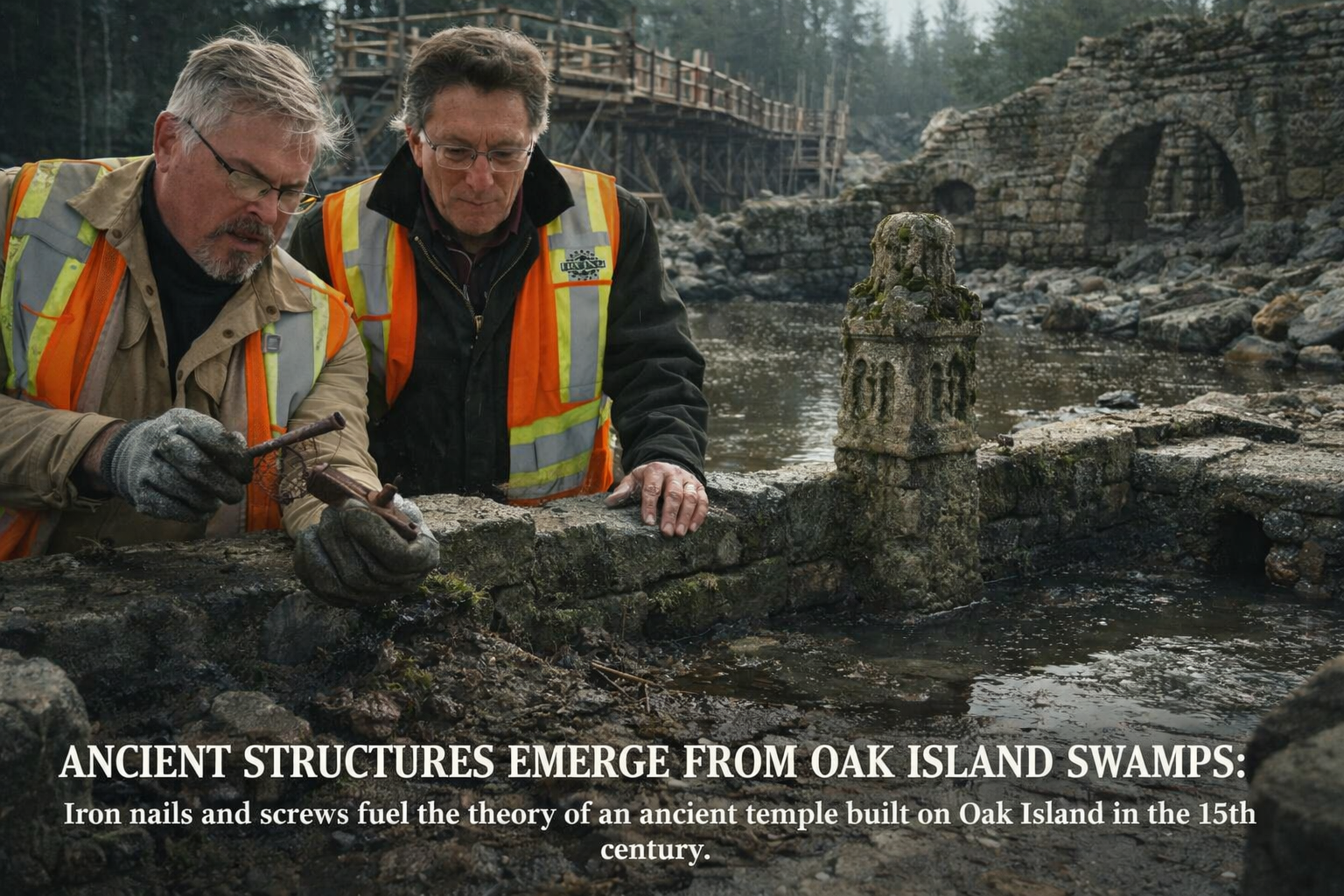
A new wave of discoveries emerging from the Oak Island swamp has reignited one of the most controversial and ambitious theories in the island’s investigative history: the possibility that a large-scale, deliberately constructed temple-like structure may have existed on the site as early as the 15th century. The latest finds—iron nails, screws, and embedded fasteners recovered from deep within the swamp’s sediment layers—are now being analyzed as potential evidence of advanced pre-colonial or early medieval construction activity.
From an analytical standpoint, this development represents a significant shift in interpretation. What was once considered fragmented maritime debris or colonial-era remnants is increasingly being re-evaluated as part of a larger, possibly organized architectural system.
A SWAMP THAT MAY ONCE HAVE BEEN BUILT, NOT FORMED
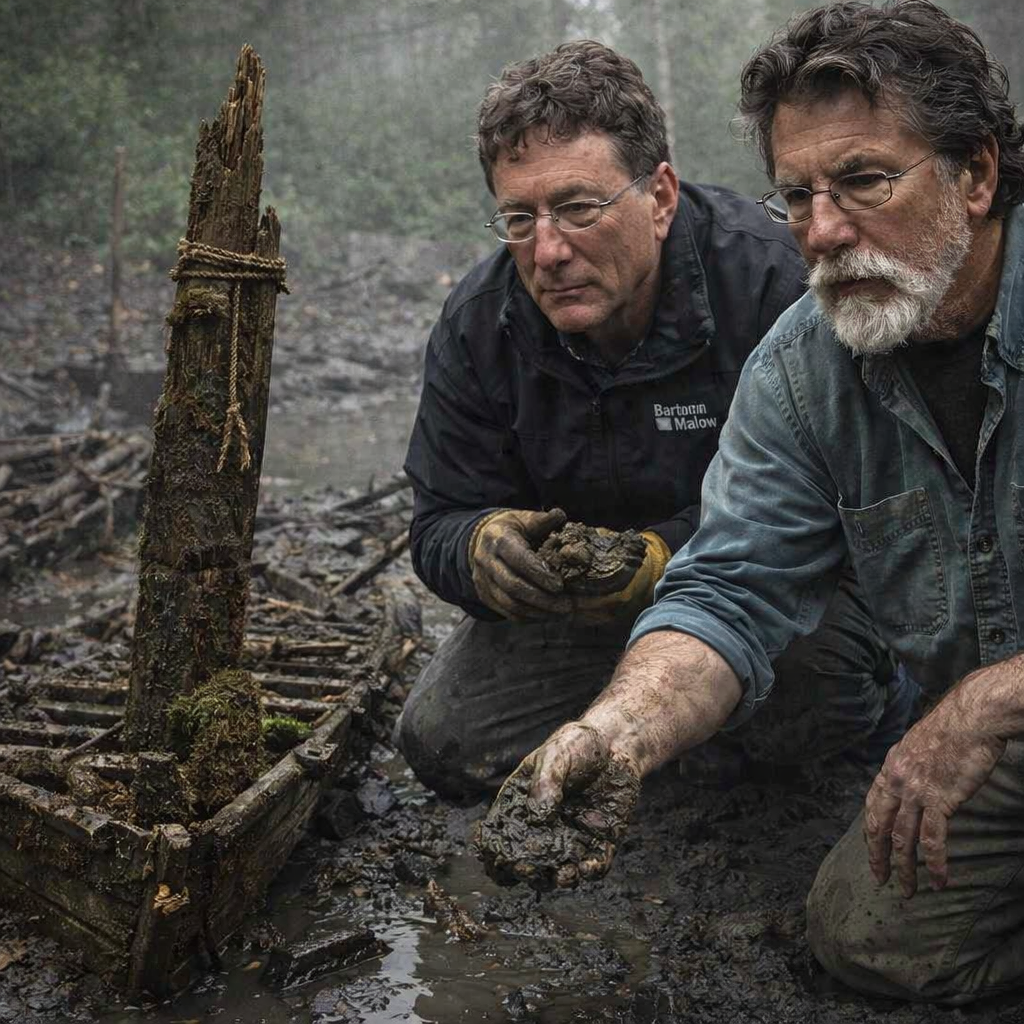
The Oak Island swamp has long been suspected to conceal engineered structures beneath its brackish surface. Previous investigations have revealed stone alignments, wooden remnants, and anomalous metal objects suggesting sustained human activity in a highly coordinated environment.
However, the latest recovered artifacts—particularly hand-forged iron nails and early-style screws—have added a new dimension to the debate. Unlike mass-produced hardware from later industrial periods, these items exhibit irregular shaping, inconsistent threading, and signs of manual forging techniques consistent with pre-1700s craftsmanship.
According to field interpretations, these characteristics significantly strengthen the argument that the swamp may contain remnants of a constructed environment rather than naturally deposited material.

THE TEMPLE THEORY ENTERS MAINSTREAM DISCUSSION
While Oak Island theories have historically ranged from pirate treasure vaults to military concealment sites, the emergence of a “temple hypothesis” marks one of the most structurally complex interpretations to date.
Under this model, the swamp is not simply a burial site or accidental accumulation zone, but rather the remains of a large ceremonial or religious complex potentially built in the 1400s. Proponents of this theory suggest that the presence of precision-aligned stone features, combined with engineered drainage or water control structures, could indicate a deliberately designed sacred space.
The newly discovered iron components are central to this argument. Their placement within what appears to be organized layers of construction debris suggests they were not randomly discarded but instead functionally integrated into structural systems.
IRON ARTIFACTS REWRITE THE TIMELINE QUESTION
One of the most critical implications of these findings lies in their potential dating. Preliminary assessments of similar artifacts from previous seasons have placed them anywhere between the 15th and 17th centuries, based on forging style and corrosion patterns.
If the current batch of nails and screws can be conclusively dated to the 1400s, it would push human engineering activity on Oak Island back centuries earlier than previously confirmed historical records suggest.
This raises an important analytical question: were these artifacts part of early European contact activity, pre-colonial maritime construction, or an entirely unknown localized settlement?
Each possibility carries significant implications for how Oak Island is understood in the broader context of Atlantic history.
STRUCTURAL PATTERNS BENEATH THE SWAMP
Beyond individual artifacts, the spatial distribution of finds is equally compelling. Excavation teams have repeatedly recovered iron fragments, wooden structural remnants, and stone alignments from tightly clustered zones within the swamp.
This pattern is consistent with structured construction rather than scattered debris fields. In archaeological terms, clustering often indicates functional design—such as foundations, docking systems, or enclosed architectural spaces.
Analysts now suggest that the swamp may have undergone intentional modification, possibly involving controlled flooding or land alteration to conceal or preserve underlying structures.
If true, this would align with theories that Oak Island’s swamp was not naturally formed, but engineered as part of a larger construction plan.
IMPLICATIONS FOR THE TREASURE HYPOTHESIS
The introduction of a temple-based theory does not necessarily displace traditional treasure hypotheses but instead reframes them. In this model, any potential treasure would not be the primary objective of the structure but rather a secondary feature within a larger architectural or ceremonial complex.
This perspective explains the presence of high-value metal artifacts in proximity to structural remains without requiring a singular hidden vault narrative.
Instead, Oak Island becomes a layered historical site—one potentially containing multiple phases of construction, modification, and concealment across centuries.

EXPERT ANALYSIS AND CAUTIONARY INTERPRETATION
Despite growing excitement around these discoveries, experts emphasize caution. Iron nails and screws alone do not confirm the existence of a temple or large-scale religious structure. Similar artifacts can also originate from shipbuilding, colonial trade activity, or industrial-era modifications.
However, what distinguishes the current findings is not any single artifact, but the consistency of engineered signals across multiple excavation zones.
From an analytical standpoint, the convergence of stone features, timber remnants, and early-forged metalwork strengthens the argument that the swamp area was intentionally shaped by human hands over an extended period.
WHAT COMES NEXT IN THE INVESTIGATION
The next phase of investigation is expected to focus on deeper stratigraphic excavation and advanced material dating techniques. Researchers aim to determine whether the iron artifacts are isolated or part of a continuous structural layer extending beneath the swamp floor.
Ground-penetrating surveys and metallurgical analysis will play a critical role in verifying whether these finds belong to a single construction phase or multiple historical periods.
If deeper layers confirm structural continuity, the temple hypothesis could shift from speculative theory to a leading interpretive model.
CONCLUSION: A MYSTERY REDEFINED, NOT RESOLVED
The latest Oak Island discoveries do not provide definitive answers, but they significantly expand the scope of the mystery. The presence of iron nails, screws, and structural fasteners within a controlled swamp environment suggests intentional human engineering on a scale that is still not fully understood.
Whether this represents a lost temple, a maritime complex, or a multi-phase construction site remains unknown. What is increasingly clear, however, is that Oak Island continues to resist simple explanations.
Each layer uncovered adds not closure, but complexity—pushing the narrative further back in time and deeper into the realm of historical uncertainty.