BETWEEN PASSION AND PADDOCK: Why Fans Are Furious Yet Hooked on The Curse of Oak Island

For thirteen seasons, The Curse of Oak Island has held a global audience captive with a singular, tantalizing premise: a multi-million-dollar treasure is buried deep beneath the swampy soil of Nova Scotia. Yet, as the historical Season 13 finale approaches, a growing collective roar is rising from the fan base. Viewers find themselves caught in a psychological tug-of-war, walking a fine line between genuine historical passion and the frustrating realization that they might be watching one of the most brilliantly orchestrated “milking” campaigns in reality television history.
Are Rick and Marty Lagina truly on the verge of uncovering a world-altering cache, or is History Channel simply stretching a 225-year-old legend to reap lucrative syndication fees, commercial ad revenue, and endless streaming residuals?
The Illusion of “The Next Big Breakthrough”
The primary source of viewer frustration stems from the show’s formulas. For over a decade, Prometheus Entertainment has mastered the art of the “curiosity gap.” Every episode follows a strict, agonizingly slow cadence: a dramatic voiceover, a sudden commercial break just as a metal detector clicks, and a series of minor artifacts that are hyped as definitive game-changers.
Longtime critics argue that the series has weaponized delay tactics. When the team uncovers a silver ingot, the fragments of a black iron code box, or a stunning purple gemstone, the narrative rarely pushes forward immediately. Instead, the find is sent away for weeks of laboratory analysis by Emma Cullen, leaving viewers trapped in a loop of repetitive speculation. To many, this feels less like a scientific expedition and more like a corporate strategy to stretch a single discovery across an entire broadcasting block to secure television syndication rights.
The Human Cost vs. The Reality Gimmick
What keeps the audience from walking away entirely is the undeniable authenticity of the Fellowship. The passion of Rick Lagina is real, as is the staggering financial investment of Marty. The physical stakes have never been higher, highlighted by the recent, terrifying excavator explosion on the western drumlin that left legendary operator Billy Gerhardt with a shattered right arm.
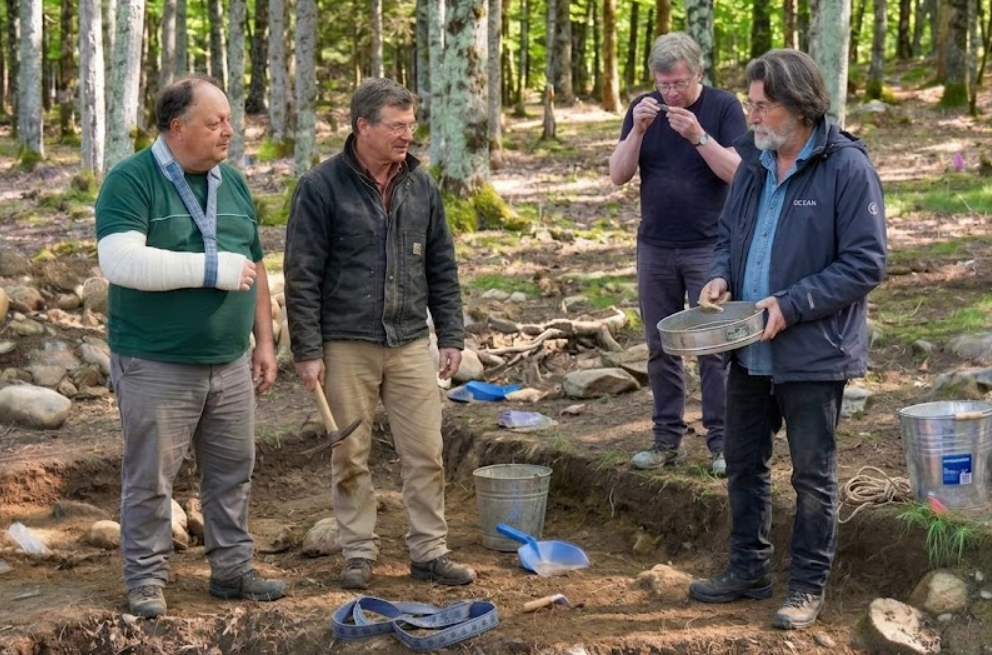
When Billy recently made his emotional visits to Lot 5 and the War Room, vowing to beat his age-related healing constraints and return to the dirt, the raw humanity of the show was on full display. Fans stay hooked because they love the crew. However, when the network counters this genuine drama with sensationalized theories—such as linking the recently excavated Viking wooden dragon or the 12,000-year-old Astrolabe directly to the lost city of Atlantis—the audience feels manipulated. Critics argue these wild leaps are designed purely to generate social media headlines and keep advertisers paying premium rates for prime-time slots.
The 20-Meter Ultimatum
The ongoing race down the 20-meter mark of the Garden Shaft has become the ultimate tipping point. The show has painted this deep-strata timber vault as the definitive gateway to the Knights Templar repository. If the team breaks into an empty cavern or gets blocked by the island’s legendary flood tunnels yet again, the “milking” narrative will likely solidify in the minds of mainstream viewers.
-
The Cynic’s View: The show will deliver a massive cliffhanger at the 20-meter line, forcing a renewal for Season 14 to keep the production revenue flowing.
-
The Optimist’s View: The sheer volume of unprecedented anomalies found this year proves the Laginas are genuinely dismantling a brilliant, ancient defense system.
The Judgment Day Finale

As the clock ticks down to the final broadcast of Season 13, the producers are out of running room. The audience’s patience is officially exhausted. The upcoming finale cannot rely on another mysterious piece of old wood or a cryptic scrap of parchment to justify its existence.
This final episode will serve as the ultimate verdict. If the Lagina brothers pull a tangible, undeniable treasure from the granite dome—proving that Captain Kidd’s Hoard or the Templar relics exist—they will secure their place in archaeological history. If the episode ends in silence, darkness, and an empty excavator cab, The Curse of Oak Island will be remembered not as a legendary treasure hunt, but as television’s most lucrative, beautifully packaged illusion.