DISCOVER FROM THE PAST: Billy Gerhardt unearthed a 100-pound iron cipher box in the Oak Island swamp.
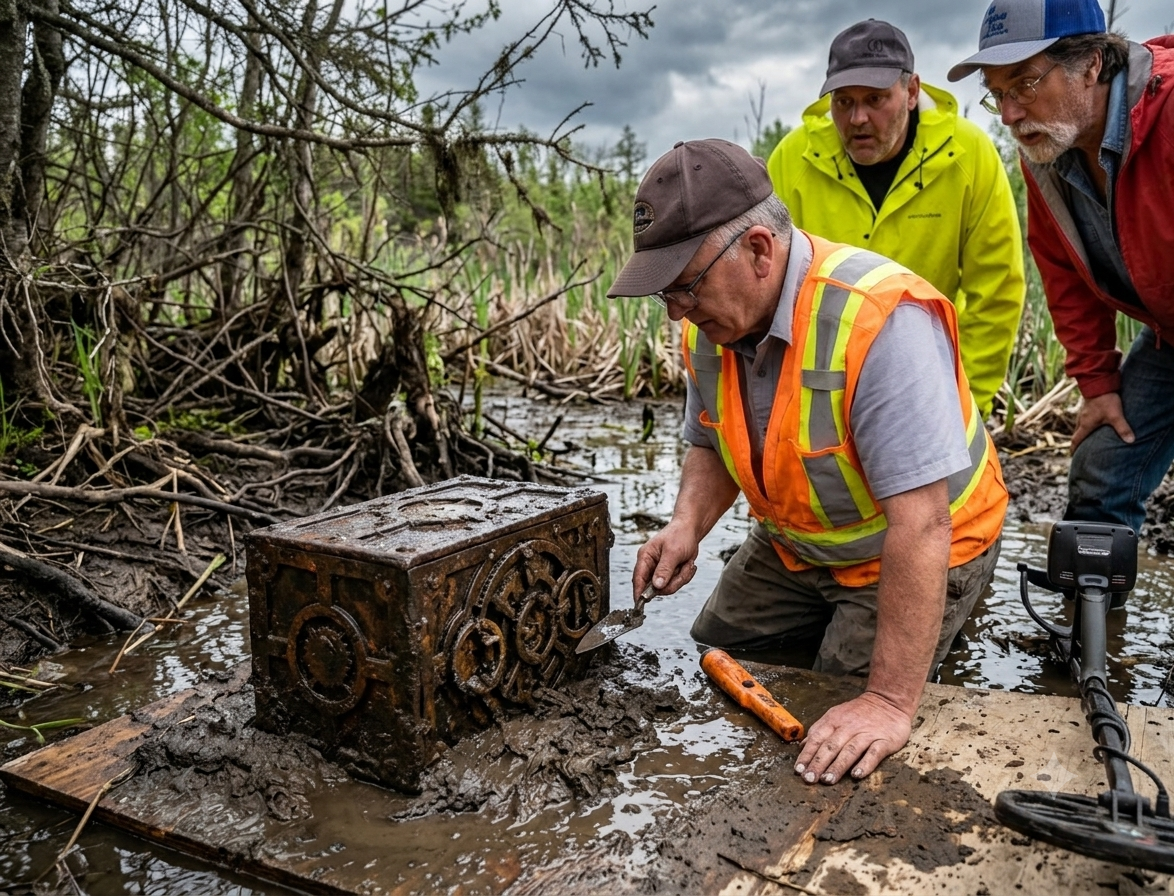
Oak Island swamp represents one of the more intriguing developments in the ongoing investigation of the island’s engineered landscape. While Oak Island has produced a long sequence of metallic artifacts, stone alignments, and waterlogged structures, the introduction of an object explicitly described as a “cipher box” shifts the interpretive framework from passive storage toward deliberate information encoding.
In the context of the swamp, this matters significantly. The swamp is no longer interpreted as a natural bog but increasingly as a constructed operational zone. Prior excavation layers have already demonstrated engineered features such as stone-paved surfaces, cobblestone roads, and timber-lined structures that cut against natural stratigraphy. Evidence from earlier seasons has also shown organized layouts of wooden stakes and pathways that suggest surveyor-driven planning rather than random deposition.
Against that backdrop, the iron cipher box—reportedly recovered during deep excavation adjacent to a compacted clay layer—fits into an established pattern: heavy, purpose-built objects placed within or beneath engineered swamp features. At approximately 100 pounds, the object’s mass alone implies it was not designed for casual transport or concealment. Instead, it suggests either intentional burial at a fixed coordinate or a mechanism intended to resist environmental degradation and unauthorized recovery.
Analytical Breakdown of the Cipher Box
From a forensic-archaeological perspective, the term “cipher box” typically implies one of three possible functions:
First, it could be a secure document container, designed to hold encoded maps, navigational instructions, or ownership records. The iron composition would provide both waterproofing and protection against crushing pressure from overlying sediment.

Second, it may represent a mechanical locking system, possibly a multi-layered compartment requiring a sequence or tool-based unlocking method. This interpretation aligns with known historical maritime and colonial-era strongboxes used for sensitive cargo.
Third, and more speculatively, it could be part of a distributed system of encoded markers—meaning the box itself is not the treasure, but a key component in a larger navigational or symbolic framework spanning multiple swamp sites.
Each of these interpretations gains plausibility when compared with previously documented Oak Island swamp discoveries. For instance, prior excavations have uncovered iron hooks, ship-related hardware, and slate-and-brick vault structures that appear deliberately positioned along linear pathways.
Context Within Known Swamp Engineering
The swamp has repeatedly demonstrated signs of layered construction phases. Earlier interpretations of stone roads, timber alignments, and drainage-controlled zones suggest at least two major historical periods of modification. One phase appears consistent with 17th-century colonial activity, while another may extend earlier, potentially medieval or proto-industrial in character.
Within that framework, the iron cipher box could represent a transitional artifact bridging those phases. Its material composition suggests post-medieval metallurgy, yet its alleged placement within deep swamp strata indicates either long-term environmental encapsulation or deliberate deposition during early construction phases.
If the box is genuinely a cipher device, it may correlate with the broader hypothesis that the swamp functioned as an engineered transit and control zone. In that model, artifacts are not random losses but structured elements of a logistical or coded system—potentially linking the swamp road network, the Money Pit corridor, and offshore landing points.
Competing Interpretive Models
There are currently three dominant analytical models that could explain the presence of such an object:
The first is the “treasure security model,” in which the cipher box is a high-security container designed to protect sensitive valuables or documents tied to a larger hoard. This would imply that the swamp functioned as a protective buffer zone.
The second is the “military or maritime logistics model,” which interprets the swamp as a controlled staging ground for cargo movement. In this case, the cipher box could represent encrypted orders, navigation charts, or coded cargo manifests.
The third is the “symbolic encoding model,” which suggests that Oak Island’s features form a layered puzzle system. Under this interpretation, the cipher box is not simply functional but part of a deliberately designed intellectual structure—possibly intended to conceal access instructions to deeper sites.
Predicted Next Steps in the Investigation
If standard investigative protocols are followed, the immediate next phase will likely involve non-destructive imaging. High-resolution CT scanning or industrial X-ray analysis would be essential to determine whether the box contains internal compartments, movable plates, or mechanical locking elements.
Metal composition analysis will also be critical. Determining whether the iron is locally forged or imported could significantly narrow its historical origin. Trace elements, slag inclusions, and corrosion patterns may reveal whether the object was produced in a European workshop or locally manufactured using colonial-era techniques.
Additionally, spatial correlation analysis will likely be conducted. If the box aligns geometrically with previously discovered swamp roads or stake formations, it could strengthen the hypothesis of a coordinated design system rather than isolated artifact deposition.

Forecasted Implications for the Oak Island Model
Should the cipher box prove to contain encoded material, it would represent one of the strongest indicators yet that Oak Island’s swamp was not merely a burial zone but an organized information environment. That would elevate the site from a collection of anomalies to a structured archaeological system with intentional design logic.
Conversely, if the box is found to be empty or purely functional, its significance would still remain substantial. Even without internal contents, its weight, placement, and construction could reinforce the argument for high-effort engineering activity in a hostile wetland environment.
Conclusion
The reported discovery of Billy Gerhardt’s 100-pound iron cipher box does not, in itself, resolve the Oak Island mystery. However, it meaningfully intensifies the analytical pressure on existing theories. Whether interpreted as a secure container, a mechanical code device, or a symbolic marker, it extends the swamp narrative toward a more structured and intentional framework.
In analytical terms, the most important development is not the object alone, but its consistency with an emerging pattern: engineered pathways, deliberate deposition, and multi-phase construction across centuries. If that pattern continues to hold, the cipher box may ultimately be remembered not as an isolated find, but as a critical node in a much larger, still-unfolding system buried beneath the swamp.