PREHISTORIC PROOF: Lagina Brothers Discover Mammoth Tusk Deep Within Oak Island
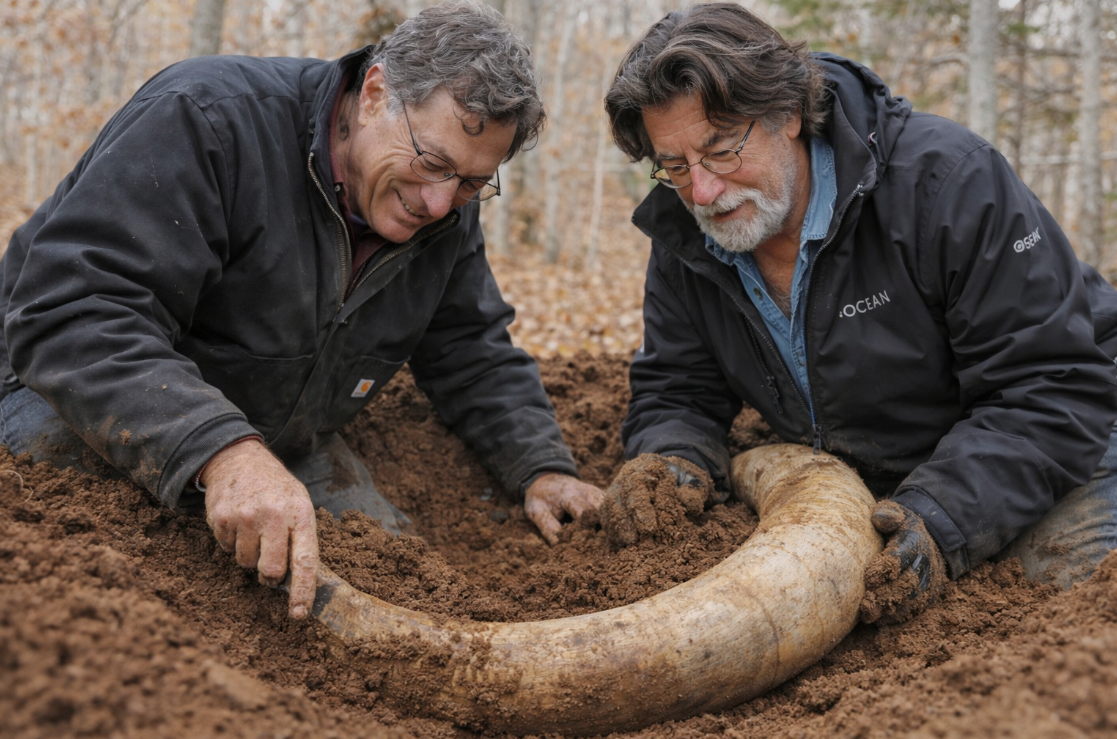
The saga of Oak Island has taken a turn from the historical to the prehistoric. In a series of events that have left both the Fellowship of the Dig and the scientific community reeling, Rick and Marty Lagina have confirmed the discovery of a remarkably well-preserved Mammoth tusk deep within the island’s subterranean layers.
This find follows a string of bizarre anomalies in Season 13, including the theft of 14th-century Roman coins, a mysterious “warfare shell,” and an oversized bone fragment. The tusk, however, provides the most tangible—and massive—evidence yet that Oak Island holds secrets far older than the Knights Templar or the Golden Age of Piracy.
A Discovery in the Depths
The tusk was located during a high-stakes drilling operation in the “Money Pit” area, at a depth of approximately 160 feet. The team was utilizing a heavy-duty oscillator to sink a ten-foot-wide steel caisson when the machinery hit a stubborn obstruction. Fearing they had struck a treasure chest or a massive boulder, the team sent down a specialized “grab” tool to clear the path.
When the tool returned to the surface, it wasn’t carrying wood or stone. Instead, it clutched a curved, ivory-colored object nearly five feet in length.
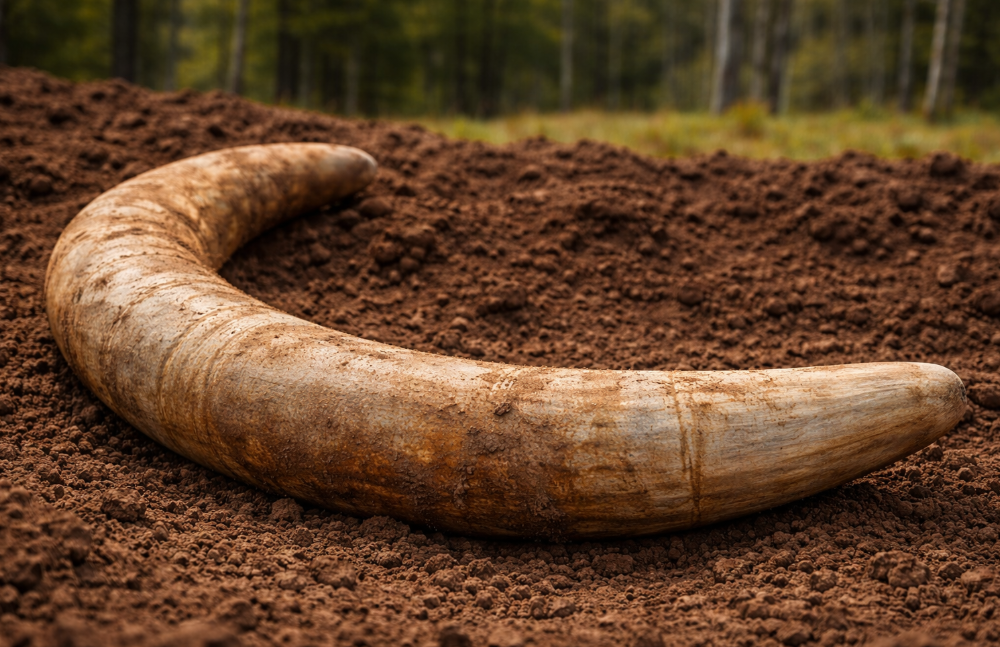
“I’ve seen a lot of strange things come out of this ground,” Rick Lagina said, visibly emotional as he inspected the find. “But to see the characteristic ‘Schreger lines’ of ancient ivory… to hold a piece of a creature that hasn’t walked this earth in ten thousand years… it’s humbling. It changes the gravity of everything we are doing here.”
Rewriting the Timeline
The Woolly Mammoth (Mammuthus primigenius) is believed to have gone extinct in mainland North America roughly 10,000 years ago. The presence of a tusk at such a specific depth raises two explosive possibilities for the team:
-
Natural Preservation: The tusk may have been naturally deposited during the last Ice Age, preserved by the unique anaerobic conditions of the Oak Island soil and flood tunnels.
-
Human Placement: More controversially, some team members suggest the tusk could have been “cached” or hidden by ancient mariners. Mammoth ivory was a highly prized commodity in the ancient and medieval worlds, often traded as a substitute for elephant ivory.
“If this was buried here naturally, it tells us about the geology of the island,” Marty Lagina explained. “But if this was brought here by the same people who built the flood tunnels, we are looking at a level of wealth and resourcefulness that goes beyond anything we previously imagined.”
The Scientific “Gold Mine”
The tusk has been transported to a climate-controlled facility under heavy guard—a necessary precaution following the recent “War Room” heist. A team of paleontologists from Dalhousie University has been called in to perform Radiocarbon Dating and DNA Extraction.
Initial scans suggest the ivory is incredibly dense, indicating the animal was in its prime when it died. If the carbon dating aligns with the 14th-century dates of the stolen Roman coins, it would suggest a truly bizarre historical anomaly: that someone in the Middle Ages was transporting prehistoric remains to Oak Island.
“This isn’t just a treasure hunt anymore,” noted metal detection expert Gary Drayton. “We’re digging through a museum of the impossible.”
The “Curse” and the Quest
For many fans, the discovery of a Mammoth tusk adds a “mythic” layer to the island’s legend. As the Season 13 finale approaches, the Fellowship is facing more questions than answers. Between the military shells, the giant bones, and now the prehistoric ivory, the “Money Pit” is looking less like a simple hole in the ground and more like a crossroads of world history.
Rick Lagina remains focused on the ultimate goal. “Whether it’s gold, Roman coins, or Mammoth ivory, the truth is down there. And we aren’t stopping until we find it.”