The Oak Island investigation team follows clues about the Templar Knights’ journey to Italy as the mystery of the Lead Cross is revealed.
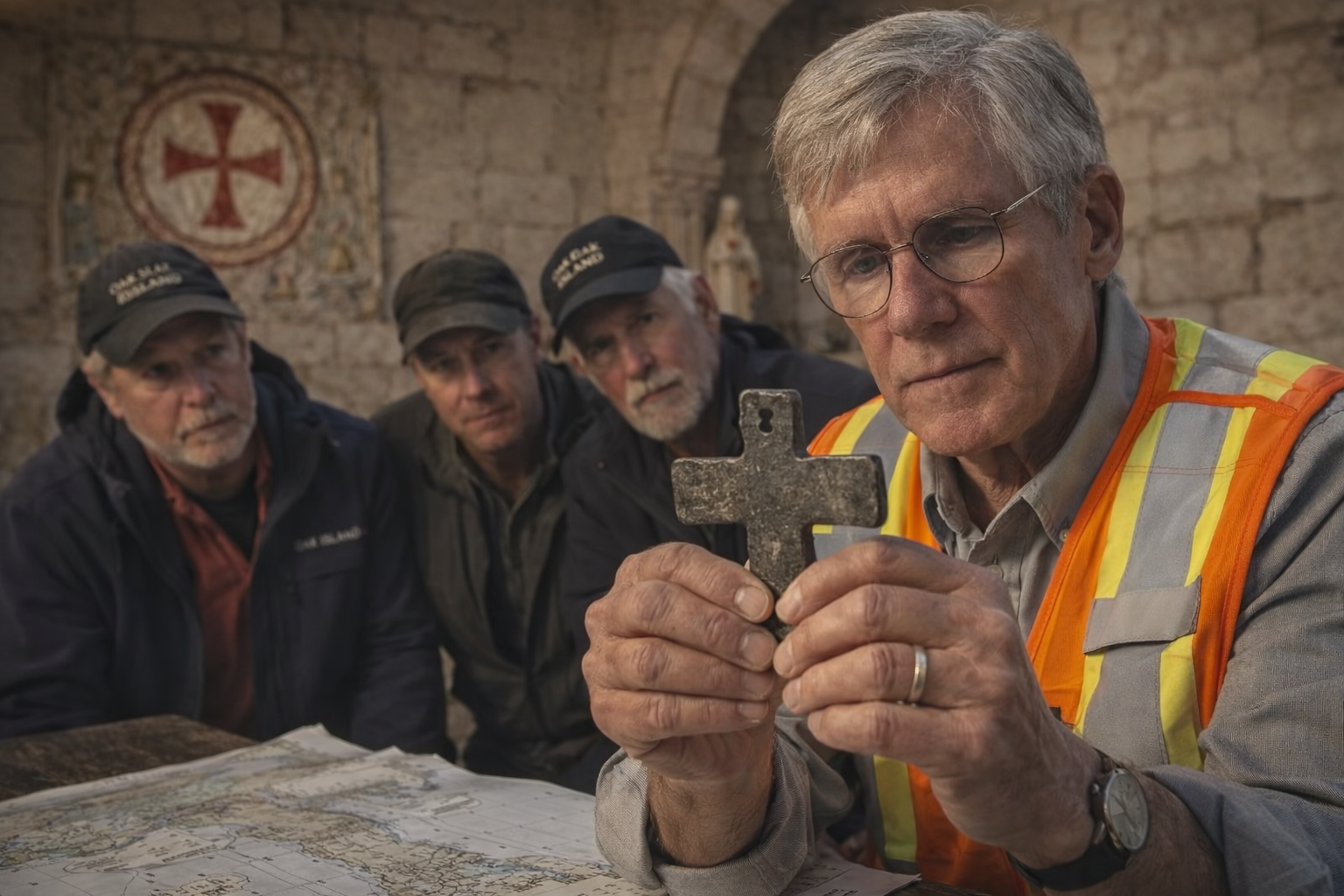
The search for answers on The Curse of Oak Island has moved far beyond the shores of Nova Scotia, taking Rick Lagina and members of the team to Italy in pursuit of one of the island’s most debated theories. In a journey stretching nearly 3,700 miles from Oak Island, Rick, his nephews Alex Lagina and Peter Fornetti, historian Doug Crowell and researcher Cory Mole travelled through a series of ancient underground sites and churches linked by symbols, caves and possible connections to the Knights Templar.
The trip was built around one of the most important artifacts ever found on Oak Island: the lead cross discovered at Smith’s Cove in 2017. Since that find, researchers have debated whether the cross could point toward a European, and possibly Templar, connection to the island. The Italy investigation aimed to test that idea by comparing the object with symbols and structures found in locations with known medieval and religious history.
The first major stop was Cammarano, Italy, where the team met researchers Emiliano Sacchetti and Alberto Recanatini. The site is known for its vast man-made underground cave system, believed to date back more than 2,500 years. Although the town itself dates to the late 12th century, the caves may have origins in the sixth century BC, long before later medieval groups reshaped parts of the region.
For the Oak Island team, the most important feature was the so-called Venus Cave. Researchers believe part of the cave system has a shape that closely resembles the Oak Island lead cross. That connection has attracted attention because the Cammarano caves were later associated with the Knights Templar, the medieval military order whose history has long been linked to legends of hidden religious treasures.

Inside the cave, the team examined the cross-shaped chamber and noted a striking similarity. One arm of the cave appeared longer than the other, matching a feature also seen on the lead cross. For Rick Lagina, the moment carried emotional weight because the research built on earlier work shared by his late friend Zena Halpern, whose theories helped push the team toward possible Mediterranean and Templar connections.
The question is not whether the cave proves that the Templars reached Oak Island. It does not. But the comparison gives the team another visual and symbolic link to investigate. In the world of Oak Island research, where physical evidence is often fragmentary, repeated symbols across distant places can become part of a larger pattern.
The team’s next stop was Osimo, where they visited the Grotte Simonetti, another extensive underground cave system. There, Alex Lagina and Peter Fornetti noticed a carved symbol that immediately reminded them of the HO Stone, an Oak Island artifact discovered in the 1920s. The HO Stone fragment is known for a cross surrounded by four dots, a design that some researchers believe may have Templar meaning.
Finding a similar symbol in an Italian cave system raised new questions. Some on the team suggested the design may have been used to mark religious or treasure-related locations. Others have connected the circle and dot symbol to gold, a theory that becomes especially interesting given the ongoing search for precious metals in the Money Pit area.
The HO Stone has long been a frustrating clue. The original boulder was destroyed by treasure hunters who believed something valuable might lie beneath it. Nothing was found at the time, but the surviving fragment continued to attract attention because of its unusual markings. If those markings match symbols found in European Templar-related locations, the fragment may hold more importance than previously understood.
The investigation then continued to Viterbo, a city north of Rome with strong medieval religious importance. The team met Gianluca Diprospero, a researcher who has spent years studying Templar activity in the region. Viterbo was once a temporary center of the Catholic Church and served as an important location during a period of unrest in Rome. It also had connections to the Knights Templar.
At the church of Santa Maria Nuova, built in 1080, the team searched for carvings and symbols that might help explain the Oak Island finds. Peter Fornetti identified another cross with four dots, similar to the symbol seen on the HO Stone. According to the researchers guiding the team, such symbols may appear in places connected with Templar activity or with sacred relic traditions.
That discovery strengthened the team’s belief that the HO Stone may not be a random carving. Instead, it could be a coded symbol or marker with religious or treasure-related meaning. Alex then examined the HO Stone markings in a broader way, suggesting that the arrangement of symbols could possibly be read as a message pointing to Templar gold or a Templar-associated relic.
The church also contained what appeared to be a compass-like carving, possibly connected to Masonic symbolism. That detail matters because Freemasons have been repeatedly linked to Oak Island’s treasure hunting history. Since the Money Pit was discovered in 1795, Masonic figures and organizations have appeared throughout the island’s long search record. Masonic-style symbols have also been reported on the island over the years.
The possible overlap between Templar and Masonic symbolism remains one of the more speculative parts of the Oak Island story. Many historians debate the idea that Freemasonry evolved directly from the Knights Templar. Still, for the team, the presence of similar symbols in medieval religious sites, combined with symbols found on Oak Island, keeps the theory alive.
From an analyst’s perspective, this Italy trip is significant because it does not focus on digging, drilling or metal detection. Instead, it expands the historical framework of the search. The team is asking whether Oak Island’s artifacts fit into a wider medieval network of symbols, religious orders and hidden meanings. That approach cannot solve the mystery by itself, but it can help shape where the team looks next and how they interpret what they have already found.

The strongest evidence remains physical: the lead cross, the HO Stone fragment, and the carvings found across European sites. The challenge is proving connection rather than coincidence. Similar shapes can appear in different places for many reasons. But when the same symbols appear in locations tied to Templar traditions, and when Oak Island has produced artifacts that seem to point back to Europe, the case becomes harder to ignore.
The Italy investigation leaves the team with a more focused question. If the lead cross and HO Stone are not isolated finds, what were they meant to indicate? Were they markers, religious symbols, coded references or simply artifacts left by visitors connected to old trade and exploration routes?
For Rick Lagina and the Oak Island team, the journey appears to have reinforced one idea: the mystery may not be confined to the island. Its clues may stretch across the Atlantic, through medieval Europe, underground cave systems and old religious sites. Whether that path ultimately leads to treasure remains uncertain, but the symbols found in Italy have given the team a new reason to keep looking backward in time for answers buried beneath Oak Island.