THE ROMAN RECONSTRUCTION: Emma Culligan’s Impossible Alloy Rewrites 2,000 Years of History
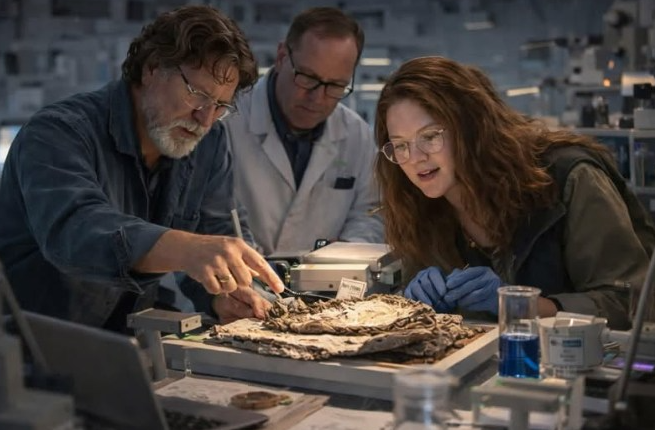
The scientific foundations of North American history were shaken this week as Oak Island laboratory specialist Emma Culligan released a metallurgical report that challenges the very timeline of European contact. Utilizing advanced X-ray Fluorescence (XRF) and diffraction technology, Culligan has identified a “precise and repeatable” match for an ancient Roman metal alloy—an impossible discovery that has directed the Lagina-led team toward a potential $260 million target.
The “Gravis” Signal
The breakthrough began with a series of anomalies found on Lot 5, an excavation site that was originally sidelined in favor of the Money Pit. When Culligan scanned a recovered copper-based coin, the readout displayed a chemical signature of 70% copper and 16% lead.
For a modern or even colonial-era coin, the results would be considered a manufacturing failure. However, for a Roman metallurgist from 200–300 AD, this was a “controlled formula” known as Gravis. This was not a singular find; Culligan’s analysis has now verified a total of six Roman-era coins on the island, including one from the reign of Emperor Claudius II (approx. 250–270 AD) featuring a reverse-side image of a figure holding an oak leaf.
From Lot 5 to the Deep Money Pit

Culligan’s work has bridged the gap between surface artifacts and the deep underground structures of the island. In a stunning geochemical correlation, she analyzed a metal fragment with 40% silver purity found near a stone foundation on Lot 5.
By comparing this elemental signature with water samples collected from the “solution channel” roughly 150 to 220 feet beneath the Money Pit, Culligan confirmed a chemical match. The data suggests that the refined silver discovered on the surface is slowly dissolving from a massive source buried deep underground—linking the 17th-century surface activity to a multi-million dollar deposit hidden in the island’s depths.
The Layered Timeline Theory
The discovery of 17th-century English shillings alongside 3rd-century Roman currency and medieval trade tokens has forced a radical shift in the investigation. “No single civilization can fully explain this,” Culligan noted.
The evidence no longer points to a single “depositor” like the Knights Templar or Sir William Phips. Instead, the laboratory data reveals a layered timeline: Oak Island appears to have been a secure, generational vault used repeatedly over 2,000 years. This “convergence of history” suggests that various groups—possibly including Romans, medieval organizations, and colonial privateers—utilized the island’s unique geography to secure valuables now estimated at a combined value of $260 million.
The Science of Truth

Emma Culligan, who nearly missed this career-defining opportunity after initially dismissing the job offer as “spam,” has become the team’s “truth detector.” Her objective, data-driven approach removes the speculation often associated with Oak Island.
“The machine reports the composition exactly as it exists,” Culligan explained. “It cannot be fooled.” As the team prepares for the next phase of excavation, they are no longer chasing ghosts or legends; they are following a chemical trail that points toward a vast, multi-generational treasure that history forgot—but the metal remembered.